New Mobile Oyster Trail Artwork Unveiled at GulfQuest
Mobile unveiled its 26th Oyster Trail sculpture, 'Estuary Gifts' by artist James Foster, highlighting the ecology of the Mobile Bay watershed.
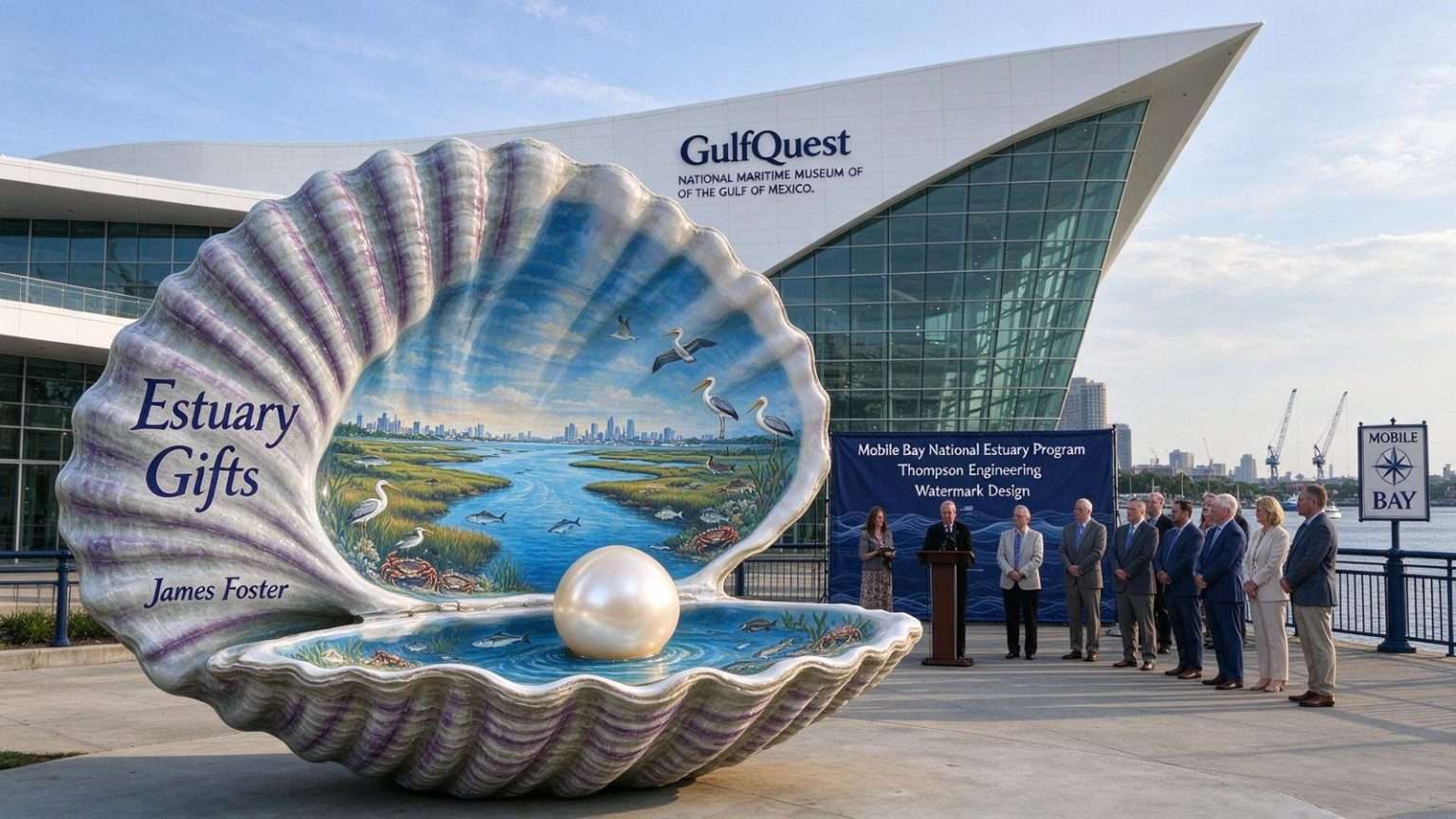
Mobile’s public art collection grew by one this month with the unveiling of the city’s 26th piece of Oyster Trail artwork, a large painted shell sculpture depicting the ecology of the Mobile Bay watershed. The new piece, titled “Estuary Gifts,” was revealed during a ceremony at the GulfQuest National Maritime Museum on the downtown waterfront, placing the newest shell at the front door of the institution dedicated to the sea that defines the city. The location was fitting in more than geography: the trail’s sculptures exist to tell the story of the estuary, and the museum exists to preserve it.
The piece was created by Mobile native James Foster and co-sponsored by the Mobile Bay National Estuary Program along with Thompson Engineering and its Watermark Design studio. The pairing of a local artist with a corporate-and-government sponsorship team reflects the model that has carried the trail from its first shells to its 26th: each sculpture is commissioned from a different artist, and each is typically underwritten by a local business or organization with a stake in the bay’s story.
Like other installations along the Oyster Trail, the sculpture takes the form of a large fiberglass oyster shell, painted with scenes representative of Mobile and the surrounding coastal region. Foster’s design focuses on the lower reaches of the Mobile Bay watershed, illustrating both the topography and the biology found in that part of the estuary. A central feature of the piece is a three-dimensional pearl resting inside a freshly opened oyster shell, forming the visual centerpiece of the interior scene painted across the sculpture’s surface — a nod, in physical form, to the idea that the bay’s value lies in what it produces and sustains.
An Art Trail With a Scientific Message
During the unveiling, a representative from Thompson Engineering and Watermark Design said the Oyster Trail, paired with the nearby GulfQuest museum, plays a role in raising public awareness about the need to protect the region’s coastal environment. He noted that oysters serve as an indicator species for the overall health of Mobile Bay, meaning changes in water quality tend to show up in oyster populations before they become apparent elsewhere in the ecosystem. The point is more than metaphor. Oysters filter enormous volumes of water as they feed, build reef structure that shelters juvenile fish and crabs, and fail visibly when salinity, sediment or pollution push the bay out of balance.
That is why the oyster — not the ship, not the bridge, not the azalea — became the trail’s motif. The Mobile Bay National Estuary Program, which coordinates the trail, was established in 1995 as part of the National Estuary Program created under the Clean Water Act, making Mobile Bay one of the nationally recognized estuaries whose long-term health is studied and managed by a partnership of governments, agencies, industry and citizens. The MBNEP’s work runs from water quality monitoring to habitat restoration to the Comprehensive Conservation and Management Plan that guides spending and policy across the watershed, and the art trail has served for years as its most visible public-facing project.
The sculptures themselves are fiberglass on steel, produced by foundries and fabricators in the region and painted by artists who each interpret a slice of coastal Alabama — seafood heritage, Mardi Gras, shipbuilding, wildlife, the rivers that feed the bay. Shells stand outside restaurants and museums, in parks and along the waterfront, each anchored to a specific sponsor’s story. The trail’s scale means a visitor can walk a route through downtown and along the water and encounter a dozen narratives of the estuary in an afternoon, each shell a painted lesson in what the watershed contains.
GulfQuest and the Waterfront It Sits On
The unveiling’s host institution is itself part of the story. The GulfQuest National Maritime Museum of the Gulf of Mexico, on Mobile’s riverfront, opened after years of planning as one of the only museums in the nation devoted entirely to the Gulf — its shipping, fishing, ecology, storms and culture. Interactive exhibits carry visitors from the decks of container ships to the wetlands at the bay’s edge, and the museum’s presence on Water Street helped anchor the broader revitalization of downtown Mobile’s waterfront district.
“Estuary Gifts” now stands among the museum’s outdoor neighbors as the 26th shell in a trail that began as a handful of prototypes and grew into one of the Gulf Coast’s most recognizable public art programs. The addition of “Estuary Gifts” continues a public art tradition that has become closely associated with Mobile’s downtown and waterfront districts, blending local artistic talent with a broader civic message about protecting the bay that has long defined the city’s economy and identity. Mobile’s connection to that identity runs deep: the city’s economy was built on the port, its restaurants still center on Gulf seafood, and its tourism calendar — from Mardi Gras to cruise departures — treats the water as the front yard.
How the Trail Works
The Oyster Trail has grown steadily since its debut, with each new sculpture commissioned from a different artist and typically sponsored by a local business or organization. The commissioning process pairs sponsors with artists selected for each project, and the finished shells go through fabrication, painting and a public unveiling that doubles as a community event. Sponsors range from engineering firms and banks to environmental groups and seafood businesses, and their names appear alongside each piece much as donors’ names do on museum walls — a quiet acknowledgment that public art in Mobile runs on local patronage as much as public budgets.
Maps guiding visitors from one shell sculpture to the next are distributed at hotels, shops and visitor centers throughout Mobile, and a digital version of the trail map is also available online for tourists and residents planning a self-guided tour. The mapping turned a scattered collection of sculptures into an itinerary: families plan outings around the shells, school groups use them as stops on estuary lessons, and the trail’s footprint draws foot traffic to the businesses and attractions near each installation. For a city that markets itself on walkable downtown blocks and a working waterfront, the trail functions simultaneously as art, education and economic development.
Why the Oyster Matters to Mobile Bay
The creature at the center of the trail carries a heavier ecological load than its fame suggests. Mobile Bay receives the discharge of one of the largest river systems in the United States — the Alabama, Tombigbee and their tributaries — and its salinity, sediment load and nutrient balance shift with every season and storm. Oysters thrive in the estuary’s mixing zone, where fresh and salt water meet, and their reefs once supported a significant commercial harvest in Alabama waters. Declines in reef extent and harvest over the decades have made oyster restoration a recurring priority for state agencies and the MBNEP, with reef rebuilding projects and spat-on-shell planting aimed at restoring both habitat and the fishery.
When scientists say oysters are an indicator species, the practical meaning for residents is that the health of oyster reefs is a readable index of the bay’s condition — its water clarity, its pollutant load, the balance of fresh and salt water that upstream development and drought can alter. A painted shell on a downtown sidewalk becomes, in that light, more than decoration: it is a standing reminder that the estuary’s fortunes are measured in living things, and that those fortunes respond to decisions made far upstream of the shoreline.
The unveiling of “Estuary Gifts” also connected two institutions with the same message. The museum indoors explains the Gulf; the trail outdoors makes the estuary walkable and visible. Visitors who step out of GulfQuest onto the waterfront find the bay itself a few steps farther — working docks, cruise terminals, the skyline across the water — and the sculpture at the door frames what they are about to see.
A Trail Still Growing
Organizers say they expect the trail to continue expanding as additional artists and sponsors come forward for future installations. Each new shell adds a name to the map, a stop to the tour and a chapter to the story the trail tells about the watershed — a story that now runs from the rivers of the Black Belt to the passes at Dauphin Island. Twenty-six sculptures into that project, the trail has become one of the largest programs of its kind in the Southeast, and its continued growth signals sustained local appetite for art that carries a civic purpose.
For the artist, the unveiling marked a hometown moment — a Mobile native’s interpretation of the estuary installed at the city’s maritime front door. For the sponsors, it extended a partnership between engineering, design and environmental management that reflects how coastal Alabama increasingly talks about its future. And for the public, it added one more shell to a collection that asks, in painted fiberglass, a question each resident and visitor eventually answers for themselves: what is the bay worth, and what does it take to keep it healthy? The 26th piece of the Oyster Trail doesn’t answer that question, but it makes sure that anyone walking the waterfront has to look at it.