

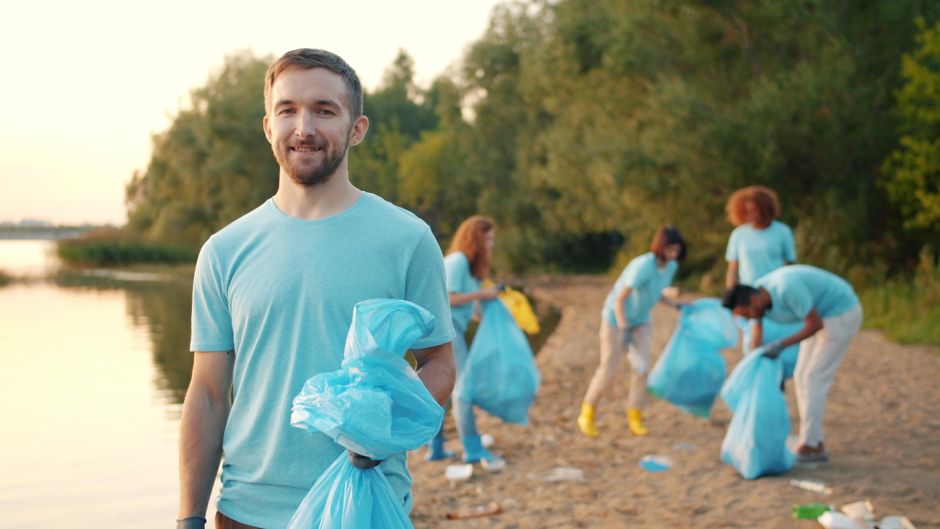
Courtney Dombroski’s business plan began with a vending machine and a dirty marsh. While servicing fish-feeding vending machines at the Original Oyster House in Gulf Shores, she noticed trash collecting in the marsh along Little Lagoon — and couldn’t leave it there. “It was such a distraction to the natural beauty, and I couldn’t just stand there and do nothing,” she said. An Original Oyster House manager saw her picking up the trash, embraced the idea of an organized cleanup, and Eco Clean Marine was born.
Three years later, the venture Dombroski started in 2022 has grown into a dual operation: Feed the Fish, the fish-feeding vending machine company she purchased from its previous owner, and Eco Clean Marine, the nonprofit she built around it, which now collects nearly 1,000 buckets of trash a year from Baldwin County waterways. Ten percent of Feed the Fish’s proceeds fund the cleanup operation.
From 600 buckets to 1,000
In its first year, Eco Clean Marine’s events collected around 600 buckets of trash. This year the count had reached almost 1,000 before the busy season even started. The growth comes from volume of events as much as volume of trash: Dombroski hosts public and private cleanup events across the coastal area, most of them booked through Chamber of Commerce networking with local businesses.
“Doing something for the community that is positive and easy to execute is an attractive way for local businesses to have an impact,” she said. “Eco Clean Marine events are great team-building exercises, and so many businesses have taken advantage of what we offer.” Businesses can sponsor a public or private event for a $500 contribution or sign on as annual sponsors. Each event ends the same way: a group photo, then a group video of everyone shouting “Eco Clean Marine” — a tradition participants, she says, love.
The calendar works like a two-stroke engine. Feed the Fish is strong through the high season and slows in winter; cleanup events run from fall through spring, when the weather is nice and the beaches are less crowded. “So it balances well,” Dombroski said.
Tap-to-pay and educated risk
On the business side, the machine route runs from Panama City, Florida, to Fort Morgan — a 13-hour day plus a 9-hour day, once a month. But the bigger development has been technological. The vending machines she acquired accepted only quarters and dollar bills, a problem in a cashless era. Converting the fleet to credit card tap-to-pay systems required upfront investment and trial-and-error to find the right platform, but revenue per machine has increased substantially. “At the end of the day, it’s a worthwhile investment,” she said.
She is now courting waterfront establishments to lease and service machines — an added revenue stream for the businesses and, as she puts it, “great entertainment for their guests.” She also spotted a knowledge gap among visitors, many of whom couldn’t tell a pelican from a blue heron, and built an e-book website guide to the area’s marine, avian and waterfowl species.
Her growth philosophy is deliberate. “I try to resist the impulse to get ahead of myself,” she said. “I wanted to settle the business purchase before taking on new projects or acquiring new technology. I pace myself financially… This also gives me time to study a problem before investing.” When a problem does present itself, she trusts it can be solved: “If we can put a plane in the air that can take you from one continent to another, then whatever problem I’m facing has a solution. That’s just how I operate.”
Doing the homework
The nonprofit side runs on the same discipline. Dombroski researched Google Ads grants for nonprofits, applied, and was awarded $2,500; once Google saw the engagement, it awarded the full $10,000 available. “You have to do your homework,” she said. She also commits time daily to engaging with like-minded organizations on social media, keeping the event calendar full.
Current projects include a new turtle sanctuary at Bay Point Golf Resort and a plastic-free reusable aluminum water bottle line. And the group video tradition — the shout, the smiles, the “Eco Clean Marine” chant — has become the organization’s signature send-off.
From a moment of frustration beside a lagoon to a growing business and a nonprofit collecting a thousand buckets a year, Dombroski’s coastal two-venture model carries a simple tagline: “Keeping Your Waterways Clean Locally.” For Gulf Shores, Fort Morgan and the points between, it’s a difference measured in buckets.