

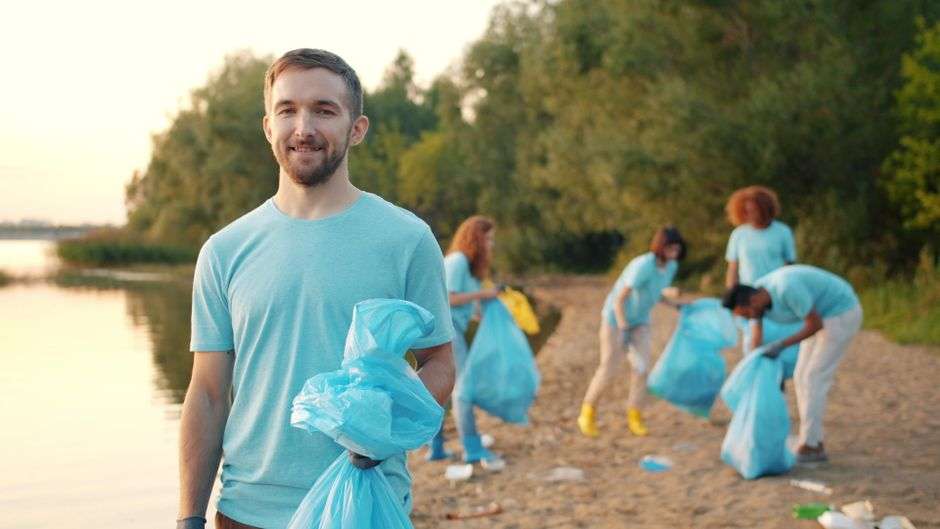
Vacations along the Alabama Gulf Coast usually come with a to-do list of sun, sand, and seafood. But on one recent visit to Gulf Shores, a group of twenty out-of-state volunteers — eleven of them children — decided their itinerary should include something else entirely: two hours of their trip spent hauling trash off the beach. Working with the coastal nonprofit Eco Clean Marine near The Hangout, the visitors collected twenty five-gallon buckets of litter before heading home, a spontaneous effort that said as much about the changing culture of the coast as it did about the trash itself.
“We’re constantly inspired by the people who step up — whether they’re locals or just passing through,” said Courtney Dombroski, founder and president of Eco Clean Marine. “This cleanup was a perfect example of how small actions, when done together, can create big results.”
For Dombroski, that kind of turnout is the whole point. Her organization has spent the years since its 2022 founding turning beach cleaning from an obligation into something closer to a community habit — monthly events, youth education, and partnerships that make showing up easy.
From a lightbulb moment at Lake Shelby
Eco Clean Marine exists because of an ordinary morning that bothered somebody enough to change her life’s direction. Dombroski grew up in Mobile, a short drive from the coast, and her family made the trip to Gulf Shores two or three times a month. Three days after graduating from Baker High School in December 2013, she moved to the beach for good, eventually working for a local parasailing and rental company, where early mornings meant paddleboards and time on the water before the customers arrived.
The entrepreneurial turn came first. She learned the vending machine trade from a friend who was selling his business, bought it herself in the spring of 2021, and rebranded the operation as Feed the Fish — bright yellow fish-feeding machines placed along the water’s edge, where families can buy a handful of special food and feed fish at the docks. It was during her rounds servicing those machines at The Original Oyster House in Gulf Shores that she noticed the problem she could not ignore: trash piling up under the gazebo over Lake Shelby and drifting toward Little Lagoon.
She put on gloves and started picking it up. A business owner saw the effort and waved her down in thanks — and somewhere between the two trash runs, the idea clicked. She did not need to hunt for the perfect volunteer opportunity. She could organize one herself.
A nonprofit built one bucket at a time
Eco Clean Marine was established in January 2022 as a 501(c)(3) nonprofit dedicated to keeping coastal waterways clean and teaching the next generation why that matters. Its service area stretches from Fort Morgan, Alabama, to Panama City, Florida, with monthly trash pickups rotating among Gulf Shores, Orange Beach, Fort Morgan, Pensacola, Destin, and other coastal communities.
The model is deliberately low-friction: one event a month, roughly an hour and a half on a Saturday morning, gloves and bags provided, trash hauled away when it’s over. What began as Dombroski picking up litter alone — she jokes that her first companion was a homeless man who joined on the promise of a free beer afterward — grew quickly. Monthly events typically draw 45 to 60 volunteers, and a single gathering can clear more than 500 pounds of trash from beaches, dunes, and shorelines that other conservation efforts often overlook. At one of the group’s Fort Morgan cleanup sites, more than 65 volunteers turned out for a single event.
The organization keeps score: more than 58,000 pounds of trash removed from Gulf Coast environments since it began. That total has accumulated through monthly cleanups, larger partnered events, and participation in Alabama’s coastal cleanup tradition — the annual statewide event, held each September since Alabama joined the International Coastal Cleanup in 1987, in which more than 100,000 volunteers have taken part over the decades. Dombroski has served as a zone captain for that event, leading one of the local sites.
Feed the Fish: education disguised as a 50-cent thrill
The nonprofit’s most distinctive feature is its connection to the for-profit fish-feeding machines Dombroski still runs. The machines take quarters and dollar bills; ten percent of everything that goes into them flows back to Eco Clean Marine, and at certain sponsored locations, 100% of the profits support the nonprofit. The arrangement gives visitors an easy, inexpensive way to interact with the water — and gives the organization a revenue stream that does not depend on grants alone.
But the machines are really a hook for education. The organization pairs the feeding stations with a free virtual e-book about the marine life children might see while feeding the fish, along with plant and flora guides drawn from Dombroski’s own bike rides through Gulf State Park — including species like the white-topped pitcher plant, found naturally only in Alabama. The hope, she has said, is that feeding the fish becomes a “core memory” for young visitors, the kind of experience that turns into lifelong environmental awareness. Visitors can even pick up a printed “treasure map” and ride from feeding station to feeding station, marking each one off — a scavenger hunt with a conservation message underneath.
Recognition, sponsors, and a growing map
Recognition, sponsors, and a growing map followed, but the heartbeat of the organization remains the monthly cleanup itself. In 2026 the group lengthened its standard event from an hour to an hour and a half, adding thirty minutes to put more gloves in the sand. The schedule rotates cities in and out — one Saturday in Gulf Shores, the next in Orange Beach, Fort Morgan, Pensacola, or farther east — and volunteers simply show up at the posted meeting spot, from parking lots along Perdido Beach Boulevard to park gazebos over the lagoon. Events for the year are announced in advance, and during Alabama’s annual Coastal Cleanup each September, the organization folds its own zone work into the statewide push, which is held on the third Saturday of the month across 28 zones in Mobile and Baldwin counties.
The work has drawn attention beyond the beach. Eco Clean Marine was a finalist for the ICON 2024 Award, which recognizes individuals and organizations fighting to improve the environment, and it has received support from the Hilton Global Foundation. Dombroski has appeared on Alabama Public Radio talking about the organization’s approach, and its cleanup schedule is published on its website. Businesses can book special cleanup events as team-building exercises — a format she has described as a team experience that leaves a lasting impression on both the participants and the community.
Getting involved requires little more than a Saturday morning. Volunteers can join a scheduled cleanup in any of the rotating cities, make a donation, sponsor the organization, or adopt one of the fish-feeding machines. There is also a popular fundraising item with a fittingly honest name: a “Bucket of Trash,” which funds the supplies volunteers use in the field — gloves, snacks, and plastic-free hydration included.
Why it matters here
Coastal Alabama’s economy is inseparable from its water. The same white sand and clear water that draw millions of visitors depend on volunteers, town crews, and organizations like Eco Clean Marine to intercept the steady trickle of litter — cigarette butts, plastic bottles, fishing line, foam — before it reaches the Gulf, where it can harm sea turtles, fish, and birds. During Alabama’s September cleanup, volunteers record what they find, and the data is submitted to the Ocean Conservancy to track what is getting into the oceans and educate the public about the sources of marine debris and its environmental effects.
The scale of the accumulated effort is considerable. In a typical pre-pandemic year, roughly 5,000 volunteers turned out across the state’s cleanup zones and removed 30,000 to 40,000 pounds of trash in a single day, along with hundreds of cubic feet of aluminum and plastic set aside for recycling. Overall, volunteers have pulled more than 1.5 million pounds of marine debris from Alabama’s coastline and waterways since the state joined the International Coastal Cleanup in 1987.
Against that backdrop, the twenty vacationers who spent two hours near The Hangout on a recent trip added their own small chapter — twenty buckets, eleven kids, one visible dent in the problem. For Dombroski, that is exactly how the mission is supposed to work: one hour, one month, one bucket at a time, until taking care of the water becomes the default. “I honestly believe that being able to give this experience to people is a step in the right direction to changing their hearts,” she has said, “which is how we change the future.”
The machines came first: the Feed the Fish story
Long before the nonprofit had a name, Dombroski was building a very different career. After high school she went to work at UTC Aerospace, building aircraft engines, and soon realized the work was not for her. She waited tables at local restaurants, and in 2018 was part of the hospitality team that opened the rebuilt Gulf State Park Lodge, spending two years immersing herself in the industry. Then the pandemic hit, her schedule opened up, and she started seeking out business mentors with a simple goal in mind: one day, she would own her own business.
The opportunity arrived at a Fourth of July party in 2020, where she met a man named Bill over a board game. Bill owned the fish-feeding business that operated the bright yellow vending machines at waterfront restaurants and docks along the coast — and he was ready to move on. Dombroski asked to ride along on his service route. “At first he tried to talk me out of it,” she has said, “but I said no, I want to see how this works, because I want to buy this business.” She spent three or four days a week on the route until, in March 2021, she bought the business outright.
Today Feed the Fish operates more than sixty fish-feeding machines — gumball machines for fish — from Gulf Shores to Panama City, Florida, along a one-way service route of 155 miles. The machines work as advertised: at new locations with no visible fish, fry show up within two weeks, bigger fish follow, and then the birds arrive. Dombroski framed the stations as a treasure hunt that leads families to new spots to explore, and the concept caught on quickly — 5,000 visitors found the website in the first year. Expansion plans call for pushing the route west across the Eastern Shore, the Causeway, Mobile, and Dauphin Island.
The numbers behind the cleanups
The merge of the two ventures shows up in the details. Dombroski markets each trash pickup site thirty days ahead through Facebook ads and stocks volunteers with buckets, grabbers, and gloves. In a single April stretch, Eco Clean Marine ran six pickup days, with participants including Kiwanis Clubs, Whole Foods, Aledade Inc., and Keller Williams Realty agents serving on their company’s annual “Red Day” of service. The organization’s biggest single turnout was 86 volunteers at Pensacola Beach — a event that grew into something more lasting when one attendee asked about organizing an annual cleanup in Perdido Key in memory of his late wife, who had loved the beach.
The early scorekeeping tells the story of rapid growth: within its first stretch of operation, 549 volunteers had gathered 1,445 buckets of trash — totals that have only climbed since, on the way to the 58,000-plus pounds the organization has now removed from Gulf Coast environments.
Dombroski’s view of the coast’s rapid growth carries the same dual lens. “It’s important to create jobs, but businesses need to support the environment as well,” she has said. “The thing that concerns me is that people are inconsiderate of the environment. As community leaders, we must hold people accountable so this remains a great place to live, work, and play well into the future.”