Orange Beach Backs Study on Reviving a Seasonal Beach Trolley Along the Coast
Orange Beach is backing a new feasibility study on whether a seasonal trolley could once again connect coastal communities along the Gulf Coast.
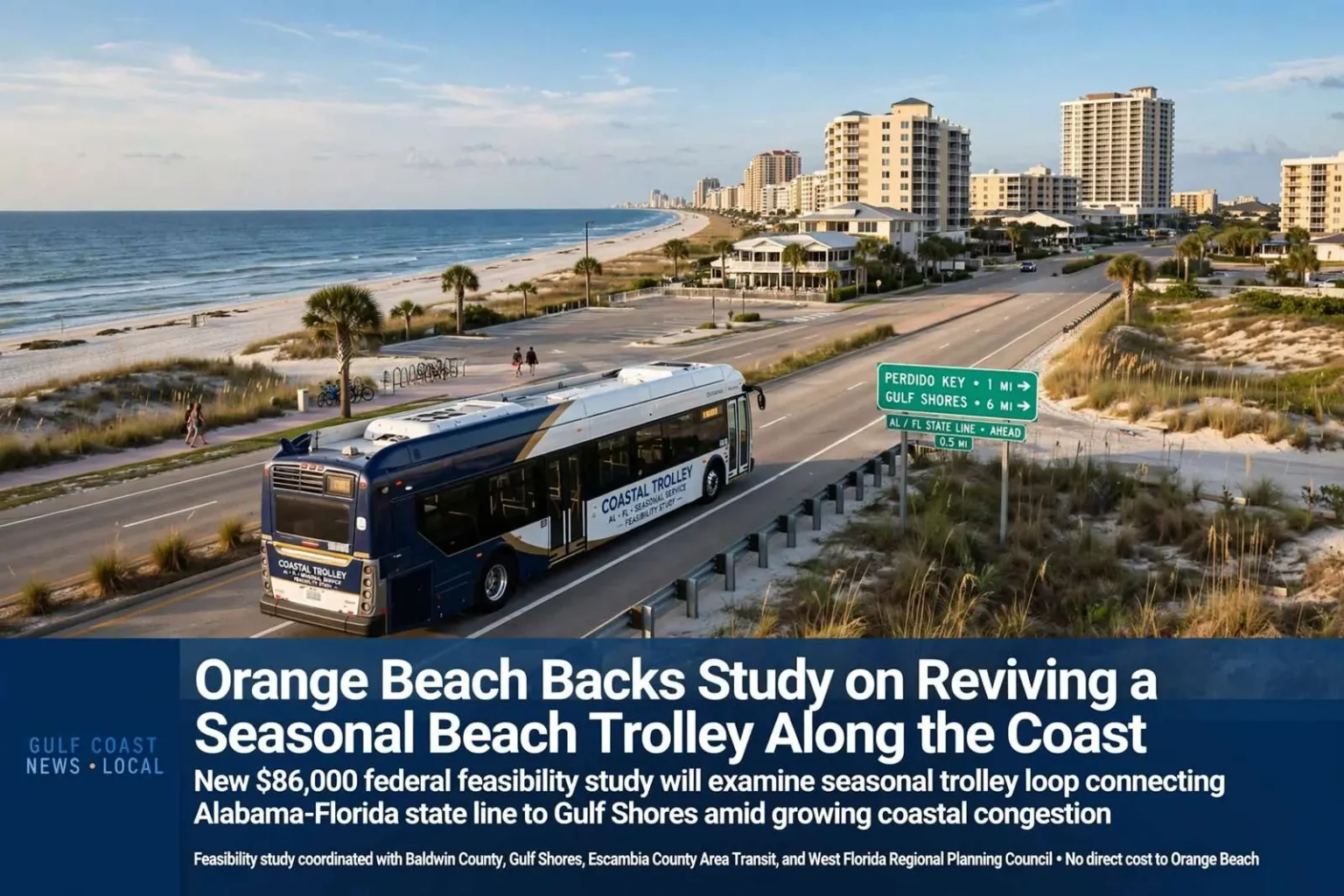
Orange Beach has agreed to support a new feasibility study examining whether a seasonal trolley system could once again link coastal communities along the Alabama-Florida line, more than a decade after a similar service was scrapped for lack of riders.
The study is being funded by $86,000 in federal urban transit money, with Escambia County, Florida, administering the funds since Orange Beach falls within the Pensacola-area urbanized transit region. The money is earmarked for transportation planning and comes at no direct cost to the city. Both the Baldwin County Commission and the Gulf Shores City Council have also pledged their support for the effort.
City Planner Griffin Powell said the study, coordinated with the Baldwin County Rural Transportation System, Gulf Shores, Escambia County Area Transit and the West Florida Regional Planning Council, will look at whether a seasonal trolley loop connecting the Alabama-Florida state line to Gulf Shores along the beach highway makes sense.
The questions planners will weigh
Planners will weigh questions such as whether the service should run only during peak weekends like Memorial Day, July Fourth and Labor Day, every weekend through the summer, or even into the winter months, depending on projected ridership. Each option carries a different cost structure and a different expectation of who the trolley would serve.
A peak-weekend-only service would target the busiest stretches of the calendar, when Perdido Key, Orange Beach and Gulf Shores all struggle to absorb the crush of vehicles funneling onto the beach highway. A summer-long weekend schedule would serve a broader audience of vacationers staying in condominiums and rental houses who might leave their cars parked if a reliable alternative existed. Extending into winter would test whether snowbirds and off-season visitors generate enough ridership to justify keeping the vehicles on the road.
The study period also allows the partner agencies to think beyond the old routes. Coastal Baldwin County has grown enormously since the last trolley attempt, adding condominium towers, attractions and entertainment venues along the corridor, and the Pensacola Beach side of the line has expanded as well. A loop that made sense, or failed to make sense, in 1999 may read very differently against today’s traffic counts.
History: the Pleasure Island Trolley era
A beach trolley isn’t a new idea for the area. The Pleasure Island Trolley ran along the coast starting in 1999, operated jointly by Orange Beach, Gulf Shores and the Baldwin Rural Area Transit System at a fare of 50 cents per ride. Gulf Shores dropped out after just one summer, and Orange Beach followed a year later, ultimately ending the service in September 2000 after complaints about frequent breakdowns and a loud warning bell mounted on the vehicles.
The old trolley’s troubles became local legend. Mechanical problems left the vehicles unavailable on some of the very summer days they were needed most, and the warning bell that announced every stop grated on residents and visitors along the route. For a service whose appeal depended on reliability and charm, both failures were fatal. The 50-cent fare was modest, but no fare level could compensate for vehicles that broke down and a sound that tourists complained about.
The lesson drawn locally was not necessarily that beach transit cannot work, but that it has to be done well. A study is precisely the tool for testing whether modern equipment, a better route design and realistic scheduling could deliver the ridership the first attempt never attracted.
The stranded trolley fleet
Baldwin County had purchased five new trolleys with a $1 million federal grant around the same time the cities decided to end the program, leaving transit officials scrambling to repurpose the vehicles. The episode became a cautionary tale in local government circles about the gap between grant-funded equipment and the operating commitments required to use it.
Buying trolleys with federal money proved far easier than sustaining the service that would keep them busy, and the county spent the years afterward searching for roles the vehicles could fill. The experience has lingered in the memory of Baldwin County officials, several of whom were involved in transit planning then and are involved in this study now.
That history gives the new feasibility study a practical edge. Planners know exactly how the last attempt failed, and the questions they are asking about seasonal schedules and projected ridership are aimed at avoiding a repeat: no new vehicles should roll until the operating plan, the funding and the demand all line up.
Why the timing is different now
More than a decade of growth has changed the calculus along the corridor. Orange Beach and Gulf Shores have become two of the most visited destinations on the northern Gulf Coast, with summer populations that swell far beyond the year-round counts of their incorporated limits. Perdido Key, just across the state line, has developed its own dense concentration of visitor accommodations. On peak weekends, the beach highway becomes a slow-moving line of cars, and parking near the public beach accesses fills before mid-morning.
Congestion of that kind is exactly the condition in which a shuttle service can succeed, provided it connects the places visitors actually stay with the places they actually go. The proposed loop from the state line to Gulf Shores follows that logic, linking the three communities into a single corridor where a family could reach restaurants, attractions and the beach without moving a car.
There is also a fiscal argument that did not exist in the same form in 1999. Federal urban transit planning money is available now, administered through Escambia County because the region’s urbanized area extends across the state line, and it requires no direct spending from Orange Beach. Studying the idea costs the city nothing; the decision that will matter comes later, if a service plan ever requires local operating funds.
Regional cooperation across the line
The list of partners on the study reads like a map of the coastal transit landscape on both sides of the state line: the Baldwin County Rural Transportation System, the city of Gulf Shores, Escambia County Area Transit and the West Florida Regional Planning Council, coordinated through Orange Beach’s planning staff. The West Florida Regional Planning Council brings regional transportation planning experience on the Florida side, while Escambia County Area Transit operates the fixed-route and trolley services in the Pensacola area, including beach routes that draw heavy summer ridership.
That cross-border structure reflects reality: the coast does not stop at the Perdido River, and neither do visitors. A tourist driving from Pensacola Beach to the Flora-Bama and on to the Gulf State Park crosses three jurisdictions without noticing, and any transit system that hopes to be useful to that tourist has to be planned across the same lines. The urbanized-area designation that made Escambia County the fund administrator is itself evidence that federal planners already treat the two coasts as one region.
Support from the Baldwin County Commission and the Gulf Shores City Council gives the study the political backing it needs on the Alabama side. No single city can run a corridor-wide service alone, and the study’s partners will have to agree on a structure before any new trolley rolls.
Remembering the first attempt
Orange Beach City Councilwoman Joni Blalock, who remembers the earlier trolley effort, brings institutional memory to the current debate, and officials like her are likely to measure any new proposal against what went wrong the first time. The old service’s critics still recall the breakdowns and the bell; its supporters still recall families riding to the beach without hunting for parking.
The difference between nostalgia and a business case is exactly what the $86,000 study is meant to supply. Federal transit planning money exists to answer these questions before equipment is bought and routes are advertised, and the partners have structured the work so that the findings, whatever they are, will be grounded in current ridership projections rather than fond memories of the 1999 experiment.
If the study concludes that a seasonal loop can draw enough riders, the next questions will be operational: which agency would run it, how the vehicles would be maintained, what the fare should be and how the costs would be shared among the cities and counties along the route. If it concludes that demand is too thin, the region will have spent planning money to avoid repeating a seven-figure mistake.
What a trolley would mean for visitors and residents
For the families who pack the beaches each summer, a reliable trolley would offer a simple quality-of-life improvement: the ability to park once at a condominium or rental house and reach dinner, shops and the shoreline without a car. For residents of Orange Beach and Gulf Shores, it would take some visitor traffic off the two-lane and four-lane stretches that now carry nearly everything on wheels, easing the summer crush that locals plan their errands around.
Business owners along the corridor have an interest too. Restaurants and attractions struggle with parking constraints at peak hours, and every visitor who arrives by trolley is a parking space freed for someone else. A loop that stops at major destinations can spread crowds more evenly along the coast, sending riders to businesses they would never have reached in a car crawling down the highway.
There is also the matter of safety. Summer weekends on the beach highway bring heavy pedestrian traffic, golf carts, bicycles and impatient drivers into close quarters. Moving even a fraction of those trips onto a single vehicle reduces the exposure, particularly around the state-line entertainment district where foot traffic and vehicle traffic mix most heavily after dark.
The road ahead for the study
The feasibility work will proceed through the partner agencies under the federal planning allocation, with findings expected to inform decisions by the cities and counties involved. The seasonal framing, from three holiday weekends to a summer-long schedule to year-round service, gives planners a range of options to price out rather than a single take-it-or-leave-it plan.
Whatever the recommendation, the region’s experience ensures the debate will be well informed. Baldwin County has operated rural transit across its communities for years, Pensacola’s transit agency has run beach trolleys on the Florida side, and the memory of the Pleasure Island Trolley supplies both the cautionary tale and the proof of concept that people along this coast will ride a beach shuttle when it works.
For now, Orange Beach has done what a growing resort city should do with an old idea whose time may have come again: it has agreed to study the question seriously, with partners on both sides of the state line, at no direct cost to its taxpayers. Whether a trolley again rolls from the state line to Gulf Shores will depend on what the numbers say, but this time the numbers will be examined before the vehicles are bought.