University of South Alabama Chatom
Pierre Pelham, 1929-2009: The Chatom Lawyer Who Ran the Alabama Senate
Pierre Pelham, the Harvard-trained lawyer from Chatom who served two terms in the Alabama Senate and became its president pro tem, died at 80. Friends and rivals recalled a formidable and elusive figure.
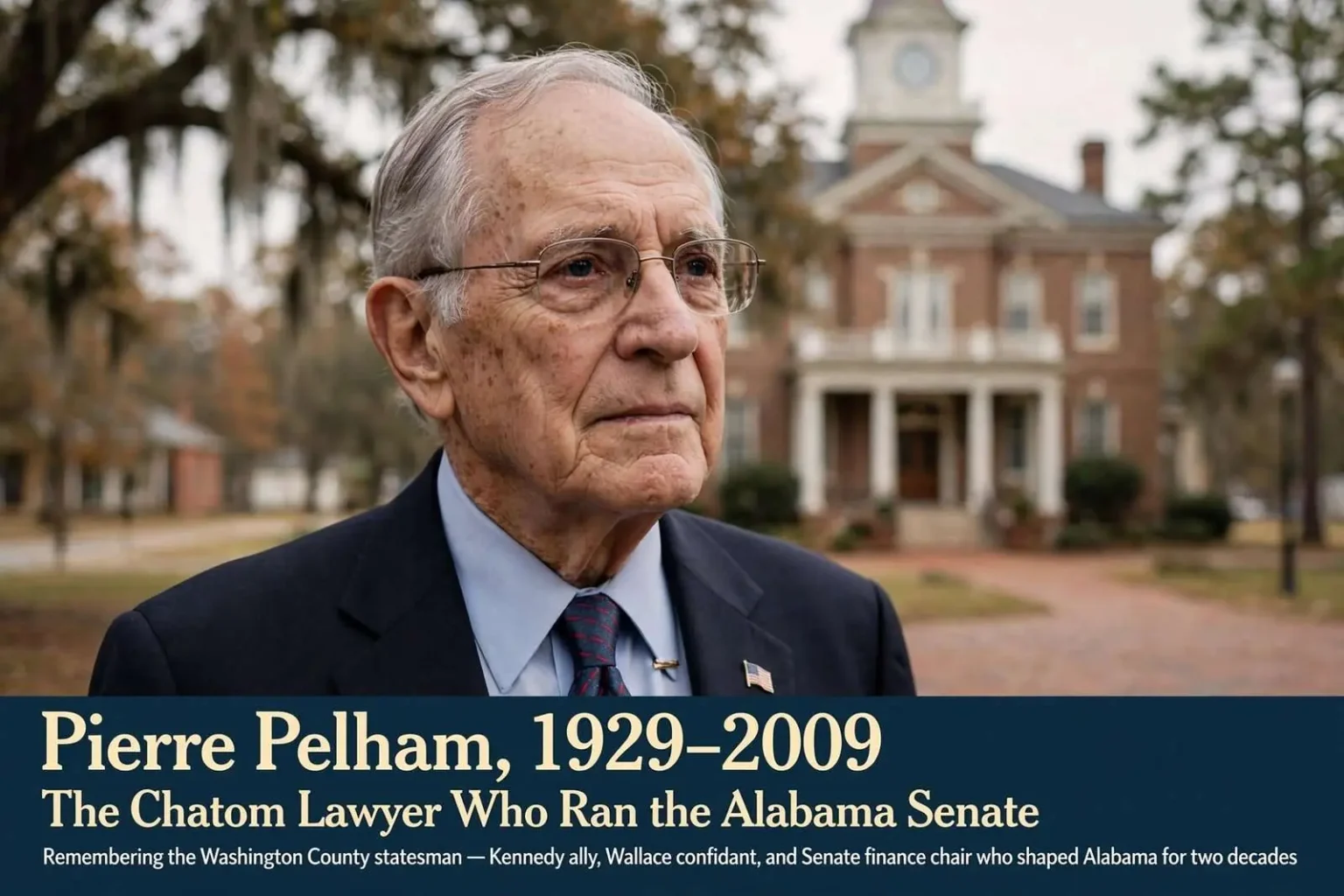
Pierre Pelham, whose voice once emptied the Alabama House chamber because members crossed the hall to hear him speak in the Senate, died in early December 2009 at the age of 80, a couple of weeks after a fall that broke five ribs. Pelham, a two-term state senator and a political ally of both the Kennedys and George Wallace, was to be buried in Chatom, the Washington County town where he was born. The family received visitors at 10 a.m. Tuesday, with services following at 11 a.m. at Chatom United Methodist Church at 20 School Street and burial at Chatom Cemetery.
To say that he was among Washington County’s few cum laude graduates of Harvard Law School is only the beginning of the story. Pelham attended Marion Institute, graduated Phi Beta Kappa from the University of Alabama, where he was a member of the SAE fraternity, and went on to Harvard. Mobile attorney John Tyson Sr., who was the fraternity’s president when Pelham arrived, later became his law partner — a partnership born at the Cawthon Hotel during the campaign season in which John Patterson was elected governor, when the two men, both on losing sides, decided their strengths might complement one another.
Early Life in Washington County
Chatom, the county seat of Washington County, shaped Pelham’s worldview from his earliest years. Washington County, Alabama’s oldest county, established in 1800 before statehood, sits in the state’s southwestern corner along the Tombigbee River. The county’s economy historically centered on timber, agriculture, and later oil and gas production, creating a distinctive political culture that blended rural conservatism with populist traditions. Pelham’s family roots in the area ran deep, and his understanding of the county’s people — their struggles, aspirations, and skeptical independence — informed his entire political career.
Pelham’s academic trajectory was exceptional for a young man from rural Alabama in the 1940s. Marion Institute, a military junior college in Perry County, provided a rigorous preparatory education that fed students into the state’s flagship university. At the University of Alabama, his Phi Beta Kappa induction signaled scholarly distinction, while SAE fraternity membership connected him to a network of future leaders in law, business, and politics. Harvard Law School, then as now a gateway to the national legal elite, exposed him to a broader intellectual world while his Southern roots kept him grounded in the practical realities of his home state.
The Tyson-Pelham Partnership
“He had unusual tastes,” Tyson recalled. “He would take cases that no one else wanted. He didn’t want run-of-the-mill business. But he was brilliant.” The Tyson-Pelham partnership, formed in Mobile during the Patterson campaign, became one of Alabama’s most distinctive legal collaborations. John Patterson’s 1958 gubernatorial campaign, built on a platform of law enforcement and anti-corruption, attracted idealistic young lawyers. Tyson and Pelham, both working for losing primary opponents, found common cause in their shared belief that the law could serve unconventional clients and causes.
The partnership’s most famous case came when the plight of Tina Onassis reached Tyson through a referral from the attorney general’s office. “I said let’s give it to Pierre; he’s single and this is the type thing that he likes,” Tyson said. Pelham traveled to France to meet the client and her lawyer, and before long the Onassises were divorced in Washington County, Alabama — another day in Chatom. The case, which drew international media attention to the small courthouse in Chatom, illustrated Alabama’s then-reputation as a haven for quick divorces, a status the state maintained through relatively short residency requirements compared to other states.
National Democratic Politics
Pelham was drawn into national Democratic politics, ran for the Democratic National Committee, and in 1962 came close to unseating the legendary Congressman Carl Elliott in the Fifth District primary. The race showcased Pelham’s ability to bridge Alabama’s political fault lines. He courted labor unions, African American voters in the district’s Birmingham precincts, and rural whites in the wiregrass counties — a coalition that foreshadowed the biracial alliances that would briefly flourish in Alabama before the civil rights era’s polarization took hold.
His friendship with the Kennedy family began during John F. Kennedy’s 1960 presidential campaign, when Pelham organized Alabama’s “Young Democrats for Kennedy” effort. Robert Kennedy later visited Chatom at Pelham’s invitation, drawing a crowd that spilled from the courthouse square onto the surrounding streets. The Kennedys valued Pelham’s intellect and his willingness to advocate for civil rights legislation at a time when most Alabama politicians resisted. Pelham supported the Civil Rights Act of 1964 and the Voting Rights Act of 1965, positions that isolated him from much of the state’s political establishment but earned him respect in national Democratic circles.
Alliance with George Wallace
Simultaneously, Pelham maintained a working relationship with George Wallace, Alabama’s dominant political figure for three decades. The alliance puzzled national observers but made sense in Alabama’s complex political calculus. Wallace, whatever his segregationist rhetoric, built a political machine that delivered tangible benefits to Washington County — paved roads, a new courthouse, industrial recruitment. Pelham, ever the pragmatist, used Wallace’s influence to secure projects for his district while quietly pursuing his own more progressive agenda on education and economic development. This dual loyalty — to the Kennedys’ liberalism and Wallace’s populism — defined Pelham’s Senate career.
In the Alabama Senate, Pelham rose to chair the powerful Finance and Taxation Committee, a position that gave him extraordinary influence over the state budget. Colleagues described his command of fiscal detail as unmatched; he could recite agency budgets from memory and spot a misplaced decimal in a hundred-page appropriations bill. His leadership style was collaborative rather than coercive. “He didn’t have to raise his voice,” a former Senate clerk recalled. “When Pierre spoke, the chamber got quiet because you knew something important was coming.”
Legislative Legacy
Pelham’s legislative fingerprints are on decades of Alabama infrastructure and education policy. He championed the Alabama Commission on Higher Education, advocating for coordinated planning among the state’s universities and junior colleges. He secured funding for the expansion of Alabama Southern Community College’s Thomasville campus, bringing technical education closer to Washington County students. He fought for the four-laning of Highway 43 through Washington County, a project completed in stages over twenty years that finally connected the county seat to Interstate 65 and the Port of Mobile.
His most enduring fight was for equitable school funding. Pelham argued that Alabama’s reliance on local property taxes condemned rural counties like Washington to perpetual underfunding. He sponsored legislation to increase the state’s share of education spending, a battle he lost more often than he won but one that laid groundwork for later reforms. The 1995 Foundation Program revision, which increased state funding for poor districts, bore his intellectual imprint through the colleagues he mentored.
Pelham retired from the Senate in 1982 after two decades, returning to his Chatom law practice and his farm outside town. He remained a trusted counselor to governors and legislators of both parties, his home on the old St. Stephens road a regular stop for politicians seeking his counsel. In his later years, he documented Washington County’s oral history, recording interviews with elderly residents about the timber boom, the civil rights era, and the transformation of rural Alabama. Those recordings, donated to the Alabama Department of Archives and History, preserve voices that would otherwise be lost.
A Life Measured in Service
Friends and family remember Pelham not for his titles but for his constancy. He attended Chatom United Methodist Church every Sunday, taught Sunday school for thirty years, and never missed the Washington County High School homecoming game. His law practice, maintained in a modest office on the courthouse square, served clients ranging from timber companies to widows probating estates. He charged what people could pay, often accepting vegetables from a garden or a share of a timber harvest in lieu of fees.
At his funeral, the crowd that filled Chatom United Methodist Church included former governors, U.S. senators, judges, and the neighbors whose wills he drafted and whose children he coached in Little League. John Tyson Jr., carrying on his father’s practice, spoke of a man who “loved the law because it was the tool by which ordinary people could claim their rights.” The current Washington County state senator, a Republican elected decades after Pelham’s retirement, acknowledged that “the roads we drive, the schools our children attend, the voice this county has in Montgomery — all of it traces back to Pierre.”
Pelham is survived by his sister, Margaret Pelham Blackwell of Chatom; nieces and nephews; and a generation of Alabama lawyers and public servants who learned from his example that public office is a trust, not a prize. In Chatom, where the courthouse clock still marks time over the square he knew as a boy, they say simply: he was one of ours, and he did right by us.