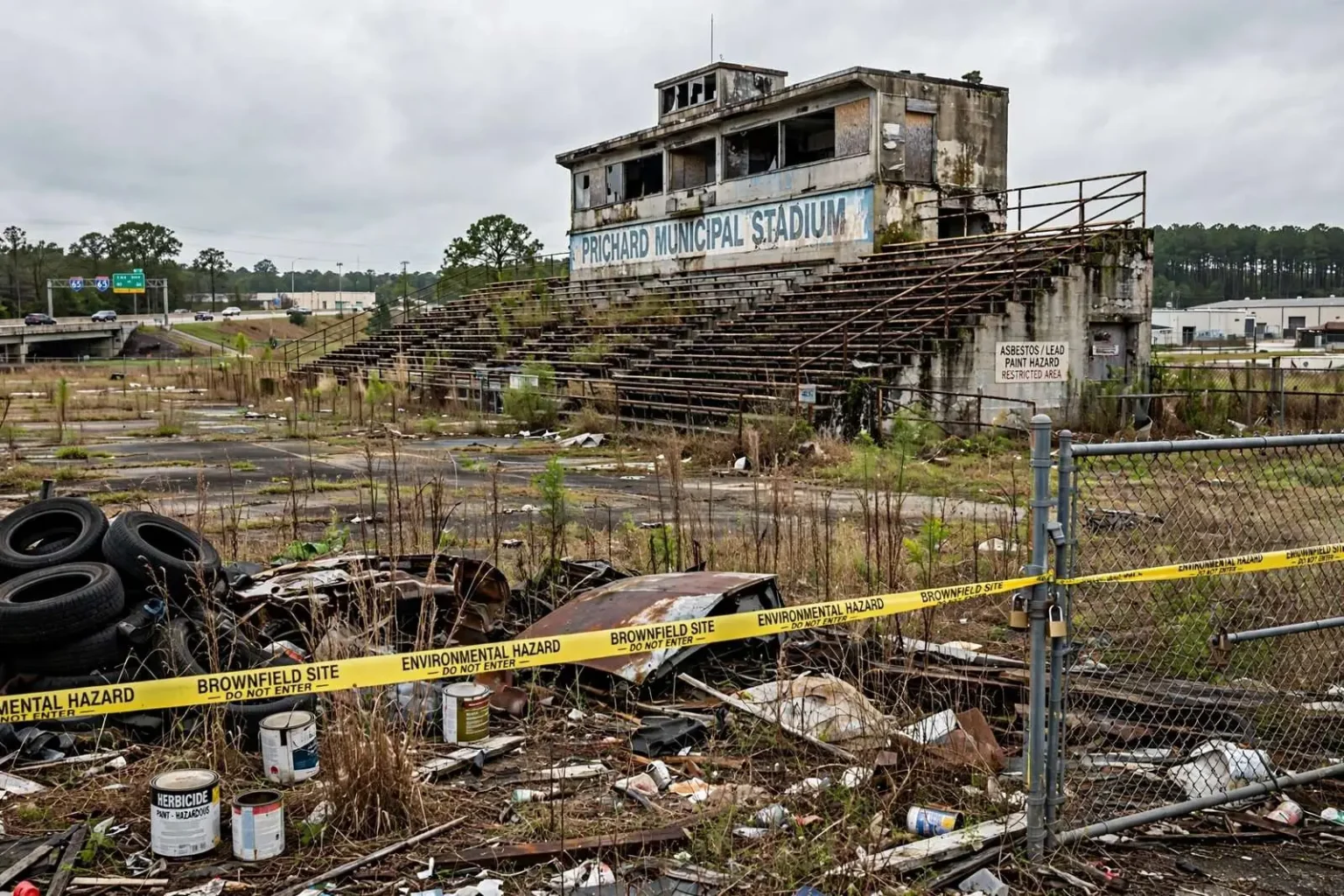
Prichard’s mayor can see past the asbestos, the lead paint and the old cars dumped in the lot — all the way to a soccer tournament. Mayor Carletta Davis says a state environmental review and a brownfield designation could unlock the money needed to turn the long-shuttered Prichard Municipal Stadium into a working venue again, and she is betting the city’s future on youth sports tourism.
In a video posted to her mayoral Facebook profile, Davis said the Alabama Department of Environmental Management is reviewing the city-owned stadium, and that a brownfield designation — a term usually reserved for old factories and other abandoned properties believed to contain harmful chemicals — could make the city eligible for state and federal funding to clean up and restore the facility.
Why a football stadium qualifies as a brownfield
The answer, Davis said after Thursday night’s City Council meeting, is what decades of neglect left behind. Davis said there have been tires, old cars, paint, and herbicides stored there; the building is very old, built before the lead paint law, and likely contains lead paint and asbestos.
Brownfield programs exist precisely for properties like this: land whose environmental problems scare off normal redevelopment, but whose cleanup can be financed through targeted state and federal programs once the contamination is documented. Once ADEM’s review is complete, Davis said, the city could pursue funding to remediate the issues and repair the facility.
What the mayor wants to build
The vision goes beyond reviving the annual football game that gave the stadium its identity. Davis said Prichard lacks athletic meeting spaces beyond parks for youth sports; they would like a soccer stadium to host championship tournaments, could convert it to track and field, and are exploring possibilities, noting youth sports tourism is a huge industry.
Resident comments under her video backed the idea, and the emotional pull is specific: bringing the “Battle of Prichard” — the annual Vigor-Blount football rivalry game — back to the city whose name it carries. The game has been played at Ladd-Peebles Stadium in Mobile for the past three years because of the Prichard venue’s disrepair.
How the stadium was lost
The city-owned football field, track and bleachers — visible to every driver passing on Interstate 65 — have been unused since at least 2020, when Vigor High School announced its football team would no longer play home games at the facility because of its “extremely embarrassing” condition. A stadium that once anchored Friday nights in Prichard became, in the span of a few seasons, a landmark the school system wanted its teams seen playing in only from a distance.
The path back runs through paperwork before it runs through concrete: ADEM’s review, a formal brownfield determination, grant applications, and then construction bids. Davis has pitched the project as an economic development play as much as a recreation one. Communities across the country have found that youth sports complexes draw traveling families who eat in local restaurants, stay in local hotels and fill weekend schedules that empty industrial corridors cannot otherwise attract.
A familiar debate in Mobile
Prichard’s push for a brownfield designation and outside money echoes a debate Mobile leaders wrestled with for years over Ladd-Peebles Stadium. The city of Mobile spent well over a decade covering maintenance and operating costs for that aging venue before selling it to the Mobile County Public School System under former Mayor Sandy Stimpson, ending the city’s direct financial responsibility for it. At various points supporters argued Ladd-Peebles could draw major college football games and concerts, and one school board member even floated a Margaritaville-branded attraction at the site. Today it serves mainly as Murphy High School’s home field and hosts a handful of HBCU games each year in addition to the Battle of Prichard.
The stadium proposal also comes as Prichard navigates other significant municipal issues, including discussions about the future of its police department, longstanding problems with the city’s water system and a period of strained relations between Davis’ administration and the City Council. Those pressures have led some observers to question how much of the city’s limited attention and money should go toward reviving a stadium that has sat unused for roughly six years.
For now, Prichard residents watching from the interstate can see the bleachers where the Battle of Prichard used to roar. Whether they see cranes there next depends on a state environmental review and the city’s ability to win the funding that follows it.
Related coverage from South AL News
- Prichard Mayor Targets Brownfield Funding to Bring Back Historic Municipal Stadium
- Prichard Mayor Carletta Davis Seeks State Funding to Restore Prichard Stadium
- Prichard Mayor Sets Aug. 4 Town Hall as Police Department Crisis Deepens
- Prichard Council President Says Mayor Put Entire Police Department on Leave Without Telling Council