Sparks Proposes Tapping Alabama’s Oil and Gas Trust for a Decade of Road Work
Democratic gubernatorial candidate Ron Sparks endorsed drawing $100 million a year for ten years from Alabama's oil and gas trust fund to rebuild highways, reviving a long-running fight over the state's savings.
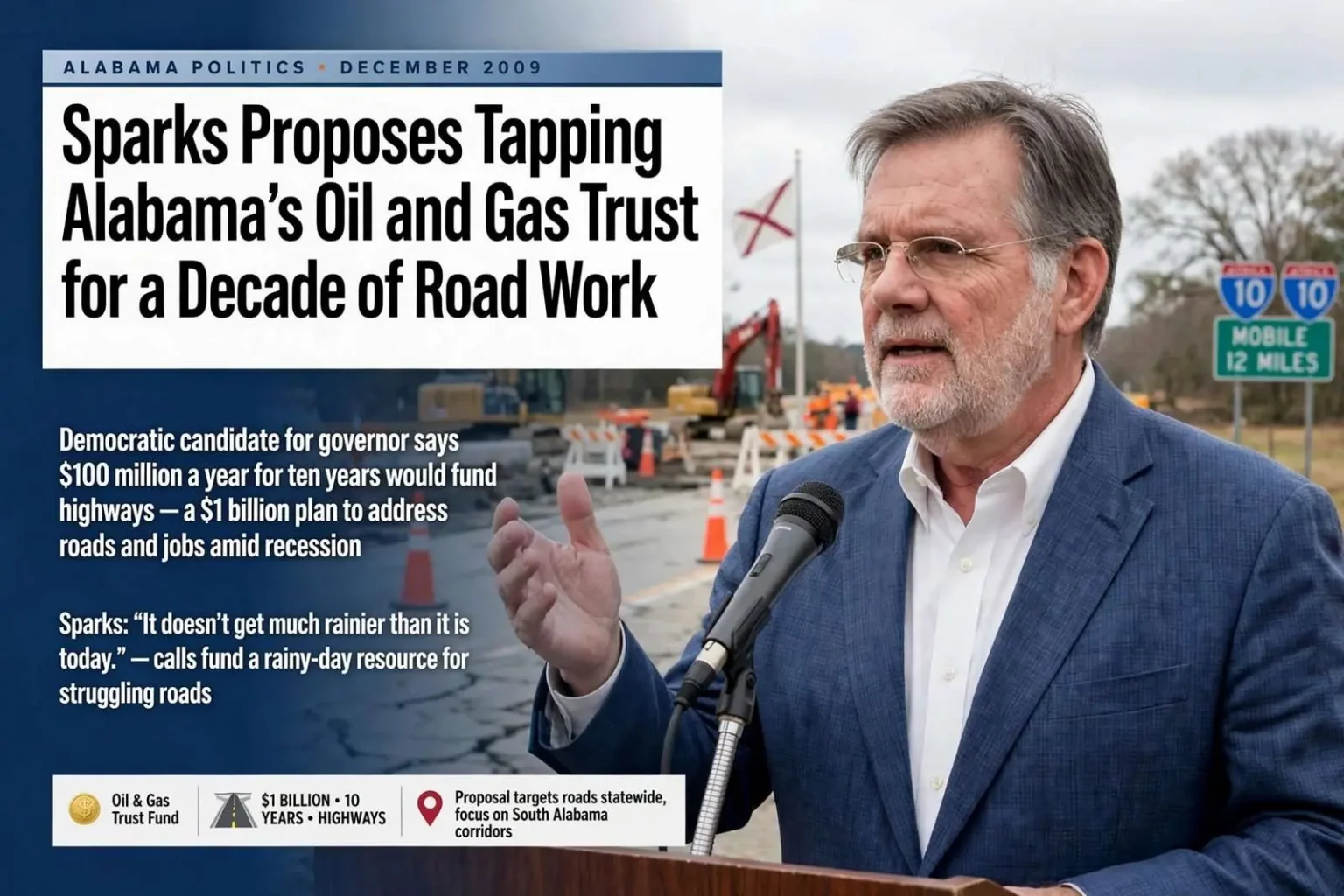
Democratic candidate for governor Ron Sparks told north Alabama audiences this week that he backed legislation to draw $100 million a year for ten years from the state’s oil and gas trust fund and spend it on Alabama’s highways — a $1 billion proposition that placed him squarely on one side of one of Montgomery’s most durable arguments.
Sparks, the state’s commissioner of agriculture and industries, was seeking the Democratic nomination for governor in the June 1 primary. He did not flinch from the criticism such proposals invariably attract.
“I don’t think it gets much rainier in Alabama than it is today,” Sparks said, playing on the shorthand officials use for the state’s reserve accounts.
The quip captured the core of his argument: a state climbing out of the worst economy in a generation, Sparks suggested, was living through precisely the “rainy day” the savings were meant for. Whether voters bought that framing would depend on how they weighed two competing instincts — the desire to fix roads now, and the caution that has kept Alabama’s reserve funds intact through decades of budget fights.
Why the trust fund is a South Alabama story
The money Sparks proposed to spend has a coastal origin that is easy to forget in Montgomery. Alabama’s trust fund was built in large part on royalties collected from natural gas produced in state waters off the Alabama coast, in and around Mobile Bay.
The wells that dot the bay and the leases beyond it converted a finite natural resource into a permanent endowment, with earnings flowing to state and local governments rather than being consumed in a single budget year. That design was deliberate, and it is why proposals to reach into the fund provoke such a sharp reaction from legislators and finance officers in both parties. The fund was meant to outlive the gas fields that filled it.
For South Alabama, the geography of the money gives the debate a local edge. The royalties came from wells visible from the shores of Mobile Bay, and the earnings distribution sends a share of the fund’s income back to the coastal counties that host the production. A proposal to divert $100 million a year to highways therefore reads differently in Mobile County, which benefits from the fund both as a coastal royalty recipient and as home to some of the highway needs Sparks cited, than it does in counties with no stake in the gas fields.
The trust fund’s structure has made it one of the state’s most protected assets since its creation. The principal — the royalties themselves — sits untouched, with only investment earnings available for spending, and even the earnings are channeled through formulas that spread money across state agencies, the Forever Wild land program and local governments. Any significant reach into the principal or the earnings stream would require legislation of a kind Alabama has rarely passed.
The case Sparks was making
Sparks’s argument was an economic one. Alabama in December 2009 was still climbing out of a recession that had gutted state revenue, forced budget proration and idled construction crews. Road and bridge money, in that environment, is not merely infrastructure spending but jobs spending, and it reaches every county in the state.
A guaranteed $100 million a year, Sparks contended, would let the state plan and let contractors hire. Highway construction is among the most predictable forms of economic stimulus a state can buy: the work cannot be outsourced, the jobs are distributed across every legislative district, and the materials — asphalt, aggregate, steel, concrete — are produced in-state by suppliers who hire locally when orders pick up.
Highway needs in South Alabama were not abstract. The region’s freight corridors, the Interstate 10 crossing of the Mobile River, the highways carrying traffic to and from Baldwin County’s beaches, and the farm-to-market roads serving Washington, Clarke, Escambia and Monroe counties all competed for a shrinking pool of state and federal dollars. Local officials had spent years warning that maintenance backlogs were growing faster than budgets.
Those backlogs were the practical face of the argument. Resurfacing schedules in rural counties had stretched from years to decades; bridges built with federal funds in the mid-20th century were approaching the end of their design lives; and the state’s matching share for federal highway projects had become harder to find in each budget cycle. A dedicated billion dollars over ten years would not close the gap entirely, but it would be the first reliable new stream of road money the state had added in years.
The objections
The standard case against Sparks’s approach is straightforward, and it was made loudly whenever a version of it surfaced. Trust fund money is one-time money; roads are a recurring obligation. Divert the earnings, critics argued, and the state trades a permanent income stream for a decade of asphalt, leaving the next governor and the one after that with the same problem and a smaller cushion.
Bond buyers and rating agencies watch reserve balances closely. State finance officials have long argued that the trust fund’s stability is part of what allows Alabama to borrow at favorable rates, and that any erosion of the endowment — even a “temporary” ten-year diversion — sends a signal that the state’s reserves are negotiable. A downgrade or even a caution from the rating agencies carries a real cost, priced into every bond the state and its municipalities issue.
Supporters countered that a savings account that cannot be touched during the worst downturn since the Depression is not much of a savings account — which was precisely the point Sparks was making with his line about the rain.
That exchange framed the debate the way it has been framed every time the fund has come up: one side sees an endowment whose purpose is to exist, the other sees a reserve whose purpose is to be used when circumstances justify it. Both sides agree on the underlying arithmetic — $100 million a year is money that either paves roads or compounds in the market, and it cannot do both at once. The disagreement is about which use a state in Alabama’s position owes its children.
The politics of the proposal
The plan also served a campaign purpose. Sparks was running behind U.S. Rep. Artur Davis of Birmingham in most assessments of the Democratic primary, and he needed issues that separated him from a rival with a national profile and a substantial fundraising advantage. A concrete, dollar-denominated plan aimed at working people in rural counties — the parts of Alabama where Sparks built his base as agriculture commissioner — was the sort of contrast he was looking for.
Sparks’s political identity had been built on exactly that constituency. As agriculture and industries commissioner, he traveled the state’s farm counties constantly, and his coalition in a gubernatorial race would run through small-town Alabama rather than the urban centers where Davis concentrated his support. A roads plan funded by the trust fund spoke directly to county commissioners, contractors and rural voters for whom the state’s highway backlog was not an abstraction but the condition of the road to the grain elevator.
Davis, for his part, had built his campaign around ethics and government restructuring, issues that played in the state’s cities and with the national Democratic audience. The trust fund proposal gave Sparks a counter-message that was immune to the ethics framing: dollars on pavement, jobs in the district, a name on a resurfacing schedule.
The road through the Legislature
Whether the Legislature would ever pass such a bill was a separate question. The protections wrapped around Alabama’s savings meant that significant changes would likely require a statewide vote, and Alabama voters have historically been reluctant to loosen them.
That history is not close. Constitutional protections for the trust fund have been tested at the ballot box, and voters have consistently chosen to keep the lock in place, even when the case for diversion was argued by governors of both parties. Legislators know this, which is why trust fund proposals surface regularly in campaign seasons and rarely survive a session. Any bill that reached the floor would also face the distribute-and-defend problem: every senator and representative would want the paving, but few would want to tell county officials back home that the royalty money that flows to local governments each year was being rerouted.
But as a statement of priorities, the proposal told voters what a Sparks administration intended to do first, and it did so in a currency — paving — that every county commissioner in the state understands.
The June 1 primary would decide whether the argument got a wider audience. If Sparks won the nomination, the trust fund debate would move to a general election against a Republican candidate, where the same coalition of budget conservatives and road-hungry local officials would be waiting. If he lost, the proposal would join the long list of trust fund diversions that Alabama candidates have floated, tested and abandoned — evidence, depending on one’s view, of either the fund’s wisdom or its waste.