Saraland’s K.J. Lacey Commits to Texas Over Auburn and Alabama
Saraland junior quarterback K.J. Lacey, a national four-star prospect coming off a Class 6A state title season, committed to Texas over Auburn and Alabama, becoming coach Steve Sarkisian's first pledge in the 2025 class.
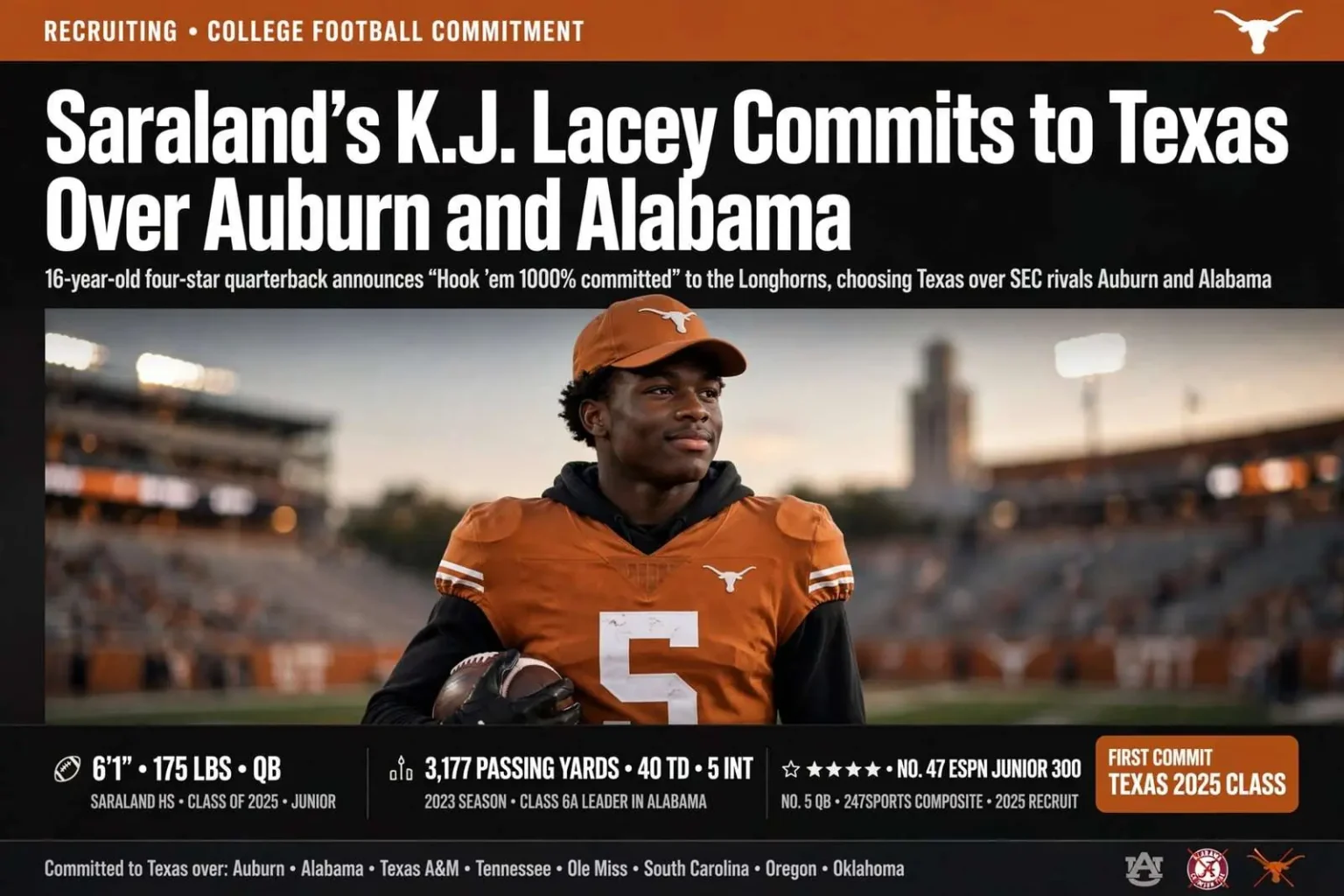
Saraland junior quarterback K.J. Lacey announced Saturday that he has committed to the University of Texas, choosing the Longhorns over in-state powers Auburn and Alabama during a visit to the Austin campus.
“Hook ’em 1000% committed,” Lacey wrote on Twitter, recounting how he answered recruiters who questioned the decision. “They asked me, ‘Why Texas?’ I say, ‘Why not Texas?'”
The commitment came just days after the four-star prospect, who turned 16 in January, trimmed his list of suitors to nine schools: Auburn, Alabama, Texas, Texas A&M, Tennessee, Ole Miss, South Carolina, Oregon and Oklahoma.
Even on that shortened list, the Longhorns were the outsider — the school farthest from Saraland, playing in a new conference home and fighting both Alabama programs for the state’s best prospect. The visit to Austin settled it, and Lacey’s announcement on social media made official what recruiters from half the country had spent months chasing.
Lacey, listed at 6-foot-1 and 175 pounds, put together a standout junior season at Saraland, completing 64% of his passes for 3,177 yards, 40 touchdowns and only five interceptions — numbers that led all of Class 6A.
He enters his senior year ranked No. 47 nationally in the ESPN Junior 300 for the 2025 class and rated the No. 5 quarterback nationally by the 247Sports Composite.
The statistics and the rankings together explained the attention. A 40-touchdown season with five interceptions is elite production at any classification; leading Class 6A, Alabama’s largest, made it a statewide standard. By the time he announced, Lacey had become the most sought-after quarterback prospect the Mobile area had produced in years.
The first brick in Texas’s 2025 class
His pledge makes him the first commitment in Texas coach Steve Sarkisian’s 2025 recruiting class and adds another highly regarded quarterback to a Longhorns program that also landed the commitment of All-American Arch Manning, who signed in December.
Being the first name in a class is a distinction recruiting staffs covet: the early quarterback commit becomes a recruiter himself, working his own relationships to pull other prospects toward the class. For Texas, landing that pledge from a Mobile-area quarterback with SEC-worthy offers signaled the program’s expanding reach into Alabama territory, historically the deepest recruiting ground in the sport.
Saraland head coach Jeff Kelly said the decision didn’t come as a surprise, crediting Texas quarterbacks coach A.J. Milwee with building a genuine relationship with Lacey over months of recruiting.
“I think the University of Texas and specifically coach Milwee did an amazing job of recruiting him and making him a priority,” Kelly said. “He came down and spent some time with K.J. in the spring and watched him practice. He did an outstanding job of building a relationship with him. Also, coach Sarkisian, with his reputation of recruiting and developing quarterbacks and putting them in a great situation to be successful, was a draw for K.J. … I’m excited for K.J. He’s a thoughtful and methodical guy and I’m proud of him.”
Milwee’s own path gave the pitch credibility. A Mobile-area high school product who played his college ball at the University of Alabama at Birmingham, Milwee had climbed through the college ranks as a position coach and offensive coordinator before joining Sarkisian’s Texas staff, and his south Alabama roots gave him a natural connection to the Saraland program.
Sarkisian’s reputation as a quarterback developer — a coach who sent passers to the first round of the NFL draft at previous stops and rebuilt his own career through offensive coordinator posts — rounded out the sales case. For a prospect choosing between the state’s two SEC giants and a national brand building a new-look roster in Austin, the development track record carried real weight.
The rise of a South Alabama prospect
Lacey’s national profile rose sharply after Saraland won the Class 6A state championship last December, a run that put his talent in front of a wider audience of college recruiters.
“You could see it coming when you look at his ability and what he did last year,” Kelly said. “The guys who make those decisions understand his potential. … K.J. at his best has got one of the quickest releases I’ve ever seen. Between the time he makes the decision to throw the ball to it leaving his hand, it’s next-level fast.”
The state title run transformed Saraland’s quarterback from a well-regarded regional recruit into a national storyline. Championship weeks gather every recruiting analyst in the state, and Lacey’s performance on the sport’s biggest high school stage converted months of practice-field reputation into public rankings, offer lists and camp invitations.
David Morris, founder of the QB Country training program who has worked with Lacey, said in December that the young quarterback has the tools to become one of the best to ever come out of Alabama.
“He can throw it as good as a lot of guys in college right now,” Morris said. “His arm is NFL (caliber) right now in terms of pure arm strength. He is 100 percent can’t miss. He’s as good as this state has ever seen and he’s not done developing. He’s ahead of his years from an anticipation and a pure arm standpoint. … He’s not even a once-in-a-decade player. I’ve been doing this since 2004 and, at this age, there’s never been one like him.”
Morris’s QB Country has become one of the Southeast’s premier quarterback training pipelines, working with dozens of college and professional passers from its Mobile-area base, and its founder’s assessments carry weight in recruiting circles. To hear the trainer who has evaluated two decades of Alabama quarterback prospects call a 16-year-old the best the state has produced at his age was the kind of endorsement that recruiters repeated in their own pitches.
The Manning question
Kelly said the presence of Manning, a fellow elite quarterback prospect who will likely still be at Texas when Lacey arrives on campus in January 2025, wasn’t a deciding factor.
“When you go to a place like Texas, there are good players there every year and you have to compete with all of them,” Kelly said. “I don’t think (Manning) enters into the equation a whole lot. K.J. is confident in who he is as a player and regardless of who is out there, he’s going to go out and do his thing.”
The depth-chart shadow of the sport’s most famous surname loomed over every Texas pitch, and the Longhorns’ staff had to answer it with each recruit. Manning’s arrival had made Austin the most watched quarterback room in college football, and adding another top-five passer at the position meant accepting a crowded competition rather than a clear runway.
Lacey’s camp framed the crowding as a feature, not a flaw — a chance to prove himself against the best roster competition in the sport — and the coach’s comments suggested the prospect never wavered from that view. Elite quarterbacks, Kelly noted, do not choose programs expecting avoiding competition.
The offers that won’t happen
Lacey’s decision effectively closes the door on a long list of other Power 5 programs that had offered him a scholarship, including Notre Dame, Miami, Florida State, Pitt, Mississippi State, Virginia Tech, Georgia Tech, TCU, Colorado, West Virginia and Michigan State.
The breadth of that list traced a recruiting map that stretched coast to coast — independents, ACC programs, Big Ten and Big 12 schools and SEC rivals alike — all for a quarterback who had yet to play a down of his senior season. Some of those programs would continue to pursue him until signing day, as recruiters routinely do with uncommitted verbals, but Lacey’s announcement gave every one of them a decision to respect.
For the in-state schools, the miss stung differently. Alabama and Auburn sign the majority of the state’s elite prospects in most cycles, and losing a top-five national quarterback from the Mobile area to an out-of-state program — and to the Longhorns, no less — marked one of the more notable recruiting defeats of the cycle on either sideline.
What it means for Saraland
The commitment adds Saraland to the short list of South Alabama high schools to produce a nationally ranked quarterback recruit, continuing a run of strong football success for the Spartans following their 2022 state title.
Saraland’s rise to the top of Class 6A has been one of the more remarkable program builds in the state over the past decade. The Mobile County school, opened in 2009 as the county’s newest public high school, grew into a perennial contender behind sustained youth-level investment, a stable coaching staff and the kind of community support that smaller cities along the Interstate 65 corridor pour into their football programs.
A nationally ranked quarterback changes the program’s profile again. Elite recruits draw national recruiting coverage to Friday games, pull college coaches onto the Saraland campus through the fall evaluation period and raise the recruiting profile of teammates along the way. Linemen, receivers and defensive prospects in the same class benefit from the traffic a marquee quarterback generates.
For Lacey, the next twelve months hold the standard senior-season expectations of a prospect in his position: a bid to defend Saraland’s regional standing, another run at the Class 6A title and the constant evaluation that follows a top-50 national recruit. His early-enrollment plan — arriving at Texas in January 2025 — means the bridge from Saraland’s sideline to Austin’s comes faster than for most high school seniors.
And for South Alabama football generally, the commitment is another data point in the region’s growing claim as quarterback-producing territory. The Gulf Coast’s passing-game pipeline, from Mobile and Baldwin County high schools through training programs like QB Country, has delivered passers to college rosters at a quickening rate, and the newest Longhorn now sits at the top of that list — a 16-year-old from Saraland who, when recruiters asked why Texas, answered why not.