Sinkhole Beneath Eslava Street Railroad Crossing Has Mobile Officials Digging for Answers
A sinkhole beneath the Eslava Street railroad crossing in Mobile has city and CSX crews investigating its cause as a local business loses customers.
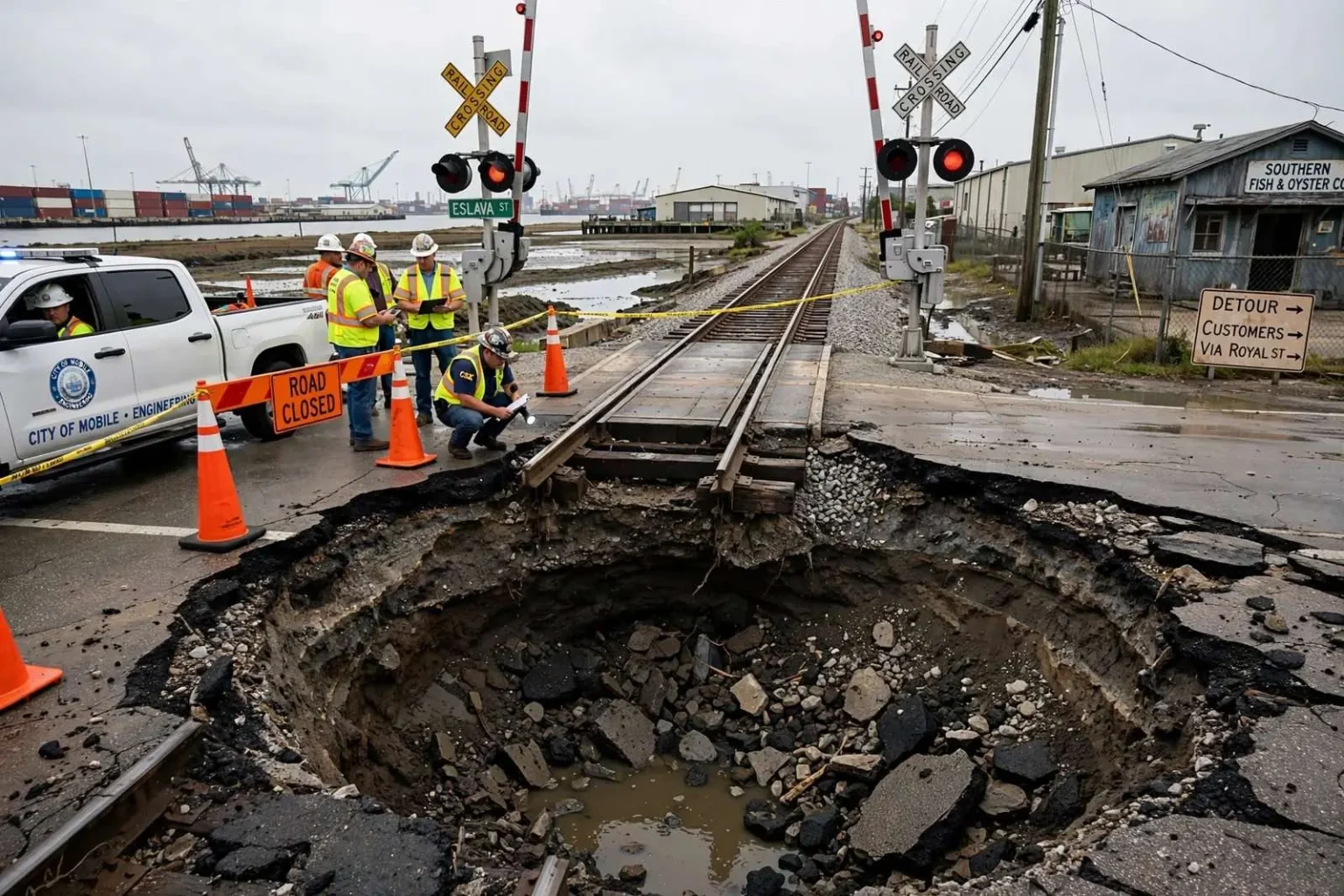
A sinkhole discovered beneath the railroad crossing at Eslava Street has city and railroad engineers scrambling to figure out what caused the ground to give way, and how long it will take to fix it for good. The hole, roughly three feet deep and five feet wide, opened up near the tracks just south of the Alabama Cruise Terminal, in an industrial stretch of Mobile where rail lines, port traffic and city streets converge. The crossing has since been blocked off to vehicle traffic, though freight trains hauling heavy cargo have continued to roll through the area without interruption. The split outcome — closed to cars, open to trains — has frustrated nearby businesses even as engineers work to keep the rail line safe.
Crews with CSX, the rail company that operates the line, first noticed the pavement around the crossing beginning to crumble. A closer look revealed a sinkhole had formed underneath both the roadway and the tracks themselves, meaning the problem was bigger than a simple surface repair. Engineers from the City of Mobile and CSX are now working together to pin down exactly what triggered the collapse, a joint effort complicated by the fact that the failure sits beneath infrastructure owned by two different parties. Until the cause is known, neither side can responsibly rebuild the crossing.
A CSX spokesperson said the immediate hole has already been filled so that trains can keep moving safely through the crossing, but a full rebuild of the crossing itself will have to wait until the underlying cause is identified and addressed. No firm timeline has been given for when that permanent fix will happen. That uncertainty is the crux of the problem for everyone who depends on the crossing: trains pass without delay, but drivers have no way of knowing when the road will reopen.
A Business Cut Off
That uncertainty is a real headache for at least one nearby business owner. Ralph Atkins runs Southern Fish and Oyster Co., the only business sitting on the east side of the tracks at that crossing. With the road blocked, his customers have had to find another way in — something Atkins said has already cost him business, particularly from people driving in from out of town who simply give up when they hit the closure and don’t know an alternate route. For a seafood business that draws customers from across the area, every confused driver who turns around is a sale that may not come back.
Atkins has tried to solve the problem himself. He posted his own detour sign near Royal Street to help steer regulars around the blocked crossing, though he said new customers unfamiliar with the area often just turn around anyway. The improvised sign is a stopgap, not a solution, and it underscores how much a single blocked crossing can ripple through a small business’s daily operations. Atkins pointed out the irony of the situation: heavy freight trains weighing around 100 tons continue rolling across the crossing at roughly 40 miles per hour, even as the same stretch of pavement was judged too unstable for ordinary passenger vehicles.
A Difficult Site to Diagnose
The location of the sinkhole is part of what makes diagnosing it so tricky. The hole sits only a couple hundred feet from the Mobile River and below the water table, placing it in an environment where groundwater is constantly at work around anything buried beneath the surface. According to the city’s engineering staff, two drainage pipes run underneath the rail line at that spot — one shallow enough to inspect directly, and another buried far deeper below the waterline that is much harder to reach because the area is tidally influenced. Inspecting a pipe that sits beneath fluctuating tidal water is a fundamentally different challenge than checking one in dry ground.
City engineers say they have been investigating the site for roughly two weeks already, working methodically through the possible explanations. Engineers explained that aging drainage pipes can slowly create hidden voids in the soil over years, as water finds its way through joints and cracks and carries soil away a little at a time. The process is invisible from the surface until the void grows large enough that the ground above it finally gives way, which is why failures like this one tend to appear suddenly even though the conditions behind them developed gradually. Heavy rain events often expose those voids once they finally give way, saturating the soil and adding weight and flow to an already weakened pocket.
That pattern echoes what happened after this spring’s record rainfall, when two large sinkholes opened up in west Mobile along McGregor Avenue near Dauphin Street and Girby Road. Those failures shut down busy thoroughfares and forced detours of their own, and they taught the city something about how drainage infrastructure behaves under sustained stress. The Eslava Street sinkhole is a reminder that the same forces at work under west Mobile’s roadways are also at work in the older industrial corridors closer to the river, where pipes may be decades old and the water table sits close to the surface.
What Happens Next
For now, city officials say the approach is a methodical one: rule out potential causes one at a time until the real source of the problem is found, so the crossing can be rebuilt with confidence it won’t simply reopen the same hole again. Rebuilding the crossing before the cause is understood would risk repeating the failure, potentially closing the road a second time and stranding the rail line’s schedule along with it. The careful pace frustrates drivers, but engineers argue it is the only way to make the repair permanent.
The collaboration between the city and CSX will determine how the fix is divided. The railroad crossing itself involves track, signal infrastructure and subgrade that CSX controls, while the roadway approach and the drainage system underneath are the city’s concern. Sorting out which party addresses which piece of the problem is a familiar exercise in Mobile, where freight lines thread through the city and share crossings with public streets. Both agencies have an interest in a durable fix: CSX needs the crossing sound enough to carry 100-ton freight cars at line speed, and the city needs a road its residents and businesses can rely on.
In the meantime, the detour remains in effect, and drivers who regularly use Eslava Street will need to keep finding their way around the blocked crossing. Business owners like Atkins continue to steer customers in as best they can, hoping the closure ends before more of their trade disappears. City engineers, for their part, continue the slow work of eliminating possible causes one by one. When they finally identify what undermined the crossing, the rebuild that follows is expected to address the drainage system below as well as the pavement above — the only combination, engineers say, that will keep the hole from coming back.
The Eslava Street closure also highlights a broader reality about Mobile’s infrastructure: the city sits in a low-lying coastal environment where water, soil and heavy industry constantly interact. Sinkholes tied to failing drainage are among the most common street failures in communities like this, and they tend to appear where pipes are oldest and traffic is heaviest. Each investigation adds to the city’s understanding of where its buried systems are vulnerable, information that shapes future maintenance priorities long after any individual crossing reopens.
For the businesses and drivers affected, the advice from the city for now is simple: plan around the closure and treat the crossing as closed until officials announce otherwise. Freight service on the CSX line continues without interruption, which means the rail corridor’s economic role carries on even as the road beside it waits. When the investigation concludes and the rebuild begins, the work will happen under the same constraints that made the diagnosis difficult — live freight traffic, a high water table and tidal influence — which is why officials have cautioned from the start that there is no firm timeline for the crossing’s return to service.
Sinkholes of this kind rarely announce themselves in advance, which is what makes them so disruptive when they arrive. The pavement at a crossing can look intact for months while a void grows quietly underneath, supported only by a thin crust of asphalt and compacted rock. By the time cracking or settling becomes visible, the failure is usually already well developed, and the response shifts from maintenance to emergency repair. That is essentially what CSX crews encountered at Eslava Street when they noticed the pavement beginning to crumble around the rails.
The two drainage pipes beneath the crossing are now the focal point of the investigation. The shallow pipe can be camera-inspected and cleaned with standard equipment, so engineers should be able to rule it in or out relatively quickly. The deep pipe is the harder question. Because it sits below the waterline in tidally influenced ground, inspecting it may require specialized equipment or temporary dewatering, and any repair would involve working around groundwater that never stops moving. If the deep pipe turns out to be the source, the permanent fix will be a substantially bigger project than filling a hole and repaving.
Local drivers have already begun adapting. Regulars who use Southern Fish and Oyster Co. have learned the route Atkins marked near Royal Street, and through traffic has shifted to other crossings along the line. What has not adapted is the unfamiliar customer — the out-of-town visitor following a GPS route that dead-ends at the closure. Until the crossing reopens, that gap between regulars and first-time customers is where the ongoing cost of the sinkhole will continue to land.