Proposed SNAP Eligibility Rule Could Cut Benefits for Millions as Gulf Coast Food Banks Brace for Demand
A proposed SNAP eligibility rule could end benefits for an estimated 6.3 million Americans. Alabama has about 740,000 SNAP recipients, and Feeding the Gulf Coast warns food banks cannot fill the gap.
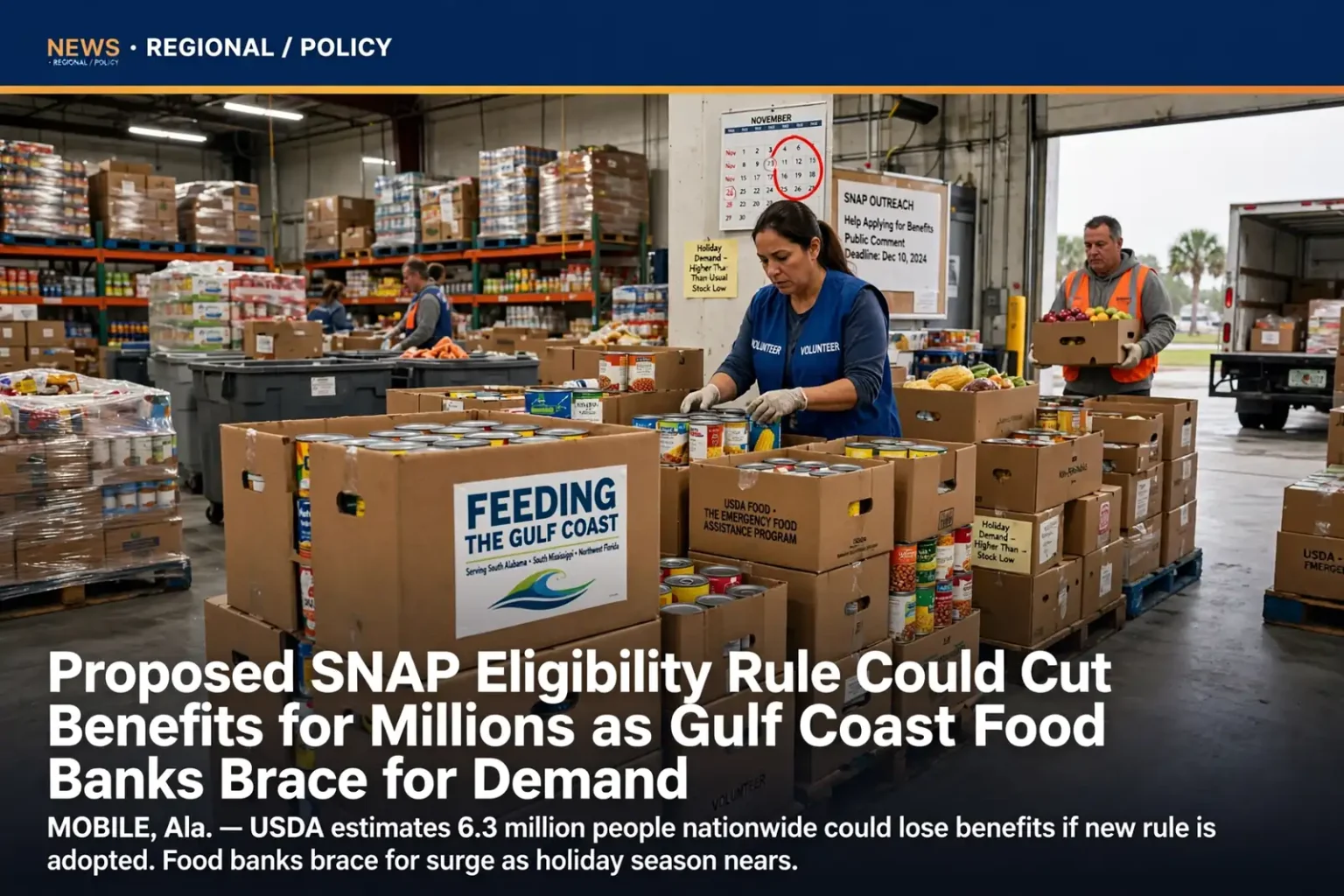
MOBILE, Ala. — A proposed SNAP eligibility rule from the Trump administration could strip food assistance from millions of Americans, and food banks along the Gulf Coast are bracing for what that could mean for families already stretched thin. The U.S. Department of Agriculture estimates that about 6.3 million people nationwide could lose benefits if the change is adopted.
In Alabama, about 740,000 people receive Supplemental Nutrition Assistance Program benefits in a typical month. Regional food bank leaders say charities simply cannot fill the hole that would be left if a large share of those households were cut off, particularly with Thanksgiving and Christmas around the corner.
What Families Should Know Right Now
- Nothing has changed yet. The proposal is not final, and current SNAP rules remain in effect while it is under review.
- Public comment is open. Members of the public have until Dec. 10 to submit comments on the proposal.
- Help is available. Feeding the Gulf Coast continues to distribute food and has an outreach team that helps families apply for SNAP and understand eligibility changes.
- Alabama is affected. The state is among those that use the policy the proposal would restrict.
Food Banks Brace for Higher Demand
Feeding the Gulf Coast, the regional food bank serving communities across south Alabama, south Mississippi and northwest Florida, is among the organizations watching the proposal most closely. A food bank official said the central worry is where families will go for help if they lose benefits, and that many will turn to the food bank and the network of local partner agencies that distribute groceries in neighborhoods every day.
The organization has already been operating at record levels. Last year it distributed 45 million pounds of food, roughly the equivalent of 37 million meals. That total is about twice what the food bank moved six or seven years ago.
Even so, food bank officials cautioned that private charity has limits that a federal program does not. They noted that for every meal a food bank provides, SNAP provides about nine. While the organization can expand to a degree, as it did during its response to a recent hurricane, its resources are finite, and its leaders worry they will not be able to replace lost benefits meal for meal.
How Food Banks Stock Their Shelves
Regional food banks draw on several sources to keep food moving. They receive donated products from grocery stores, manufacturers, farmers and food drives, purchase some items with donated money, and distribute federal commodities provided through USDA programs such as The Emergency Food Assistance Program. That food then flows to a network of partner agencies, including church pantries, soup kitchens, shelters and school programs, which hand it out directly to families. Because so much of the supply depends on donations and fixed allotments, a sudden jump in demand can quickly test the system.
Lessons From the Recent Storm
The food bank’s response to the recent hurricane showed both its strengths and its limits. In an emergency, food banks can ramp up quickly, mobilizing volunteers and trucks to get food to hard-hit areas. But disaster surges are usually temporary, while the loss of SNAP benefits for thousands of households would be an ongoing gap month after month.
Holiday Season Adds Pressure
The timing adds to the concern. Demand at food pantries traditionally climbs during the holidays, when families face higher grocery bills, holiday travel and, for some, seasonal changes in work hours. Food bank leaders say the need for assistance remains high heading into Thanksgiving and Christmas, and a reduction in federal help would land on top of that seasonal strain.
Understanding the Proposed Change
At the center of the proposal is broad-based categorical eligibility, often shortened to BBCE. The policy streamlines SNAP enrollment for certain households that already receive other forms of public assistance. In practical terms, if a household qualifies for a related benefit, the state can treat it as eligible for SNAP without repeating every step of a separate eligibility review.
Under BBCE, states can extend SNAP eligibility to households that receive a benefit or service funded through the federal Temporary Assistance for Needy Families program. Many states use the option to ease or set aside SNAP’s asset test and, within federal limits, to allow households with somewhat higher gross incomes to qualify. Most states, Alabama included, use some form of the policy.
A food bank official explained that BBCE makes it simpler for people already enrolled in other programs to receive SNAP. If the policy is restricted, the official said, the households currently qualifying through that shortcut would need to be reviewed and verified individually, a step that could cause many to lose benefits.
Not the First Attempt
Restricting BBCE is not a new idea. A similar proposal surfaced in 2019, during the president’s first term, but it was never put into effect. Supporters of tightening the policy have long argued that it allows some households to receive benefits without a full review of their finances. Opponents counter that it reduces paperwork, keeps working families with modest savings from being penalized, and helps children in those households maintain access to school meals.
Changes Already Approved by Congress
The new proposal follows significant changes to SNAP that Congress approved last year. Among them was an expansion of work requirements, which tie benefits for certain adults to working, volunteering or participating in job training for a set number of hours.
Work rules are not new to SNAP. For years, federal law has limited adults classified as able-bodied and without dependents to three months of benefits in a three-year period unless they work or take part in qualifying activities for at least 80 hours a month, with some exemptions. The changes approved last year widened the group of people subject to those rules, meaning more recipients now must document their hours to keep receiving help.
Taken together, the earlier legislation and the new proposal could reshape who qualifies for SNAP and how they keep their benefits. For families, that may mean more paperwork, more frequent reviews and, for some, the loss of assistance altogether.
How SNAP Works in Alabama
SNAP, which many people still call food stamps, is a federal program overseen by the USDA’s Food and Nutrition Service and administered by the states. In Alabama, the program is run by the Alabama Department of Human Resources. Eligible households receive monthly benefits on an electronic benefits transfer card, which works much like a debit card at grocery stores, supermarkets and many farmers markets.
Benefits can be used to buy most foods meant to be prepared and eaten at home, including produce, meat, dairy, bread and cereals. They cannot be used for items such as alcohol, tobacco, vitamins or household supplies. The program is designed to rise and fall with need, expanding during economic downturns and disasters and shrinking as conditions improve.
Who Relies on SNAP
Nationally, a large share of SNAP participants are children, older adults or people with disabilities. Many recipient households also include adults who work but earn wages too low to cover all of their basic expenses. For these families, monthly benefits often make the difference between a full refrigerator and skipped meals near the end of the month. Benefit amounts depend on household size, income and certain expenses such as housing costs, and households generally must recertify their eligibility on a regular schedule.
Why SNAP Matters to Local Economies
Because SNAP dollars are spent at local grocery stores and markets, the program also supports retailers, their employees and the farmers and distributors who supply them. In rural parts of south Alabama, where grocery options may be limited, that spending can be an important part of a store’s customer base.
How to Weigh In Before Dec. 10
The proposal is still in the federal rulemaking process. When an agency proposes a rule, it publishes the plan in the Federal Register and invites the public to respond before a deadline. Comments are typically submitted through the regulations.gov website. After the comment period closes, the agency must review the input it receives before deciding whether to finalize the rule as written, revise it or set it aside. A final rule would also generally include an effective date, giving states time to adjust their systems.
Residents, community groups, retailers and local officials who want their views considered have until Dec. 10 to file comments. Comments that explain how a change would affect a specific family, business or community are often the most useful to regulators.
Where to Find Help
Families who are worried about their benefits, or who think they may qualify for SNAP for the first time, do not have to sort through the rules alone. Feeding the Gulf Coast’s outreach team helps people apply and understand changing eligibility requirements, and the food bank continues to supply food to pantries, churches and community partners across the region.
Current recipients should keep their contact information up to date with the Alabama Department of Human Resources and respond promptly to any notices or requests for documents, since missed paperwork is a common reason benefits lapse. Those who want to help their neighbors can support local food pantries with donations of food, funds or volunteer time, especially during the busy holiday season.
For now, food bank leaders say they will keep working as hard as they can to meet the need while watching closely to see what Washington decides.