Alabama Republicans Search for Answers After Losing Legislative Seats in the Nov. 3 Election
Alabama Republicans kept control of state government but lost four legislative seats on Nov. 3. GOP senators now point to Trump, affordability and voter anger as they weigh what went wrong.
MONTGOMERY, Ala. — Alabama Republicans are still firmly in charge of state government after the Nov. 3 election, but the party’s lawmakers are now wrestling with an uncomfortable question: why did so many voters turn away from them? In the days since Democrats flipped four legislative seats and narrowed GOP margins across much of the state, Republican state senators have offered sharply different explanations, from frustration with President Donald Trump to the rising cost of everyday life.
Their reflections suggest the party is entering the next four years with smaller majorities, a new governor and a clear warning from voters who, at least in some districts, were willing to cross party lines to be heard.
The Numbers Behind the Concern
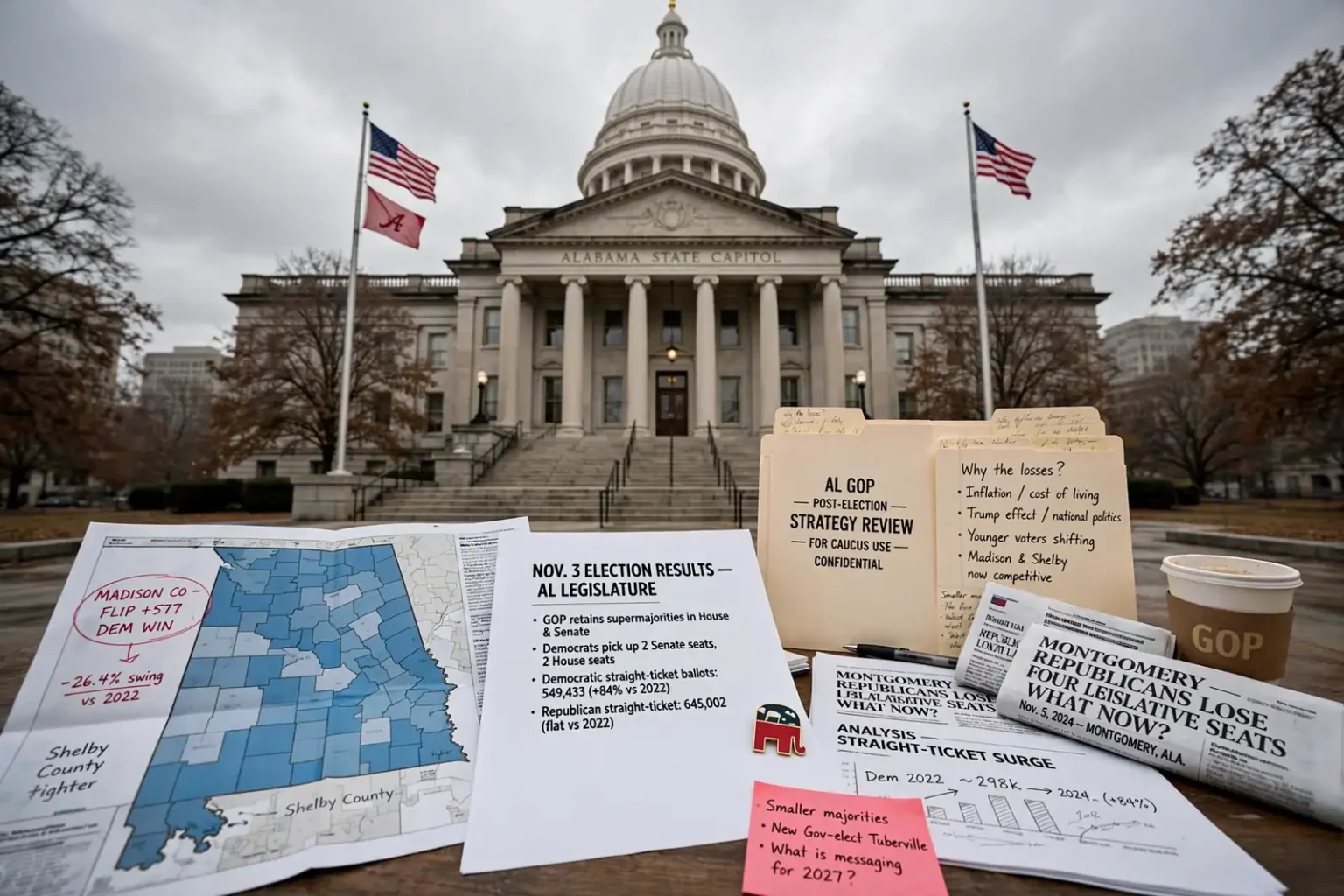
On paper, Republicans had a strong night. The party won every statewide office and kept its supermajorities in both chambers of the Legislature. Yet Democrats picked up two seats in the Alabama Senate and two in the Alabama House, and several Republican incumbents found themselves in races that were far closer than expected.
The most striking result came in a Madison County Senate district. A Democrat captured the seat by 577 votes, taking 50.5 percent of the vote in a district where the Republican incumbent had won by a margin of over 25 points in 2022. The shift from that earlier race amounted to a 26.4 percent move in the Democrats’ direction.
A Surge in Democratic Straight-Ticket Voting
Unofficial figures from the Alabama Secretary of State’s office show that more than 70 percent of voters chose a straight party ticket. Alabama remains one of a small number of states that still let voters select every candidate of one party with a single mark.
- Republican straight-ticket ballots: 645,002, close to the party’s 2022 total
- Democratic straight-ticket ballots: 549,433
- Democratic growth since 2022: up from roughly 298,000, an increase of about 84 percent
Those figures reinforce the concerns several senators have raised about party loyalty and enthusiasm. Republican voting held steady, but Democratic participation surged.
Why Straight-Ticket Totals Matter
In a state where most voters choose a party rather than individual candidates, straight-ticket totals act as a rough measure of each party’s base. When one side’s straight-ticket count climbs sharply while the other’s stays flat, down-ballot races that once looked safe can suddenly become competitive. Legislative candidates, who often receive less attention than those at the top of the ticket, are especially sensitive to those shifts because many voters never look at their individual names. That dynamic helps explain how a district that was not considered competitive four years ago could change hands by a few hundred votes.
A Defeated Senator Points to Washington
One Republican senator who lost his seat said the outcome caught him off guard, explaining that his own polling had badly missed the shift. In his view, the surveys failed to capture how motivated Democratic voters were, and they did not account for Republicans who either skipped the election or voted for the other party.
He noted that he lost precincts he had carried before, including fast-growing residential areas of Huntsville. But he said the loss was not simply the result of Democratic newcomers settling in Madison County. In his view, a number of voters who had backed Republicans for years appeared to have switched sides. He recalled a Democrat contacting him after the election to say the vote had been about Washington rather than about him personally.
Blame Directed at the President
The senator then turned his criticism toward Trump. He argued that Republican candidates have felt pressure to seek the president’s favor in order to win nominations, and he said that dynamic cost the party control of the U.S. Senate and contributed to Republican defeats in South Carolina, Texas and possibly North Carolina. He criticized the president for distancing himself from those losses.
Now that he is leaving office, the senator said, the president no longer has any power over his political future. He described today’s Republican Party as belonging to Trump.
He also questioned whether Alabama Republicans have kept up with a changing electorate, saying the party needs to accept that Madison County has become politically purple. Republican leaders, he said, need to rethink how they reach voters, especially younger residents whose priorities may differ from the party’s traditional base. Both the message and the people delivering it matter, he said, and in his view the party has fallen short on each.
A Focus on Prices and Paychecks
A second Republican senator, who won reelection, offered a broader economic explanation. He cautioned against drawing firm conclusions before the voting data have been studied in detail, but said the losses reflected voter unhappiness with economic conditions and national politics.
He pointed to the war with Iran, higher gasoline prices and the Democrats’ sustained emphasis on affordability, which he believes ultimately won the argument with voters. In his assessment, Democrats tapped into frustration over everyday costs, while Republicans struggled to make the case for positive economic signs such as unemployment figures and stock market performance. He also faulted some of the messaging coming out of Washington.
Echoes of 2010
The senator compared the moment to 2010, when voter frustration with the Obama administration and national Democrats fueled big Republican gains, including at the state level in Alabama. This year, he said, the political pendulum simply swung back in the other direction.
A Warning Against Business as Usual
A third senator, who represents a heavily Republican district in south Alabama and won by a wide margin, urged his colleagues not to treat the results as a passing national backlash that will fix itself. He said Republicans need to understand why the party lost ground with voters in certain districts but held firm in others.
He observed that national politics played out differently in Madison and Shelby counties than in Baldwin County. Baldwin’s voters, he said, are more closely aligned with Trump, while Republican voters in Madison and Shelby include people with a different set of priorities.
Like his colleague, he highlighted economic frustration, saying voters cast ballots based on their wallets. If they believe Republicans in Washington are making their finances worse, he said, that will always show up at the polls. Lawmakers, he added, should look hard at whether voters were unhappy with the president, with the top of the ticket or with policies made in Montgomery.
Voters Sending a Message
The senator said continuing with business as usual would be the wrong response. He described voters who are angry and who want lawmakers to pay closer attention to pocketbook issues they feel have been neglected.
He pointed to a Huntsville House race in which a Democrat defeated a Republican incumbent and became Alabama’s first openly transgender state legislator. In his view, that outcome showed that some voters were willing to support a candidate they may have disagreed with on social issues in order to send Republican leaders a message. The real question, he said, is whether the party will listen.
He also said state lawmakers must do more to set themselves apart from national political figures, and he described the Senate Republican Caucus’s recent choice of a new majority leader as an opportunity to communicate better with voters. The loss of two colleagues, he said, has already weighed on the caucus, making its first meeting after the election a sobering experience. Some voters who backed Trump in 2024, he added, were frustrated enough two years later to support Democrats in state races, and he urged Republicans to take seriously the fact that those voters are now engaged.
What Comes Next in Montgomery
The election results set the stage for a period of adjustment at the State House. Alabama legislators serve four-year terms, and the 2027 regular session will be the first of the new term. Lawmakers will be working with Governor-elect Tommy Tuberville’s incoming administration, a batch of newly elected members and slimmer Republican majorities.
The senator who pointed to affordability said he expects the 2027 session to move at a slower pace than usual, as legislators build relationships with the new administration and with first-term colleagues. He also anticipates a tighter budget picture. He described the coming session as largely a chance for everyone to get acquainted.
Key Questions for the Party
- Will Republican leaders change how and to whom they communicate, particularly with younger and suburban voters?
- Can state lawmakers separate their record from national politics in the minds of voters?
- Will the surge in Democratic straight-ticket voting hold in future elections, or fade?
- How will smaller majorities and a new governor shape the legislative agenda in 2027?
A Party Taking Stock
The views offered by the three senators differ in emphasis. One places much of the blame on the president and the party’s national direction. Another sees the results mainly as a verdict on prices and economic anxiety. The third calls for a hard look at why loyal voters in some parts of the state broke away while others did not. All three, however, agree that the results should not be brushed aside.
For Alabama Republicans, who have dominated state politics for more than a decade, the Nov. 3 results did not change who holds power in Montgomery. They did, however, show that the party’s hold on some of the state’s fastest-growing areas is less secure than it once appeared, and that voters in those areas are paying close attention to what happens next.