

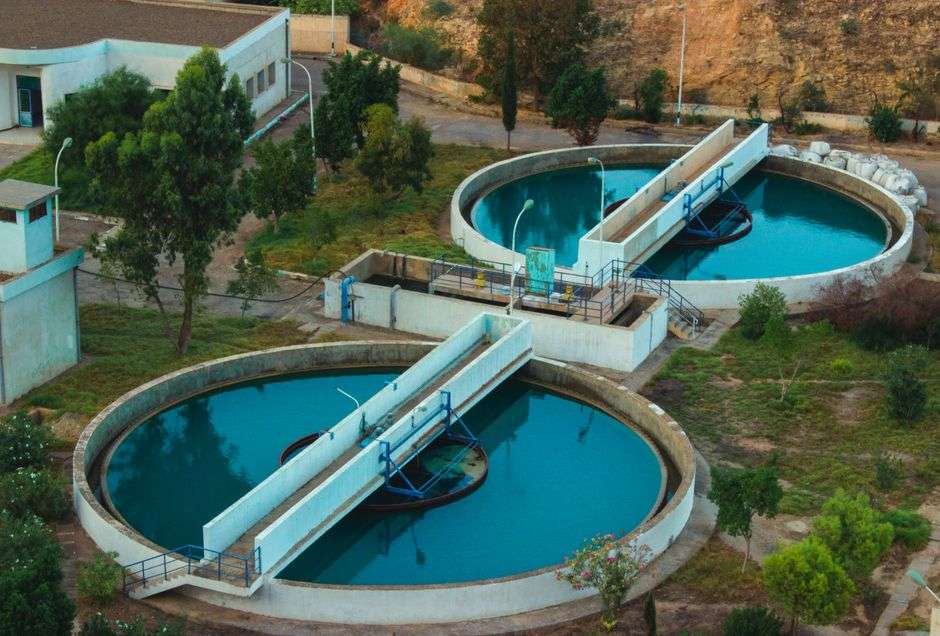
The Alabama Department of Environmental Management has decided a public hearing is required before it will act on a permit that would allow a major expansion of a wastewater treatment plant on the Fort Morgan peninsula, following an unusually large wave of public comments from residents worried about the health of nearby Little Lagoon.
Baldwin County Sewer Service, the private utility that owns and operates the plant, filed an application in January seeking to increase the facility’s capacity by 65 percent, from 1.2 million gallons per day to 2 million gallons per day. The Fort Morgan Wastewater Treatment Plant is the southernmost of five plants the company runs in Baldwin County, and the expansion would make it the largest in the utility’s system.
In a March 31 letter to BCSS principal manager Clarence Burke, ADEM Water Division official Jeff Aul informed the utility that a public hearing would be necessary because of requests the agency received during the public notice period for the draft permit. Aul directed BCSS to pay an $8,450 public hearing fee within 30 days, warning that failure to do so could result in denial of the permit application altogether.
ADEM spokesperson Lynn Battle confirmed the agency will hold the hearing and said a 30-day notice will go out once logistical details are finalized. The public comment period on the draft permit closed Feb. 26, but generated 95 comments, a striking number for the sparsely populated stretch of coastline around Little Lagoon.
The plant uses a chlorine treatment process and discharges its treated wastewater into percolation ponds on the property, where it soaks into the groundwater rather than being piped into a river or the Gulf. Because of that discharge method, ADEM regulates the facility as a Class V injection well under the federal Underground Injection Control program.
“The Underground Injection Control program permits and manages compliance with wastewater treatment plants that inject treated sanitary waste into injection wells, such as percolation ponds, as the method of discharge,” Battle said. “These systems are covered under the National Pollutant Discharge Elimination System program. Regardless of the program that a wastewater system is regulated under, the intent is to ensure that the discharges from the system are protective of the water quality standards, which are developed to be protective of human health and the environment.”
Many of the residents who wrote to ADEM raised concerns about elevated nutrient levels, the risk of sewage spills and how well the agency enforces permit restrictions and violations once they occur. Several also questioned why BCSS wants to route sewage from the middle of Baldwin County to the Fort Morgan facility rather than expanding one of its newer, more modern plants farther inland.
Tom Eberly, a retired chemical engineer who has lived on Little Lagoon since 1976, told ADEM he has watched water quality decline over the decades alongside a rise in algae blooms. “It has become clear to me that the lagoon is high in harmful nutrients that are causing the algae blooms,” he wrote, adding that he could be persuaded otherwise with solid data, but that such data has been hard to come by. Eberly said common sense points to the four BCSS percolation ponds, which sit only a quarter-mile from the lagoon and discharge into groundwater that naturally flows toward it. “In essence,” he wrote, “Little Lagoon is their fifth percolation pond.”
Dennis Hatfield, a geologist and president of the roughly 275-member Little Lagoon Preservation Society, wrote separately to suggest the algae blooms could stem from excess phosphorus and nitrogen escaping the plant, along with other pollutants such as pharmaceuticals and household chemicals. Hatfield said the group is awaiting results from a study led by University of South Alabama hydrologist Dr. Alex Bebee, who is comparing nutrient profiles in the shallow aquifer and the water flowing into the lagoon from unpopulated land, golf courses, subdivisions, man-made canals and the sewage plant itself.
Roberta Swann, director of the Mobile Bay National Estuary Program, told ADEM in her own letter that Bebee’s study was expected to wrap up this spring. The research uses stable isotope analysis to distinguish between natural, fertilizer-derived and wastewater-derived sources of nutrients in the water, she wrote. “Preliminary results indicate anomalously high nutrient concentrations in shallow wells and surface water seeps south of the BCSS plant,” Swann wrote, adding that Bebee has so far been unable to rule out the treatment plant’s effluent disposal ponds as a source of the nutrients impairing the lagoon. Swann asked ADEM to delay the permit and hold public input sessions.
Other nearby residents flagged additional concerns to the agency. Charles and Mary Richardson, who live adjacent to the treatment plant, told ADEM that BCSS built a new sludge pond on the property last year that they say lacks any stormwater control measures. “It would be the height of folly for ADEM to issue a permit that allows for the construction and operation of such a tortious facility,” the couple wrote, calling it contrary to public policy and the public interest.
Stephen and Trudy Hesse, who live a few hundred yards south of the plant, described the expansion proposal as “dangerous and ridiculous” in their letter to the agency. “I have lived within 10 miles of Gulf Shores my whole life, vacationed on Little Lagoon for 20 years, before moving to Little Lagoon and have seen the effects to water quality and smell of the poo seeping up from the ground and pouring out of the French drains between our homes,” they wrote, adding that algae blooms have at times been severe and that the risk to residents’ health keeps growing.
Charles Caban, a retired chemical and environmental engineer who lives in Foley, urged BCSS to consider alternative treatment methods and locations altogether, noting that Little Lagoon experiences little to no tidal flushing because its pass to the Gulf is frequently choked with sand. “Little Lagoon is a tremendously important natural asset for the community of Gulf Shores,” Caban wrote. “Consider the consequences if, during the warmest weather, the lagoon turns green and slimy or if fecal coliform levels rise to make human contact with the water to be dangerous.”
With about 20,000 accounts and still growing, Baldwin County Sewer Service is the largest privately owned sewer utility in Alabama. The outcome of the Fort Morgan permit fight is likely to be closely watched by residents and environmental groups elsewhere along the Gulf Coast, where aging wastewater infrastructure and rapid population growth have increasingly put pressure on fragile coastal waterways.
Fort Morgan sits at the tip of a narrow peninsula that holds the Mobile Bay entrance from the Gulf of Mexico. The area is home to both the historic Fort Morgan State Park and a residential community that has grown over the past several decades. The peninsula’s wastewater infrastructure has been a recurring topic of community meetings and regulatory proceedings.
Little Lagoon, the large shallow lagoon that runs along the north side of the Fort Morgan peninsula, has experienced periodic water-quality concerns tied to stormwater runoff, septic system failures and the discharge from the local wastewater treatment plant. The Alabama Department of Environmental Management has held hearings on the plant’s operations in past permit cycles.
Public hearings on wastewater permit modifications are part of the formal ADEM process. The hearings give residents an opportunity to comment on proposed changes to the plant’s discharge limits, treatment processes and monitoring requirements.
Local governments and community partners are working through the implications of the situation, and several follow-up meetings have been scheduled for the coming weeks. Members of the public who want to weigh in on the matter can find the meeting dates on city and county websites, and written comments can be submitted through the standard channels used by the relevant agencies. Local news outlets will continue to cover the story as it develops.
Across south Alabama, similar issues are being addressed in other communities, and the lessons learned here are likely to inform how those communities approach their own challenges. Local officials have indicated they are in regular contact with counterparts in neighboring cities and counties, and they expect to share best practices as the situation continues to evolve.
The agencies involved in the matter have committed to keeping the public informed as the work progresses, and residents who want to receive updates directly can sign up for email or text alerts through the relevant city or county websites. Local community organizations have also agreed to share information as it becomes available, and several have scheduled public forums in the coming weeks to give residents a chance to ask questions of the officials involved.
For background, readers can consult the official websites of the relevant agencies, the local newspapers that have covered the story, and the public-meeting archives that document the prior deliberations on related topics. The combination of those resources should give residents a thorough understanding of how the current situation developed and how the agencies and elected officials are approaching the decisions that remain.