

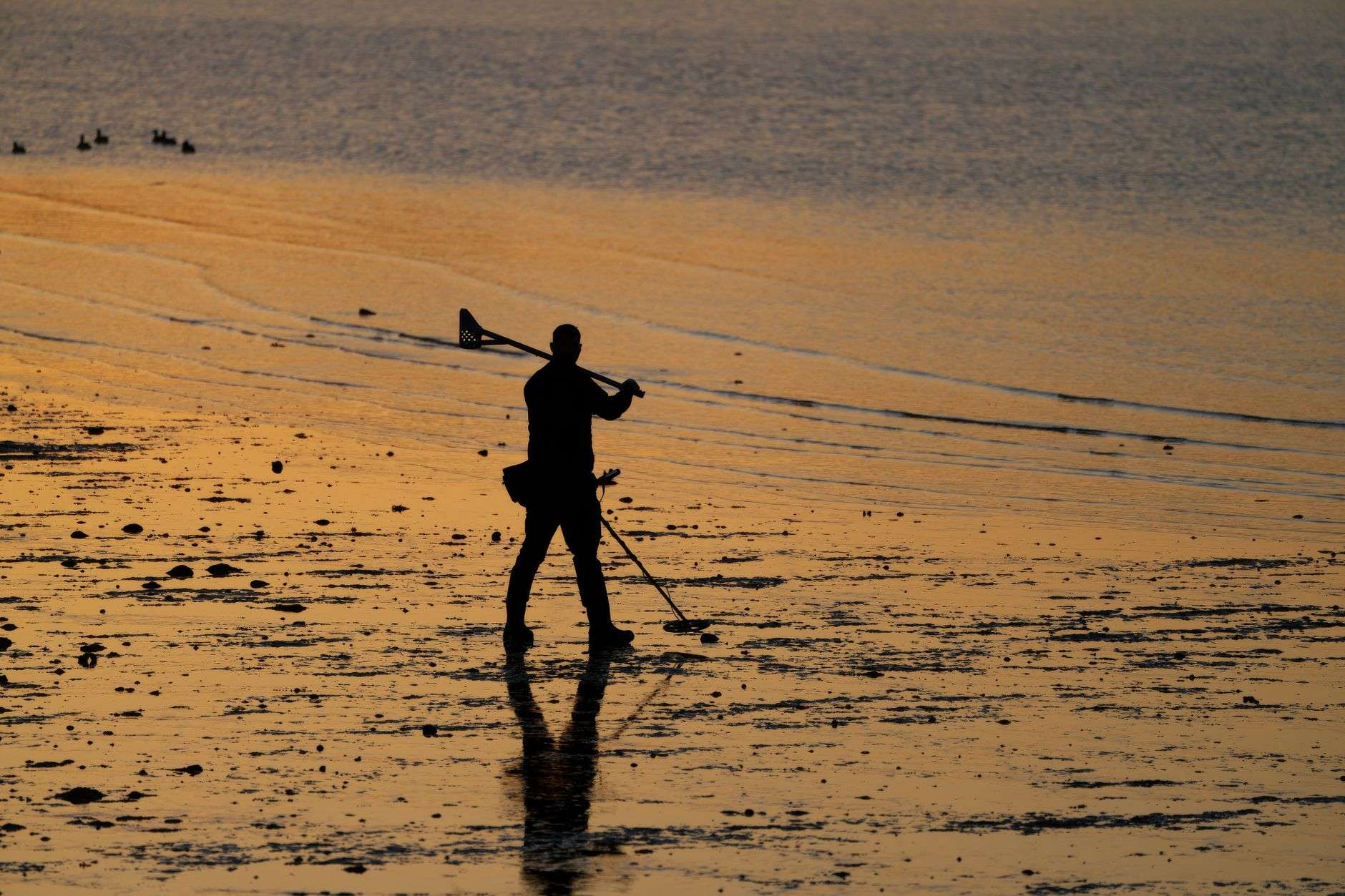
ORANGE BEACH, Ala. — When a ring slips off in the surf or disappears into the sand, the vacation can go with it. Along Alabama’s Gulf Coast, two metal detectorists known as “Stingray” and “Beach Angel” have made a habit of giving those vacations back.
Darren Mason, who goes by Stingray, and Cheryl Clark, known as Beach Angel, sweep the beaches and shallow waters of the Gulf Coast with metal detectors, searching for jewelry and other valuables that visitors have lost. Sometimes they find what they are looking for in minutes. Sometimes they find things no one knew were missing.
An Engagement Ring Lost in the Gulf
Jeannie Zamora of Arkansas was on her annual vacation in Gulf Shores when her engagement ring slipped off her finger while she was swimming in the Gulf. She did not realize it was gone until later, at the pool.
“I looked down and I only had my little band on and I was like, oh my gosh. I know that I had my ring on. Where is it? So, I went to my husband and I was like, it’s not here. Where is it? I was distraught. I was in tears,” Zamora said.
She went back to look for it herself, borrowing a pair of goggles from a child to search the water. It did not turn up.
“I just thought it was a gonner and then, we came and kind of looked and I grabbed a little girl’s goggles and I’m looking like I’m really going to find something, you know,” Zamora said.
With few other options, Zamora posted about the ring on a social media page dedicated to lost and found items along Alabama’s beaches. Both Mason and Clark saw the post and responded — even though the two had never met or worked together before.
‘That Young Lady Almost Hugged Me Dry’
Conditions were not in their favor. Mason said the water that day was much rougher than it looks on a calm afternoon. He found the ring anyway.
“Yes, this is the first time that I met her, and the water was far rougher than what you see out there. Managed to find the ring. Unbelievable. And that young lady almost hugged me dry. She was so thrilled to get it back,” Mason said.
For Clark, moments like that are why she does it.
“Well, people are mostly down here on vacation, so you lose something that’s precious to you and it ruins your vacation. So, to be able to come out and find it for somebody and see the look of joy on their face…the smiles…it’s the biggest reward you could ask for,” Clark said.
Rings are among the most common things people lose at the beach. Cold water can make fingers shrink slightly, sunscreen and lotion make skin slick, and waves and swimming motions can pull a loose band free without the wearer ever feeling it. Once a ring hits the bottom in moving water, it can quickly settle into the sand, which is why a metal detector often succeeds where eyes and goggles fail.
An Auburn Class Ring, 374 Days Later
Clark has been metal detecting as a hobby for nearly 20 years, and one of her searches reunited a family with a ring they had long given up on.
Miranda Dunnam said her husband, Tyler, lost his Auburn class ring while playing water volleyball in Little Lagoon over the July 4th weekend in 2024. The timing, she said, was almost unbelievable.
“We were playing, had been playing and my stepdad just starts…shares a story. He’s like, oh yeah. Years ago my uncle lost his Auburn class ring, just sharing with people you know and I’m not kidding you, maybe two minutes later, my husband, Tyler stops the game. He’s like stop! He’s like my ring literally flew off and I don’t know where it is,” Dunnam said.
The family searched now and then over the following weeks and months without any luck. Eventually Dunnam, who lives in Baton Rouge, reached out to Clark for help.
Little Lagoon presented a different kind of challenge than the open beach. The lagoon stretches roughly 10 miles along the western side of Gulf Shores and is about half a mile wide, covering some 2,480 acres. Its brackish water, a mix of fresh and salt, averages 4 to 6 feet deep and connects to the Gulf through Little Lagoon Pass, an opening that formed during a 1916 hurricane.
“She was hesitant at first because it’s the lagoon. People, you know it’s a little different. She’s used to walking on the sandy beaches and she agreed to do it and not even ten minutes later she found the ring, just by me sending a photo of the area and circling on there, hey this is where we think it is,” Dunnam said.
Tyler Dunnam got his ring back 374 days after it flew off his finger.
Buffalo Nickels, Gold Coins and Everything in Between
Not everything the pair pulls from the sand has an owner waiting for it. At Cotton Bayou in Orange Beach, Mason showed off some of what turns up on a typical outing.
“Junk jewelry, earrings. Well, I’ve got a little bit of something here. I can show and tell. If I can get it out without dropping it so I don’t have to hunt it up. Normally, stuff like this right here and every once in a while, you find something just a little out of place. That is a buffalo nickel. I found it in the water and it’s either 1925 or 1935,” Mason said.
Buffalo nickels were minted from 1913 to 1938. Designed by sculptor James Earle Fraser, the coin shows a Native American profile on one side and an American bison on the other. The design had a well-known weakness: the date wore away easily in circulation — which is why it can be hard to tell exactly what year a well-worn example was struck.
Clark’s most memorable discovery was even rarer.
“I did find a gold coin out in the water,” Clark said. “A three-dollar gold coin. Somebody had made it into a pendant I guess because it had a hole in it. Um, rings, watches, phones. Like you said. You name it, we’ve found it.”
The United States minted three-dollar gold pieces only from 1854 to 1889. Designed by Mint Chief Engraver James B. Longacre, the coins never caught on in everyday commerce, and Congress abolished the denomination in 1890. Coin experts consider all of them scarce today.
Not every find is a treasure. The pair have also come across illegal drugs that were left behind or washed up on the beach, and those discoveries prompted a call to law enforcement.
How Stingray Got His Name
Mason’s nickname comes from an encounter he would rather not repeat. He said he was recently stung by a stingray while detecting in the water near Turquoise Place in Orange Beach.
“I decided to just do a little metal detecting and I was walking that way and I got out in the water and I’m just barely in the water and I’m almost to Turquoise Place and I got hit and I knew immediately what it was. My first thought was it was bound to happen eventually. A stingray,” Mason said.
Stingrays are not aggressive; they sting defensively when they are stepped on or startled. Swimmers and waders can lower their risk by doing the “stingray shuffle” — sliding their feet along the bottom instead of taking big steps, which alerts rays so they can move away. Stings can be intensely painful. Standard first-aid advice is to get out of the water, rinse the wound, and soak it in hot water between about 104 and 113 degrees Fahrenheit for 60 to 90 minutes, and then have it checked by a medical provider to make sure no piece of the barb remains in the wound.
Putting Their Skills to the Test
To see the searchers in action, a wedding band was buried in the sand at Cotton Bayou as a test for Mason. He swept the area and dug several times without coming up with it. Then Clark stepped in and found the ring.
“See there. Beach Angel. That’s why teamwork makes the dream work, right?” Mason said.
It was a fitting end to the demonstration for a pair who first teamed up by chance over a stranger’s lost engagement ring.
If You Lose Something at the Beach
The stories of Zamora and the Dunnams point to a few practical lessons for anyone who loses something valuable along the coast:
- Note the location as precisely as you can. Dunnam’s photo of the area, with the likely spot circled, helped Clark find the class ring in under 10 minutes.
- Reach out for help. Zamora’s post on a lost-and-found page for Alabama’s beaches is what connected her with Mason and Clark.
- Don’t give up too soon. Tyler Dunnam’s ring was recovered more than a year after it was lost.
For Mason and Clark, the payoff is not the gold or the old coins. It is the moment a stranger gets back something they thought was gone for good — and their vacation along with it.