Tourist who drowned in Destin identified as 36-year-old from Louisiana
The Okaloosa County Sheriff's Office has identified the tourist who drowned in the Gulf of Mexico off Destin as a 36-year-old Louisiana man.
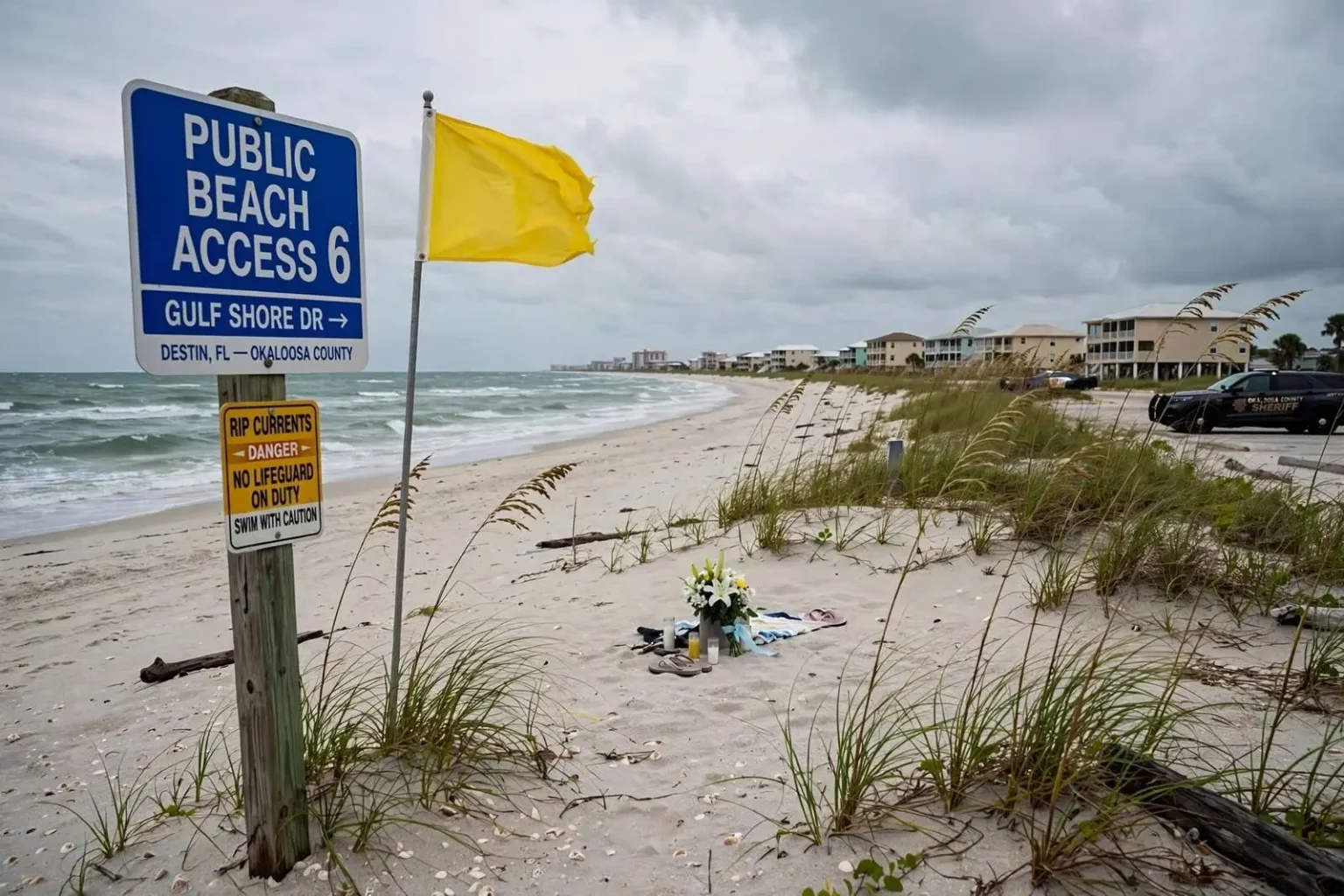
DESTIN, Fla. — A tourist who drowned in the Gulf of Mexico off Destin has been identified as Carlos Wuberto Rodriguez, 36, of Baton Rouge, Louisiana, by the Okaloosa County Sheriff’s Office. The agency confirmed his identity in an update issued June 16, two days after the fatal incident.
Rodriguez was seen struggling in the water near Gulf Shore Drive around 2 p.m. on June 14. Bystanders pulled him to shore, but he was already unconscious and did not survive, according to the sheriff’s office. Authorities did not release additional details about what happened in the moments before he was spotted in distress.
The stretch of shoreline near Gulf Shore Drive sits among the busier sections of Destin’s beach, where vacation rental homes and public access points draw heavy crowds during the summer season. Like many stretches of the Emerald Coast, much of that shoreline is unguarded, which means swimmers in trouble often depend entirely on the people around them rather than on lifeguards standing watch from a tower.
The episode underscores a pattern that public-safety officials along the northern Gulf Coast repeat every summer: the same clear water and gentle surf that draw so many visitors can produce dangerous conditions with little warning, and the difference between a close call and a tragedy frequently comes down to how quickly someone on the beach notices a swimmer in trouble.
Rip currents remain the Gulf’s most persistent hazard
Along the Florida Panhandle, as elsewhere on the Gulf, the leading natural hazard for swimmers is the rip current — a narrow channel of water that pulls away from the beach, often forming near sandbars, jetties and passes where water pushed ashore by waves seeks a path back out to sea. Rip currents are generally difficult for an untrained eye to spot from the beach, and they can shift position from one hour to the next as tide and wave conditions change.
Swimmers caught in a rip current frequently describe the same sequence: they are carried away from shore faster than they can swim back in, they panic, and they exhaust themselves fighting the current directly. Safety guidance from beach officials is consistent — a person caught in a rip should stay calm, float or tread water, and swim parallel to the beach until clear of the narrow current before angling back to shore. The current itself does not pull a swimmer under; it carries them seaward, and most fatalities occur when exhaustion or panic sets in before escape.
Even strong, experienced swimmers can be overmatched, which is why warnings along the Gulf so often emphasize that conditions considered routine in a pool or a calm bay are a different matter in open Gulf water. Changing wind, tide and wave conditions can turn an apparently calm morning into a hazardous afternoon, and conditions can differ dramatically from one beach access point to the next depending on the shape of the underwater sandbars and the proximity of passes and structures.
How beach warning flags work in Florida
Visitors to Destin and the surrounding beaches encounter a colored flag system posted at public access points, following the warning scheme used across Florida’s coastal communities. A green flag signals calm conditions, yellow indicates moderate surf or currents and calls for caution, and a single red flag warns of high hazards with strong surf or currents. A double red flag means the water is closed to the public, while a purple flag alerts beachgoers to dangerous marine life such as jellyfish or stingrays.
Safety officials urge anyone entering the Gulf to check the posted flag before getting in the water and to understand that the flag reflects conditions at that moment, not for the entire day. Wind and tide can shift a beach from moderate to hazardous in a matter of hours, and flags are updated as conditions change, so a swimmer who arrived under a yellow flag should look again before going back in after lunch.
Swimmers are also advised to enter the water near other people, keep children within arm’s reach, avoid swimming alone or after dark, and stay off inflatable floats in open water, where wind and current can carry a rider well away from shore before anyone on the beach notices. Alcohol is another recurring factor in Gulf drownings, since it impairs both swimming ability and judgment, and officials recommend that newcomers to the Gulf swim only when conditions are calm and never venture past their depth without a clear plan for getting back.
Bystanders are often the first responders
On the many unguarded stretches of the Emerald Coast, bystanders on the beach are functionally the first line of rescue, as happened near Gulf Shore Drive on June 14. Beach-safety organizations advise would-be rescuers to help from the shore first — calling 911, throwing a floatable object such as a boogie board, cooler or life ring, and keeping the person in sight — before attempting an in-water rescue, because untrained rescuers routinely become victims themselves.
Emergency dispatchers in Okaloosa County field calls from the beach communities throughout the tourist season, and response times depend in part on how precisely a caller can describe their location. Officials suggest noting the nearest public beach access number, cross street or landmark when calling from the sand, since long stretches of shoreline can look alike from the water’s edge.
When a swimmer is pulled from the water unconscious, the minutes before EMS arrival are critical, which is why many coastal communities have pushed CPR training and public-access defibrillators in recent years. Rescue crews also emphasize that a person recovered from the water should be evaluated by medical personnel even when they appear to recover on the sand, because complications from water in the lungs can develop hours after the initial rescue.
The geography of the coast shapes the risk as much as the weather does. Okaloosa County’s beachfront includes the city of Destin on the east side of East Pass and the Okaloosa Island area to the west, and between the public parks and the rental neighborhoods there are miles of shoreline with no guard on duty at any hour. Visitors staying in beach houses, as many do along Gulf Shore Drive, are often steps from the water but miles from the nearest lifeguard, and the crowded feel of a beach in mid-June can mask how isolated a struggling swimmer actually is.
That reality has shaped years of public-education campaigns by coastal governments and tourism organizations, which spend the spring and summer pushing rip-current awareness on social media, on rental-property notices and at beach access points. The campaigns ask visitors to do a handful of simple things that cost nothing: look for the flag before entering the water, keep a phone on the beach, and make sure someone in every group is watching the water while others swim.
What follows a drowning investigation
After a drowning, sheriff’s investigators typically work to confirm the victim’s identity, notify next of kin and establish the circumstances before closing the case. Identification often waits on family notification, which is why agencies publish an update a day or two after the incident itself, as the Okaloosa County Sheriff’s Office did on June 16. The office does not routinely release medical findings; an official cause and manner of death rests with the medical examiner.
For the family and the bystanders involved, the aftermath can be difficult even when no fault is assigned. Agencies generally commend bystanders who enter the water or perform aid on the sand, while reminding the public that such rescues carry real risk and that calling 911 immediately remains the most important step anyone can take.
A reminder for a busy tourist season
Destin and neighboring Okaloosa Island draw visitors from across the Southeast each summer, and the beach is the centerpiece of nearly every trip. For the vast majority of vacationers, a day on the Gulf passes without incident. The circumstances of individual drownings vary — sudden illness, exhaustion, alcohol, sudden shifts in current — but officials continue to stress that respect for the water is the common thread in nearly every prevention message.
Rodriguez had traveled to the area from Baton Rouge, a drive of several hours that thousands of Louisiana families make each summer to reach the Panhandle’s white sand and emerald water. His death drew attention locally precisely because it fit a familiar and sobering pattern: a swimmer in distress on an unguarded beach, spotted by bystanders too late for their efforts to save him.
Sheriff’s officials and beach-patrol officers along the coast will spend the rest of the summer delivering the same advice they deliver every year: check the flags, swim near other people, watch children constantly, never turn your back on the water, and if you see someone struggling, call for help before going in. The Gulf gives little margin for error, and on a June afternoon near Gulf Shore Drive, that margin ran out for one visitor from Louisiana.