Yellow Flags, Heat Advisory Mark Tuesday’s Beach Conditions in Orange Beach
Orange Beach flew yellow flags Tuesday under a heat advisory, with moderate rip current risk. The report also details Molly's Patrol, the city's Surf Rescue program.
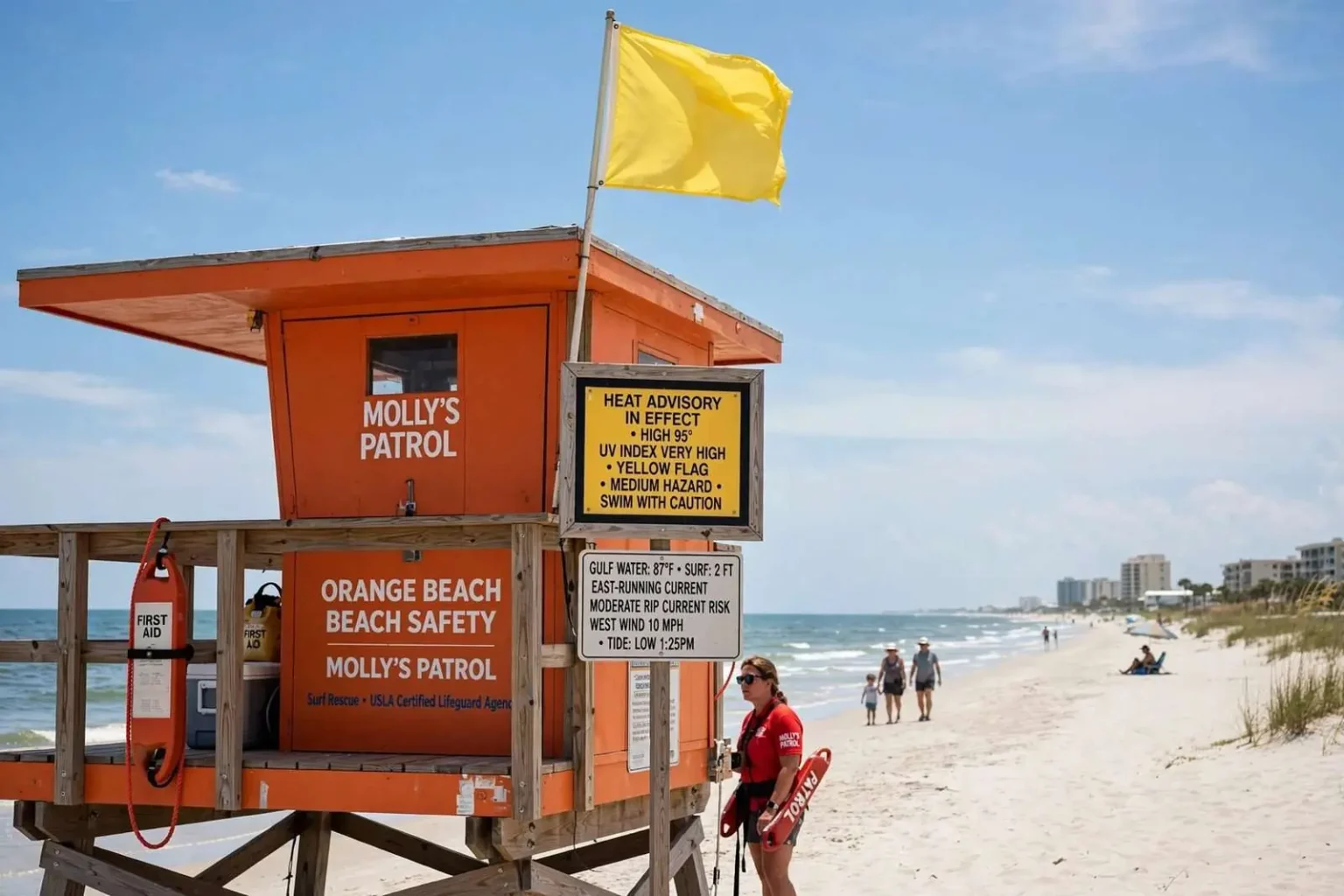
Orange Beach’s Beach Safety Division flew yellow flags along the coastline Tuesday, Aug. 18, signaling a medium hazard as swimmers dealt with moderate surf and currents in the Gulf of Mexico, according to the city’s daily beach report.
Beachgoers were urged to swim with caution as a heat advisory remained in effect for the area, with highs expected in the mid-90s under mostly sunny skies. The Gulf water temperature measured 87 degrees, and surf conditions were rated fair, with waves around 2 feet and a strong east-running current. Officials rated the risk of rip currents as moderate for the day.
West winds blew around 10 mph, and the UV index was rated very high. High tide was set for 12:37 a.m., with low tide following at 1:25 p.m.
A yellow flag means swimmers should stay alert and close to shore — a step below the red flag that closes swimming outright, and above the green flag of a calm day. Along Alabama’s beaches, where the beachfront is lined with towers that fly the day’s color at each public access point, reading the flag before walking onto the sand is a habit safety officials have spent two decades trying to build into every visitor’s routine.
The team behind the daily reports
The daily conditions reports come from Orange Beach’s Surf Rescue program, known locally as Molly’s Patrol, which has grown considerably since it was formed in 2008 under the city’s Parks and Recreation Department. What began as two lifeguards covering 7.5 miles of coastline has since expanded into a full Beach Safety Division, created when the program moved under the Orange Beach Fire Department on Jan. 1, 2012. Today, Surf Rescue operates as a Certified Lifeguard Agency under the United States Lifesaving Association (USLA).
The division’s staff includes 33 employees: six full-time positions, including the Beach Safety Chief, two Beach Safety Supervisors and three Open Water Lifeguard Specialists; three part-time Beach Safety Supervisors; and 24 temporary and seasonal lifeguards.
Lifeguards work a seasonal schedule from March 1 through Oct. 31, with hours running 10 a.m. to 6 p.m. in the spring and fall shoulder seasons, and extending to 10 a.m. to 8 p.m. between Memorial Day and Labor Day, with reduced staffing after 6 p.m. No lifeguards are on duty from November through February, though the department maintains limited patrols during that stretch.
The seasonal shape of the operation tracks the Gulf Coast tourism calendar almost exactly. Peak staffing lands in the months when condo occupancy and day-trip crowds are highest, and the reduced winter patrols exist chiefly to keep eyes on the water during the off-season weeks when a handful of swimmers, surfers and anglers still venture in.
Lifeguards cover nearly 8 miles of coastline stretching from Flora-Bama to the Gulf State Park Pavilion, using seven stationary towers at public beach access points, including Shell Beach, Alabama Point East, Cotton Bayou, the COASTAL/Resident Beach, Romar Beach and Phoenix West II/The Oasis. Roving lifeguards patrol the rest of the shoreline using six Honda UTVs, three beach trucks and two Jet Skis. Beachgoers can approach any tower to ask about current conditions or regulations.
The tower system is what makes the daily report practical rather than theoretical. Because the towers sit at the access points where crowds concentrate, a family arriving at Cotton Bayou or Romar Beach can see the flag color, ask the guard on duty whether the east-running current is pulling hard along that stretch, and adjust plans before entering the water. The roving units cover the gaps between towers, watching the uncongested stretches where swimmers are fewer but supervision is thinner.
Water rescues along this coast are dominated by rip currents — narrow channels of water pulling away from shore that can overwhelm even strong swimmers. The standard advice officials repeat is to swim parallel to the beach to escape the current rather than fighting it directly, and to call for help rather than attempting a rescue alone.
The east-running current flagged on Tuesday is a different but related hazard: a lateral drift that can carry a swimmer far from the point where they entered the water before they realize it. Guards at the towers watch for exactly that sign — a swimmer visibly sliding along the beach line — and the morning reports call out such currents so families know where the drift is strongest.
Honoring Molly Bryant’s legacy
The program’s Molly’s Patrol name honors Molly Bryant, who drowned in a rip current in July 2003 at age 15 while swimming during a youth church group trip to the Gulf Coast. Earlier that same summer, Molly had spent part of her final months on a mission trip in San Francisco, feeding and ministering to homeless children, an experience that shaped her hope to devote her life to children’s ministry.
Following her death, Molly’s parents, Tommy and Rebecca Bryant, made donations that led Surf Rescue to adopt the Molly’s Patrol name in her memory. The Bryant family has continued working toward stronger beach and water safety standards along the coast, with the goal of keeping Orange Beach among the safest beaches on the Gulf Coast for future generations.
The naming turned a private loss into a public institution. Every tower flyover, every school-group lesson and every rescue performed under the Molly’s Patrol banner traces back to the summer of 2003, when a visiting teenager was lost to a hazard that a trained, staffed shoreline might have prevented.
Getting involved
Beach Safety officials are already preparing for next year’s lifeguard hiring season. The 2026 application process runs through the City of Orange Beach’s jobs portal, and candidates are encouraged to begin training for the required 500-meter swim, which must be completed in under 10 minutes to qualify for a tryout.
Those training for the test can use the Orange Beach Aquatics Center at 4853 Wilson Blvd. free of charge by signing in at the front desk. After a successful tryout, candidates attend a 40-hour USLA Lifeguard Academy held over two back-to-back weekends, Feb. 28-March 1 and March 7-8, followed by interviews and selection.
The 500-meter swim standard is the program’s first filter, and it is a demanding one for candidates who have not trained in open water or competitive-style pool sets. Officials urge applicants to build the distance gradually over the winter months rather than attempting the test cold, and the free pool access at the Aquatics Center is designed to remove the main excuse for not being ready.
Successful graduates of the academy step into one of the Gulf Coast’s most visible public-safety jobs. Open-water lifeguarding differs from pool work in almost every respect — currents, surf entries, spinal management in moving water and coordination with fire and EMS units — which is why the USLA certification and the two-weekend academy exist before a single shift on the sand.
Families interested in water safety education for children can also look ahead to the Junior Lifeguard Program, which typically runs three sessions each summer. Online registration opens April 1, 2026, at 8 a.m., with parents required to set up a family account before enrolling.
The program teaches rip current safety, beach safety, CPR, physical fitness, teamwork and water rescue skills, alongside daily physical activities. Sessions are divided by age: Session 1 (ages 9-11) runs June 8-12; Session 2 (ages 12-15) runs June 15-19; and Session 3, an advanced track for ages 12-15, runs June 22-26.
Participants should bring running shoes, swimsuits, goggles, towels, lunch and snacks daily, with pickup and drop-off at the Orange Beach Aquatics Center, 4853 Wilson Blvd.
The junior program doubles as a feeder into the hiring pipeline. Teenagers who spend a June week learning to read currents and run rescue drills routinely return as lifeguard applicants a few summers later, arriving already fluent in the flag system, the tower network and the vocabulary of open-water rescue that the academy then formalizes.
For a city whose summer economy depends on tens of thousands of visitors stepping into the Gulf every week, that pipeline — from junior camper to seasonal guard to full-time Beach Safety specialist — is the quiet infrastructure beneath the daily flag reports that residents and tourists check each morning before the day at the beach begins.
Residents who want to follow the daily conditions reports through the season can watch the flags themselves at any tower — yellow for medium hazard, red for high, green for calm, purple for dangerous marine life — and the city’s beach report distills the same information into water temperature, surf height, current direction, tide times and UV rating for each day.
That transparency has become part of Orange Beach’s identity. A city built on visitors trusting the water with their children has invested, over nearly two decades, in the staffing, training and equipment to make that trust reasonable — and in the daily ritual of telling those visitors exactly what the Gulf is doing before they step in.