$3.8 Million Opportunity Zone Land Deal and Wilkins Miller’s Downtown Mobile Return Highlight Regional Business Growth
A $3.8 million Opportunity Zone land sale near I-65 and Wilkins Miller's move back downtown highlight a wave of commercial activity across Mobile.
A wave of commercial real estate activity is reshaping downtown Mobile and the surrounding region, highlighted by a nearly 70-year-old accounting firm’s decision to return to the central business district and a major land sale tied to a federal Opportunity Zone designation. The transactions described in recent weeks trace a regional market expanding in several directions at once — office space in the urban core, industrial acreage along the interstate corridors, retail and entertainment concepts in midtown and west Mobile, and a residential market across Baldwin County that continues to set records.
A Homecoming on Dauphin Street
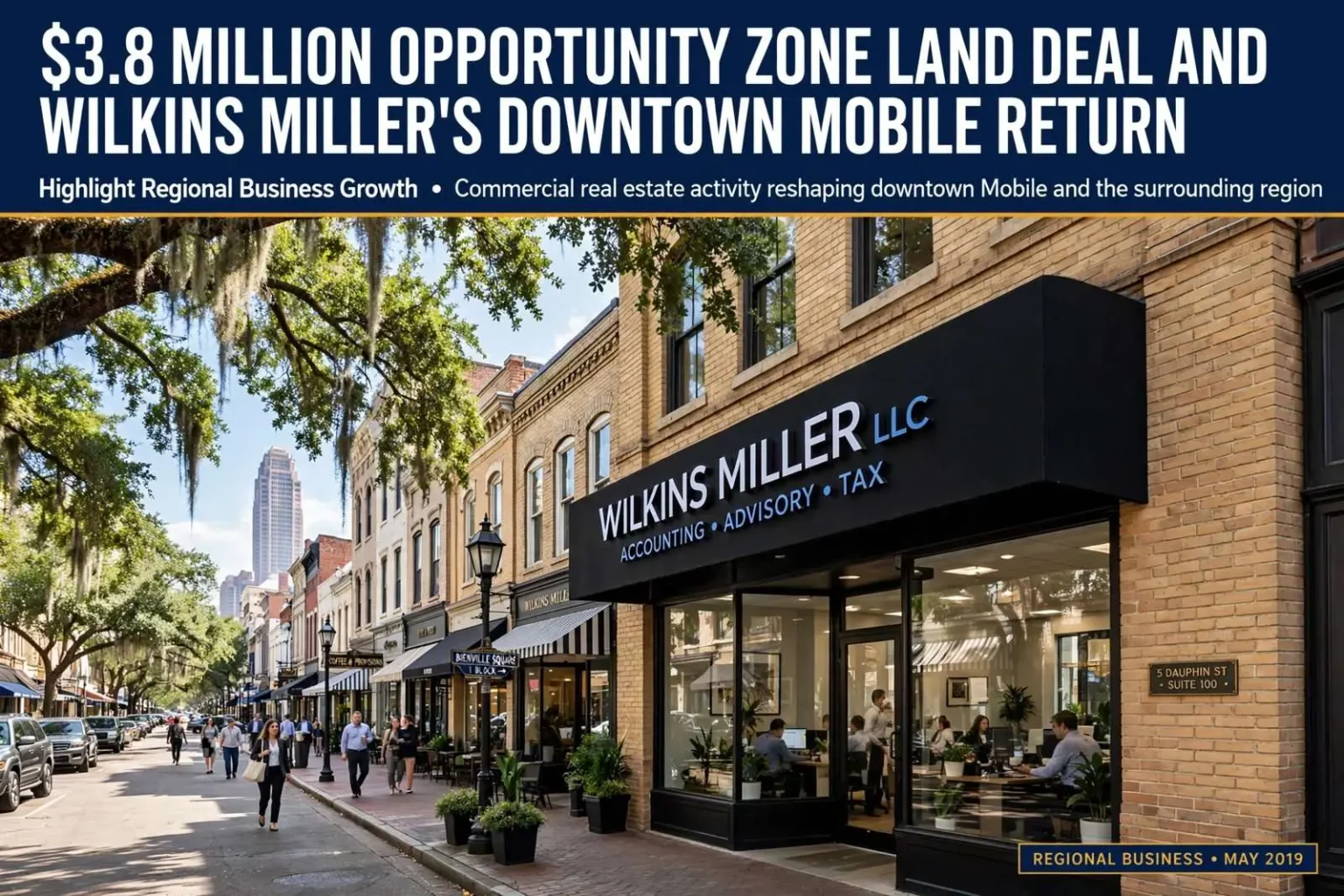
Wilkins Miller LLC, a Mobile-based accounting and advisory firm, recently celebrated the opening of a new 2,000-square-foot satellite office at 5 Dauphin St. in downtown Mobile. The move marks a homecoming of sorts for the firm, which was headquartered in the Central Business District until the late 1970s before relocating elsewhere in the city. For a practice that traces its Mobile roots back generations, the return to the street-level commercial fabric of Dauphin Street places its professionals within walking distance of the banks, law offices, and municipal offices that make up much of its client base.
The new downtown suite will house up to five accountants and is being leased from Brian Metcalfe of Metcalfe & Associates, the building’s owner. Wilkins Miller now employs more than 80 professionals and is considered the largest locally based accounting firm in the Mobile area. The firm’s service lines extend beyond traditional audit and tax work into advisory services for privately held businesses, nonprofit organizations, and governmental entities across the region — the kind of diversified practice that has allowed locally owned firms along the Gulf Coast to hold their own against national competitors.
Downtown Mobile has worked for years to rebuild the office population that once defined its Central Business District. The Dauphin Street corridor, in particular, has seen a steady stream of loft conversions, restaurant openings, and boutique office tenancies as property owners repurpose historic commercial buildings near Bienville Square. An accounting firm choosing to station part of its workforce there is the sort of tenancy downtown advocates have long pointed to as evidence that the district can support professional services, not just nightlife and special events. Leasing rather than buying keeps the commitment flexible — a common approach for professional practices testing whether a second location justifies itself. The lease with Metcalfe & Associates also reflects the role of individual property owners in downtown’s revival; buildings on Dauphin Street are frequently held by local families and entrepreneurs who have stuck with the district through its leaner decades.
Opportunity Zones and the Mega-Site Corridor
Nearby, a large tract of undeveloped timberland comprising roughly 1,945 acres recently sold to out-of-state investors for $3,889,760 as part of a 1031 real estate exchange. The property sits within a federally designated Opportunity Zone at the southeast quadrant of State Highway 59 and Interstate 65, with about 2.7 miles of frontage along I-65 adjacent to the South Alabama Mega Site. Brandon Broadus and Pete Riehm of NAI Mobile brokered the transaction.
The 1031 exchange structure matters to how such deals get done. Under Section 1031 of the federal tax code, an investor who sells one income-producing property and reinvests the proceeds in another — within strict deadlines — can defer capital gains taxes that would otherwise be owed on the sale. For out-of-state buyers redeploying equity, raw timberland in a growth corridor offers low carrying costs and long-term optionality: the land can keep producing income as a timber asset while the investor waits on the region’s development curve to reach it.
Opportunity Zones were created under a federal law adopted in Alabama to spur investment in economically distressed communities. Under the program, new investments in designated zones can qualify for preferential tax treatment once a site has been nominated by the state and certified by the U.S. Treasury Department. Alabama’s nominations, made through the governor’s office following the census-tract selection process laid out in the federal statute, mapped zones across both urban neighborhoods and rural corridors — including stretches of the interstate system where large tracts could accommodate manufacturing, logistics, or mixed-use development if the market eventually calls for it.
The southeast quadrant of Highway 59 and I-65 is one of the strategically significant intersections in southwest Alabama. Interstate 65 is the spine that connects Mobile to Montgomery, while Highway 59 carries traffic from I-65 south toward Gulf Shores and the beach communities — meaning the corridor sees both freight and tourism traffic in volume. Proximity to the South Alabama Mega Site, a large state-certified industrial site marketed for major manufacturing projects, gives land in the vicinity plausible long-term upside: suppliers, warehouses, and service businesses tend to cluster near certified mega sites once an anchor manufacturer commits.
Midtown Retail: Fitness and Axe Throwing
Elsewhere in Mobile’s retail and entertainment scene, Greenville, South Carolina-based 9Round 30 Min Kickbox Fitness has opened a 1,400-square-foot training studio inside the Publix-anchored Midtown Mobile Shopping Center at 100 Florida St., near Old Shell Road. The fitness franchise offers functional, interval, cardiovascular and circuit-training workouts in 30-minute sessions. Amber Dedeaux of Vallas Realty represented the landlord, while David Dexter of NAI Mobile represented the franchise.
9Round’s model is built around a circuit of stations — bags, pads, and bodyweight work — that members move through in timed intervals with no set class schedule, which makes it attractive to shift workers, parents, and anyone whose calendar does not cooperate with fixed gym class times. The brand’s expansion across the Southeast has followed the same pattern now visible in Mobile: small-footprint studios tucked into grocery-anchored neighborhood centers, where co-tenancy with a supermarket delivers consistent daily traffic without the parking and visibility costs of a standalone building. Fitness tenants have been a reliable backfill category nationally — they draw members multiple times a week, hold long leases, and are largely immune to the e-commerce pressure that hollowed out apparel and electronics retailers.
In Foley, American Fork, Utah-based Surge Nutrition has opened in about 1,500 square feet of retail space at the Outdoor Center on State Highway 59, selling nutritional shakes, smoothies and teas. The store joins existing tenants Planet Fitness, Magnolia Dance Company, Gulf Coast Tools and Studio Bliss Hair Salon. Amanda Goldman of Stirling Properties handled the lease.
Foley’s position as the northern gateway to the Alabama beaches makes Highway 59 through the city one of the busiest commercial corridors in Baldwin County, particularly in summer when beach-bound traffic stacks up through town. Nutrition and supplement shops have multiplied across such corridors in recent years, often pairing with fitness tenants — an adjacency the Outdoor Center already embodies with Planet Fitness among its neighbors. The center’s mix of service, fitness, and specialty tenants is characteristic of the smaller, multi-tenant centers that have proven durable in the county: no single anchor to lose, and a roster that serves daily needs rather than discretionary big-ticket shopping.
Back in Mobile, Greer’s Old Bay Market at 10835 Dauphin Island Parkway recently held a ribbon cutting hosted by the Southwest Mobile Chamber of Commerce following an extensive renovation of the roughly 14,000-square-foot grocery store. Upgrades included new flooring, new equipment, new glass doors and new LED overhead lighting.
Greer’s is a Mobile grocery institution — a locally owned chain whose stores have served neighborhoods across the city for generations, including areas the national chains have historically passed over. The Old Bay Market location at the southern end of Dauphin Island Parkway serves the communities toward the causeway and the island itself, a corridor that mixes established neighborhoods with the marinas, seafood houses, and camps that line the bay. Chamber-hosted ribbon cuttings like this one do double duty as civic rituals and marketing: they signal to the surrounding community that a long-standing merchant is investing rather than retreating, which matters in neighborhoods where grocery access shapes daily life.
Also in Mobile, a new California-based nail salon has leased about 1,750 square feet of retail space at 1234 Hillcrest Road, next to Ollie’s Mediterranean Grill, with an anticipated October opening. Other tenants in the strip center include Republic Finance, Knots Salon and Prometric. McArthur of Stirling Properties also handled that transaction.
The Hillcrest Road corridor in west Mobile is a dense strip of neighborhood retail serving the residential subdivisions that spread toward Airport Boulevard and Cody Road. Personal-service tenants — salons, nail studios, finance offices, testing centers — dominate these centers because they draw steady weekday traffic and are unaffected by online retail. A salon arriving from out of state and choosing the corridor reflects the pattern of regional operators expanding into Sun Belt metros where household formation continues and strip-space rents remain moderate compared with national averages.
Industrial and Flex Space Change Hands
In other commercial property news, the 16,634-square-foot former Mobile Bay Transportation building at 3024 Airport Blvd., situated on about 3 acres, sold to a speculative buyer for $875,000. The former limousine service facility includes 20 parking bays and roughly 9,000 square feet of office space. Charlie Christmas of Christmas Properties represented the buyer, while Marietta Urquhart and Jamie Ison of White-Spunner Realty represented the seller.
Airport Boulevard is one of Mobile’s principal east-west arterials, running from the I-65 interchange toward the airport itself and threading through a long band of office, medical, and light-industrial uses. A building with 20 parking bays, a large vehicle footprint, and 9,000 square feet of built-out office is a rare flexible asset — usable by a transportation or service fleet, a contractor needing indoor storage, or a company wanting office space with yard access. A speculative buyer purchasing such a property without a tenant in hand is a bet that the corridor’s demand, driven by the port economy and the metro’s logistics growth, will fill it.
In Daphne, a local investor purchased a 12,000-square-foot office and warehouse building on 3.31 acres at 26374 Pollard Road for $950,000. The fully leased property still has about 2 acres available for future development, according to Angela McArthur of Stirling Properties, who represented the seller.
Pollard Road sits on the eastern edge of Daphne’s commercial grid, near the U.S. 98 corridor that connects the Eastern Shore’s fast-growing residential areas. A fully leased office-warehouse building changes hands with income already in place, and the surplus 2 acres give the buyer the option — increasingly valuable in Baldwin County — to expand or build again as the surrounding area fills in.
Baldwin County Housing Hits a New High
Meanwhile, the residential real estate market in Baldwin County continues to strengthen. The Baldwin County Association of Realtors recently released its May 2019 report showing median home prices reached a new high compared to the same period a year earlier. The report forecasts that as the peak summer season continues, newly listed properties will see shrinking time on the market.
Baldwin Realtors’ Multiple Listing Service reported total residential active inventory of 3,206 properties in May 2019. A total of 785 properties sold in May, a 6 percent increase over the 741 sold in May 2018. Properties also sold faster, spending an average of about 76 days on the market compared to 88 days a year earlier — nearly 14 percent quicker. Total sales volume for the month climbed 15.8 percent year-over-year to $243,834,526, up from $210,551,609 in May 2018. The average sales price for residential properties in Baldwin County rose 9.3 percent to $310,617, compared to $284,145 the previous year.
The numbers describe demand arriving from several directions at once. Baldwin County’s population growth — among the fastest in Alabama for two decades — has drawn retirees, military families tied to the region’s bases, and workers who trade a longer commute for newer housing stock. Eastern Shore cities such as Fairhope, Daphne, and Spanish Fort absorb commuters working in Mobile, while the beachside corridor from Gulf Shores to Orange Beach pulls second-home and investment buyers whose purchases show up in the same MLS totals. Faster market times, rising prices, and dollar volume growing far faster than unit count are the signature of buyers competing for a supply that is not keeping pace — and of the urgency agents along the Eastern Shore and the beach corridor have described for several seasons.