$2.52 Billion Federal Loan Closes the Financing Gap on the Mobile River Bridge; Construction Expected to Begin Next Month
The U.S. Department of Transportation will lend Alabama up to $2.52 billion through TIFIA for the Mobile River Bridge and Bayway, completing the $3.2 billion project's financing. Construction is expected to begin next month, with tolls starting around 2031.
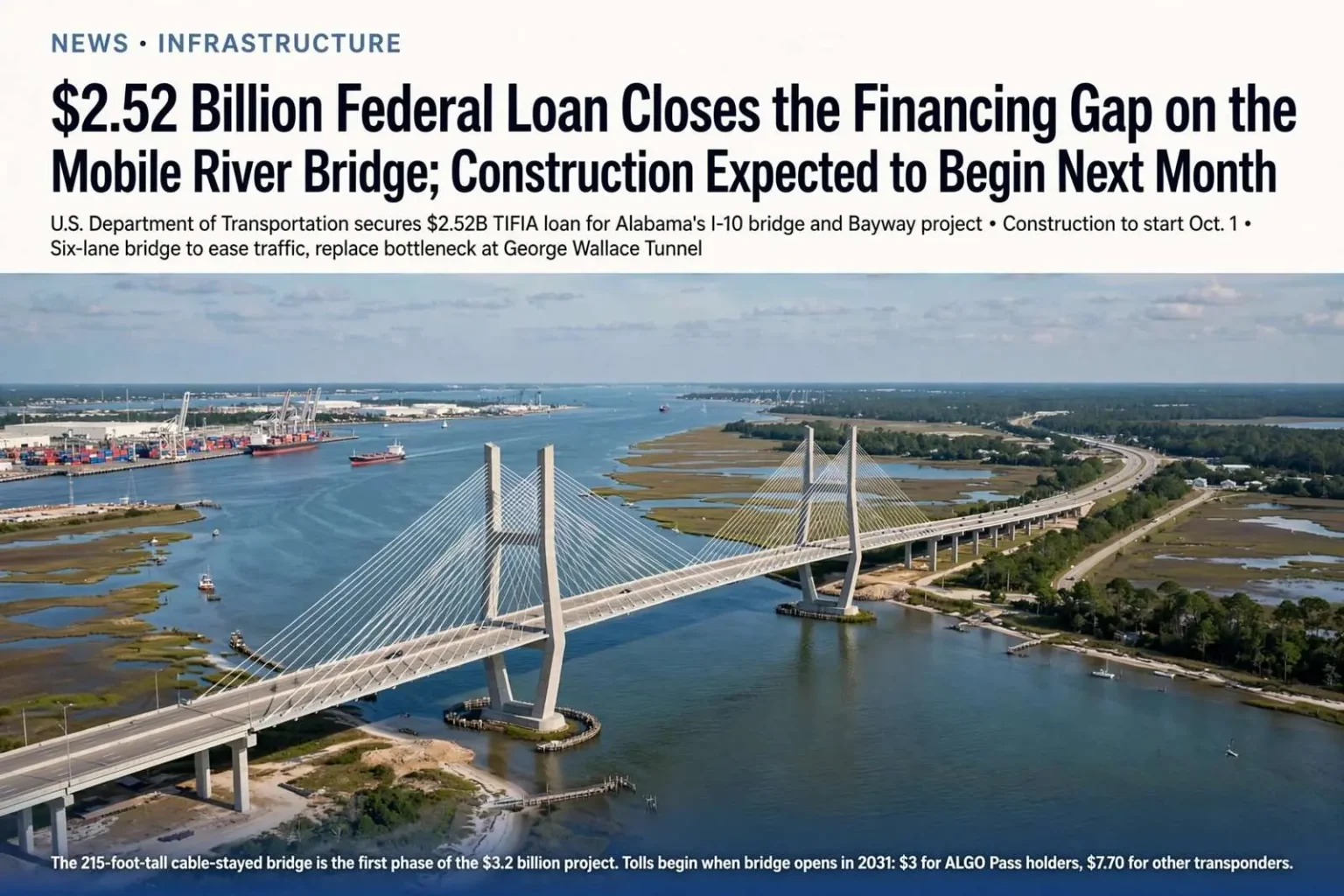
WASHINGTON — A newly secured $2.52 billion federal loan will help kickstart construction of the Mobile River Bridge, closing out the final chapter in a years-long effort to finance the massive infrastructure project.
The U.S. Department of Transportation announced Friday that Alabama will receive up to $2.52 billion in a Transportation Infrastructure Finance and Innovation Act loan through the Build America Bureau for the I-10 bridge and Bayway project.
Transportation Secretary Sean P. Duffy said the Mobile River Bridge and Bayway project will ease traffic congestion, boost freight flow, and enhance safety for drivers.
What Gets Built
Construction on the first phase, a six-lane cable-stayed bridge, is expected to start next month, the Alabama Department of Transportation said in July. The state will also restripe the existing 7.5-mile Bayway to make six lanes.
The new six-lane cable-stayed span will stand 215 feet tall over the Mobile River and is expected to eliminate the notorious bottleneck at the George Wallace Tunnel. The first phase, financed through the TIFIA loan, is expected to take about five years and focuses primarily on building the bridge.
How the $3.2 Billion Was Assembled
The TIFIA loan is the final funding piece to unlock the first phase of construction for the $3.2 billion project. Additional financing has come from:
- A $125 million Infrastructure for Rebuilding America (INFRA) grant
- A $550 million federal Bridge Investment Program grant
- At least $250 million in state funding
The structure of that package is worth understanding, because the largest component is not a grant. A TIFIA loan is credit assistance — federal money that must be repaid, at favorable terms, from a dedicated revenue stream. That is why the toll structure is inseparable from the financing.
Tolls Begin When the Bridge Opens
Drivers will not have to pay tolls until the new bridge is complete, likely in 2031. The tolls will help the Alabama Toll Road, Bridge, and Tunnel Authority pay off the $2.52 billion federal loan.
Toll fees will depend on the driver. Those with an ALGO Pass will pay $3 per trip, while those with interoperable transponders will pay $7.70.
The causeway, Wallace Tunnel, Bankhead Tunnel and the Africatown Bridge will remain toll-free routes.
The preservation of toll-free alternatives has been a central issue throughout the project’s long public debate, and it remains the answer to the question most frequently raised by residents who cross the bay daily.
A First-in-the-Nation Pilot
The Trump administration allowed Alabama in July to become the first state to implement the Interstate System Reconstruction and Rehabilitation Pilot Program, which will allow it to collect tolls on the interstate for reconstruction and rehabilitation purposes.
That authorization was necessary because federal law has generally prohibited tolling existing Interstate highway lanes. Without it, the revenue stream backing the TIFIA loan would not exist in its current form.
What State Officials Said
Gov. Kay Ivey said the project will bring monumental improvements for travel along the Gulf and lead to greater commerce across the region.
Ivey said this advancement marks the final piece needed for the decades-awaited Mobile River Bridge and Bayway project, and once completed, the project will finally alleviate traffic gridlock across Mobile Bay.
U.S. Sen. Tommy Tuberville, R-Ala., who credited President Donald Trump for speeding up the process, said the Mobile River Bridge will be a game-changer for the Gulf, helping ease traffic congestion and expand freight access to the Port.
The Political History of the Funding
One part of the project’s financing, the $550 million grant, was originally awarded under the Biden administration in 2024 as part of the 2021 Infrastructure Investment and Jobs Act.
Other than U.S. Rep. Terri Sewell, D-Birmingham, all of Alabama’s congressional delegation voted against the 2021 Bipartisan Infrastructure Law.
Why the Project Has Taken Decades
The Mobile River Bridge and Bayway project has been under discussion in various forms for decades, and its difficulty has always been financial rather than engineering. The Wallace Tunnel and the Bayway carry Interstate 10 across Mobile Bay, and both are capacity-constrained and vulnerable — the tunnel to height restrictions that force trucks onto surface routes, and the Bayway to storm surge.
A previous financing plan built around higher tolls collapsed in 2019 after substantial public opposition. The current package, which combines two federal grants, state funds and a repayable federal loan against a lower toll rate for ALGO Pass holders, is the product of that history.
The 2031 completion estimate means drivers crossing Mobile Bay should expect roughly five years of construction activity before the new span opens.
Update: Toll Rates, the Borrower and the Second Phase
Additional details have emerged about the structure of the loan and the tolling plan that will repay it.
The borrower is the Alabama Toll Road, Bridge and Tunnel Authority, which will receive up to $2.52 billion through the TIFIA program. The Alabama Department of Transportation will construct and manage the project.
What Drivers Will Pay
The loan will be repaid through tolling, with one-way trips costing as much as $7.70. Frequent users will receive a discounted one-way rate of $3.
A monthly unlimited-use Bayway pass will cost $60 — up from the $40 monthly rate proposed under the 2021 plan. That $20 increase is a notable change for daily commuters between Mobile and Baldwin counties, for whom the monthly pass is the relevant number rather than the per-trip maximum.
Current plans call for tolls to begin only after the new Mobile River Bridge opens, projected around 2031. Existing routes — the Wallace Tunnel, the Bankhead Tunnel, the Causeway and the Africatown Bridge — would remain toll-free.
What Phase One Includes
Beyond the new six-lane cable-stayed bridge, Phase One covers improvements to major interchanges and traffic flow on both sides of Mobile Bay, reconstruction of approximately one mile of the existing Bayway, and restriping the full 7.5-mile Bayway from two lanes to three in each direction.
The Bayway restriping will extend from the bridge to the U.S. 98/90 interchange in Daphne. ALDOT and the Eastern Shore Metropolitan Planning Organization are separately pursuing a $44 million project to widen Interstate 10 from that point to the Alabama 181 interchange.
The new span is described by USDOT as eliminating the state’s primary bottleneck. Hazardous-material trucks are prohibited from using the George Wallace Tunnel, which opened in 1973, forcing hundreds of trucks each day onto alternate routes through Mobile. The new bridge will give those vehicles a direct interstate crossing. USDOT says the improvements could cut travel times by as much as 30 minutes while strengthening hurricane evacuation capacity.
Phase Two
The second phase, which does not yet have a cost estimate, calls for demolishing the existing Bayway and replacing it with a new interstate structure. Rather than replacing the entire Bayway immediately, ALDOT’s revised approach adds capacity to the existing structure during Phase One, with a completely new Bayway planned for Phase Two as additional funding becomes available and as future toll revenue accrues.
The revised two-phase approach was unveiled in July after overall costs exceeded $5 billion. More than a decade ago, the project carried an estimated price tag of $800 million.
The Officials on the Record
Build America Bureau Executive Director Morteza Farajian said the financing will finally help deliver a long-awaited, generational infrastructure project that will vastly improve traffic congestion, strengthen the supply chain network, and make travel safer for everyone.
ALDOT Director John Cooper, who has spent years advancing the project and its financing plan, said the Mobile River Bridge and Bayway project is the largest, most complex road project in Alabama history and one of the largest of its type in the nation. He added that strong partnerships at the federal, state, and local level have brought the project to this point, and he is thrilled to see it become a reality and benefit Alabamians for generations to come.
Gov. Kay Ivey said the TIFIA loan approval marks the final piece needed to move the project forward, and once completed, the project will finally alleviate traffic gridlock across Mobile Bay.
U.S. Sen. Katie Britt called the I-10 corridor a lifeline for the state, connecting the Port of Mobile, shipbuilders, military assets, workers, and businesses across Alabama’s Gulf Coast. U.S. Sen. Tommy Tuberville called the project a game-changer for the Gulf, saying the expansion will relieve traffic, enhance safety, and expand freight access to the Port.
U.S. Rep. Barry Moore, whose 1st Congressional District includes Mobile and Baldwin counties, said the project has been a top priority for him since he took office.
A Partisan Dispute Over Credit
The announcement has become a point of political contention. USDOT’s news release did not mention previous federal grants awarded to the project — funding that has become a subject of partisan debate.
Much of the project’s federal support came in 2024, including a $550 million grant awarded through the Infrastructure Investment and Jobs Act. The project has also received $250 million from the state and $125 million through a federal grant secured by former U.S. Sen. Richard Shelby in 2019.
Democratic lawmakers have argued that Alabama Republicans should acknowledge the role of the Bipartisan Infrastructure Law, which all members of Alabama’s Republican congressional delegation opposed. Republicans have argued that the restructuring of the project and its financing plan is what made construction possible, crediting the Interstate System Reconstruction and Rehabilitation Pilot Program, which permits tolling on interstate reconstruction projects.
Tuberville, who is running for governor against Democrat Doug Jones in the Nov. 3 election, voted against the federal infrastructure law five years ago.
A Long Road to This Point
The project has loomed over Gov. Ivey’s tenure. It became a source of frustration in 2019 when a previous public-private partnership proposal collapsed amid public opposition, and Ivey declared that version of the project “dead” after the Eastern Shore MPO voted to remove it from its transportation plans. Seven years later, the current toll plan has drawn nothing approaching the same backlash. A subsequent proposal that placed much of the toll burden on commercial trucks was later abandoned.
Update: ‘We’re Getting a Bridge,’ Mobile Mayor Says
Mobile Mayor Spiro Cheriogotis celebrated the $2.5 billion Transportation Infrastructure Finance and Innovation Act (TIFIA) loan announced by U.S. Transportation Secretary Sean Duffy, which goes to the Alabama Toll Road, Bridge and Tunnel Authority to fund the largest infrastructure project in state history.
Cheriogotis said they are getting a bridge, thanking the many people who have worked for years to make it a reality. He thanked the White House, Senators Katie Britt and Tommy Tuberville, U.S. Representatives Barry Moore and Shomari Figures, the Alabama Department of Transportation, Gov. Kay Ivey, and federal, state, and local partners for helping reach this point.
The mayor said the bridge will improve commerce by eliminating the bottleneck at the George Wallace Tunnel, enhance hurricane evacuations, and expand traffic capacity between Mobile and Baldwin counties. He added that this is a truly exciting day for the City of Mobile and the entire region, and he cannot wait to see the bridge when it’s built.
Initial Toll Rates
- ALGO Pass: $3 per trip, or a $60 monthly pass
- Out-of-state toll transponder: $7.70 per trip
- No transponder: $15.40 per trip, with the option to open an ALGO Pass account and pay the lower rate
- Commercial vehicles without a transponder: up to $121.10
Financing documents show those rates are scheduled to rise annually during the first decade of tolling.
Work Begins October 1
In a Friday afternoon announcement, ALDOT said it expects to authorize construction crews to begin work on the six-lane cable bridge over the Mobile River on Thursday, Oct. 1. The new span will connect to the existing Bayway, and ALDOT expects the bridge to open to traffic in five years. The borrowed federal funds will cover the bridge’s construction, interchange improvements on both sides of Mobile Bay and re-striping the existing Bayway into three lanes in both directions, all part of the project’s first phase. The new six-lane I-10 Bayway will be built at a later date in the second phase, with tolls collected from the bridge funding that construction. Tolling will not begin until the bridge is complete.
Update: Fuller Statements From Federal, State and Congressional Leaders (Sept. 22, 2026)
Additional remarks from the officials who announced and welcomed the loan offer more detail on how each framed the financing. The loan is the first TIFIA loan for ALDOT and the Alabama Toll Road, Bridge and Tunnel Authority, according to the Build America Bureau.
Transportation Secretary Sean Duffy tied the loan to the administration’s infrastructure agenda, saying that after decades of delay, this historic investment into Alabama is another example of how President Trump is delivering big, beautiful infrastructure projects that will transform communities for the better.
Build America Bureau Executive Director Morteza Farajian described the loan as a way to save public money, saying the Bureau is proud to help usher in the Golden Age of Transportation and partner with ALDOT and the Authority for their first TIFIA loan. He added that by utilizing the TIFIA credit program, Alabama is embracing an innovative approach that saves taxpayer dollars and gets good projects built faster.
Gov. Kay Ivey opened her statement by crediting the White House, saying President Trump and Secretary Duffy are once again proving the administration is dedicated to making generational change across the country, and this major infrastructure investment in Alabama’s Gulf Coast will make monumental improvements for travel and commerce across the region. She closed by thanking the Trump Administration for investing in the state and saying Alabama is proud to be part of the Golden Age of Transportation.
ALDOT Director John Cooper also thanked federal partners, saying he wants to thank the Trump Administration and the U.S. Department of Transportation for their collaboration and assistance with the project, which has been instrumental to its success.
Congressional Delegation
U.S. Sen. Katie Britt said the loan cleared the final hurdle for the bridge. She said that for decades, families, commuters, and local businesses have waited for this bridge, and today they have cleared the final hurdle to make it a reality, noting she has fought for the project since her first days in the Senate. She thanked President Trump, Secretary Duffy, and White House Chief of Staff Susie Wiles, and said the investment will mitigate ongoing safety concerns, strengthen hurricane evacuation routes, and keep the economy moving for generations to come.
U.S. Sen. Tommy Tuberville drew a contrast with the prior administration, saying that ever since he got to Washington, he has been hearing from Alabamians about the urgent need to expand the Mobile bridge. He said that for four years, Joe Biden sat on his hands, but thankfully, President Trump and Secretary Duffy are taking action.
U.S. Rep. Barry Moore called the announcement a long-awaited milestone, saying today marks a milestone many Alabamians have waited decades to see. He expressed appreciation to President Trump, Secretary Duffy, Susie Wiles, the Alabama delegation, and state and local partners for working to make the project a reality, adding that the investment will improve travel across the region and strengthen the Gulf Coast for generations to come.
The TIFIA loan builds on earlier support for the project, including the $550 million federal grant awarded under the Infrastructure Investment and Jobs Act during the Biden administration, $250 million in state funding and a $125 million federal grant secured in 2019 by former U.S. Sen. Richard Shelby.
Related coverage from South AL News
- Mobile River Bridge Groundbreaking Launches Long-Awaited I-10 Bayway Project After Decades of Delay
- ALDOT: Construction on $3.2 Billion I-10 Bridge Project Could Begin Before Halloween
- Toll Authority Approves $3.2 Billion Mobile River Bridge Financing, Sets $3 Toll
- Shovels Go In Friday: Ivey Clears Mobile River Bridge Construction as Baldwin Commuters Count Down to Relief