ALDOT Eyes $3 to $6 Toll Range for New Mobile River Bridge Project
ALDOT says it is studying a $3 to $6 toll range for the full 10-mile Mobile River Bridge, Bayway and Wallace Tunnel corridor, with collections set to begin once construction wraps and continue for roughly 50 years.
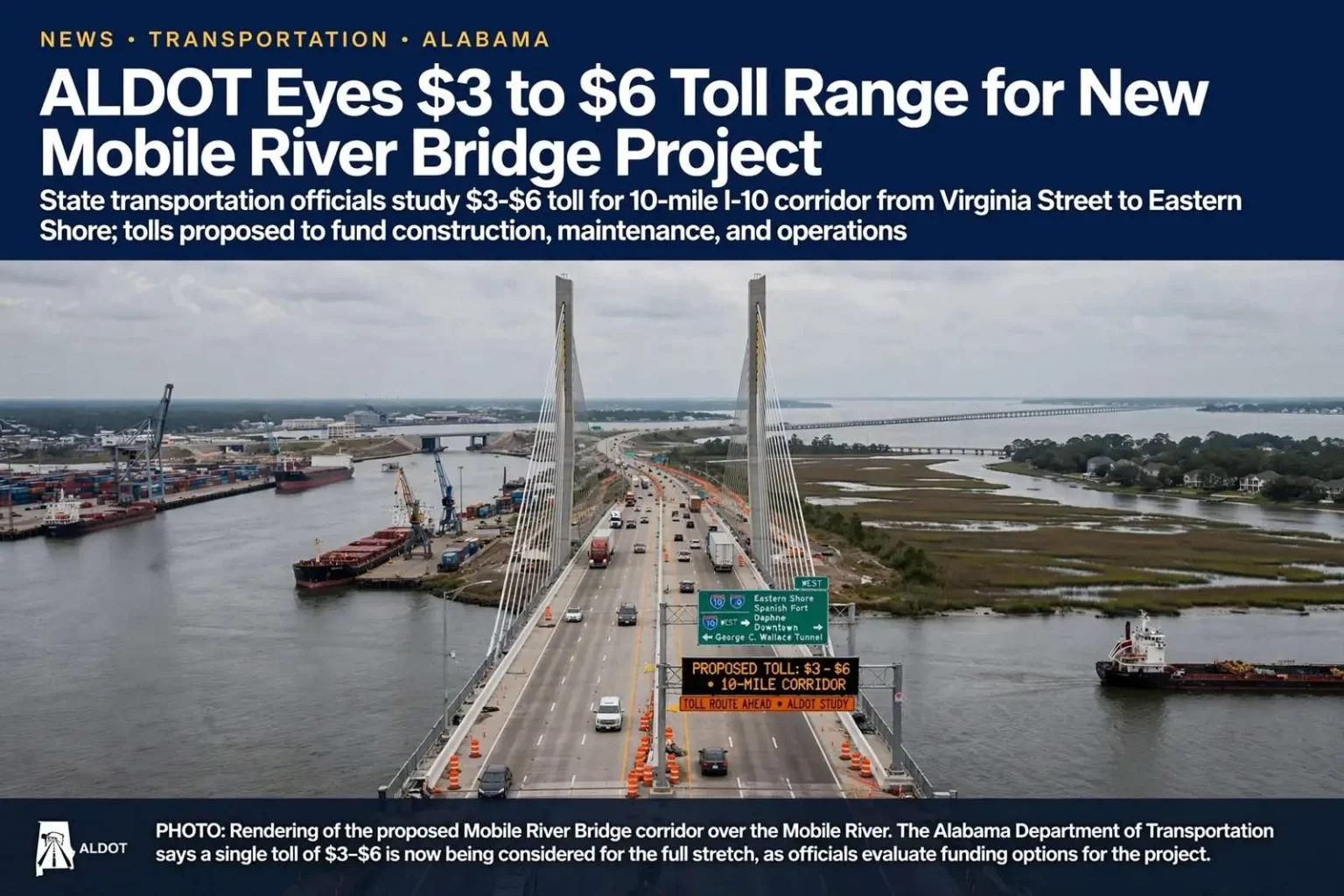
Drivers who use the future Mobile River Bridge, the Bayway and the George C. Wallace Tunnel could pay somewhere between $3 and $6 to cross the full 10-mile stretch, according to a state transportation spokeswoman who confirmed the pricing range is now being studied in detail. The figure is the clearest sign yet of what crossing Mobile’s riverfront will cost once the long-planned project becomes reality, and it gives commuters and freight haulers on both sides of the bay a concrete number to weigh against their daily routes.
The Alabama Department of Transportation has said publicly since last summer that tolls would help pay for the massive project, but agency spokeswoman Allison Gregg said officials have now narrowed in on specific figures for the entire corridor. “We’re studying a $3 to $6 tolling range for use of the entire alignment,” Gregg said. “That’s from Virginia Street through to the Eastern Shore on I-10.”
The boundaries she described take in the most congested segment of interstate in the region — the stretch of I-10 that funnels traffic off the Mobile River Bridge, through the Bankhead and Wallace tunnel corridors and across the Bayway into Spanish Fort and the rest of the Eastern Shore. Anyone who has sat in the daily bottleneck around the tunnels knows the geography: a handful of lanes channeling traffic that swells every morning and afternoon as commuters, beach traffic and freight trucks converge on the same narrow crossing.
One toll, one corridor
The toll would apply to the full length of the project rather than being broken into smaller segments, Gregg said, because of the scope of construction involved from one end to the other. “It’s an expensive 10 miles of bridge,” she said. “That includes everything from the start, including the approaches to the bridge all the way through the Bayway.”
Charging a single toll across the alignment, rather than piecemeal fees at separate points, simplifies the payment experience for drivers and gives the financing plan a cleaner foundation. A segmented approach would have required multiple collection points, complicated enforcement and made it harder to predict the revenue stream that backers of the project count on. With one toll covering the corridor, drivers will pay once per crossing whether they use the full distance or a portion of it.
ALDOT has been consulting with tolling specialists and professionals who have worked on comparable bridge and highway projects elsewhere as it settles on a final pricing structure, according to Gregg. “We’re looking at the cost to design, build, operate and maintain the project,” she said. “Those are the factors that go into tolling, as well as traffic rates.”
The reference to traffic rates is a nod to the delicate balance every tolling authority strikes: set the price too low and the project struggles to cover its debts, set it too high and drivers divert to free alternatives, undercutting the revenue the tolls are meant to generate. In Mobile’s case, the free alternatives — the old tunnel crossings and the surface streets that feed them — are exactly the routes officials hope a new bridge will relieve, making the pricing study one of the most consequential pieces of the planning effort.
A user-funded model
Officials have framed the toll as a user-funded approach to paying down the cost of construction, rather than relying solely on general transportation revenue. “The people who use the alignment will pay for it,” Gregg said. “It’s pay-as-you-go.”
The framing reflects a broader reality in transportation funding. Fuel taxes — the traditional engine of highway finance — have not kept pace with construction costs, and a megaproject on the scale of the Mobile River Bridge carries a price tag that conventional funding sources alone cannot cover. By charging those who drive the new crossing, the state shifts the burden to the direct beneficiaries of the improved route while sparing residents who never use it. Tolling also spreads the cost across the decades in which the road delivers its benefits, so future users help pay for the infrastructure they inherit rather than forcing today’s taxpayers to carry the whole load upfront.
A timeline already stretched
The project has already seen its timeline pushed back once, after a federally required environmental review process took longer than ALDOT initially anticipated. Environmental review under the National Environmental Policy Act requires the agency to document the project’s impacts on traffic patterns, neighborhoods, wetlands and historic resources — no small task for a crossing that touches a working port, downtown streets and the Mobile River itself. The delay pushed back every downstream step, including the selection of the private partner who will help finance and operate the facility.
The environmental document also shapes more than the schedule. Federal review examined reasonable alternatives for relieving the I-10 bottleneck — improvements to existing crossings, new routing concepts and combinations of the two — and the record it produced is the foundation on which the project’s federal approvals rest. A longer-than-expected review means those findings are more recent and, the agency hopes, more durable against legal challenge, which matters for a project whose financing depends on construction starting on time.
As a result, the agency has not yet selected a concessionaire from among three finalist teams competing for the contract. Under the public-private partnership model ALDOT has pursued, the concessionaire helps arrange financing for construction and then operates and maintains the tolling system over the life of the agreement, in exchange for a share of the toll revenue. The three finalist teams bring experience from toll roads and bridges around the country, and their bids are evaluated on financing strength, technical approach and the tolling plan each proposes.
Once a concessionaire is chosen, ALDOT will sign a 55-year concession agreement that will govern the bridge’s operation long after the ribbon-cutting. Such agreements spell out who collects the tolls, how maintenance is handled, what happens if revenue falls short and what protections drivers have against arbitrary rate hikes. The length of the term reflects the scale of the investment: a partnership that spans more than half a century gives the private partner time to recoup its financing while transferring the day-to-day operational risk away from the state.
What it means for drivers
For the hundreds of thousands of residents who move between Mobile and the Eastern Shore every week, the toll range is the beginning of a longer conversation about daily budgets and commuting choices. A $3 crossing each way adds up quickly for a worker commuting from Daphne or Spanish Fort to a downtown job, and for the trucking companies that move freight through the port, the per-trip cost becomes a line item that may eventually show up in shipping rates. At the upper end of the studied range, a $6 toll would rival the per-crossing charges on some of the most heavily tolled urban corridors in the country.
Drivers will also want to watch how the final plan treats electronic tolling and discounts. Modern toll facilities on new bridge projects typically collect payment electronically, with no toll booths, reading transponders and license plates as vehicles pass at highway speed. Many agencies pair that setup with frequent-user discounts, resident programs or lower off-peak rates, and the details ALDOT and its eventual concessionaire work out will shape how much the range’s top end actually touches the average commuter’s wallet.
There is also the question of what happens to the existing crossings. The Wallace and Bankhead tunnels and the old Bayway lanes are expected to remain open and toll-free once the new bridge is up, giving drivers a slower but unpaid alternative. That arrangement is precisely why ALDOT must price the new crossing carefully: too high a toll sends traffic back into the tunnels, recreating the congestion the bridge was designed to cure and starving the project of the revenue that pays for it.
The road ahead
With the tolling study underway and the concessionaire decision pending, the next milestones in the project’s life are largely financial and contractual rather than physical. Construction on the bridge itself — with its signature cable-stayed span rising over the Mobile River — comes after the teams and the money are locked in. Until then, the $3-to-$6 range stands as the public’s best guide to what the crossing will cost, and as the number around which commuters, businesses and elected officials will continue to debate the project’s merits.
What is clear from ALDOT’s position is that the toll is not an afterthought but the financial backbone of the plan. The people who use the 10-mile alignment, from Virginia Street to the Eastern Shore, will be the ones who pay it off — one crossing, and one toll, at a time.