ALDOT Chief Defends Mobile River Bridge Toll Plan as Pricing Details Emerge
ALDOT Director John Cooper is defending a proposed tolling plan for the Mobile River Bridge and Bayway, including a $6 one-way charge and discounted commuter passes, as the agency also announced a $150 million federal grant for the project.
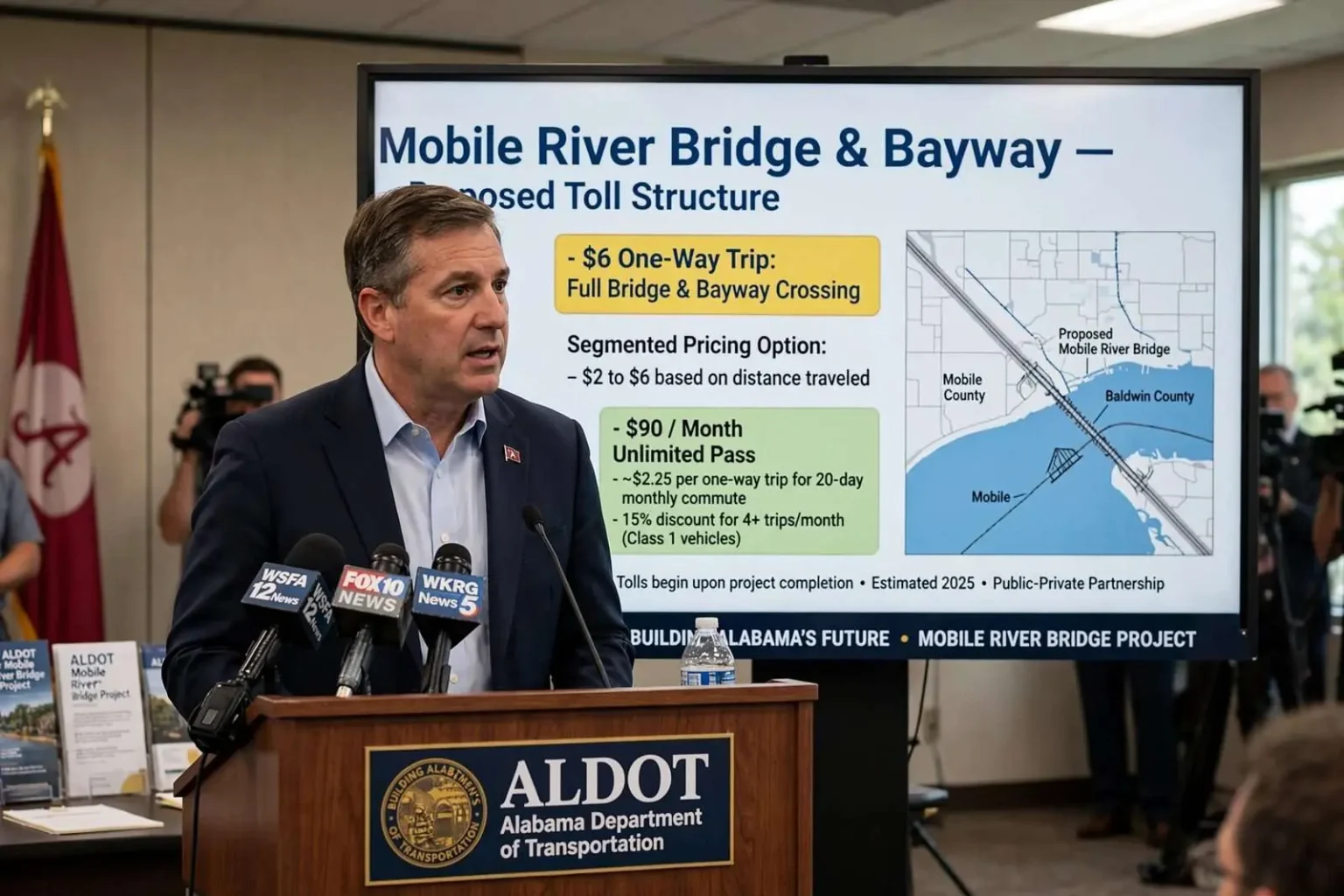
Alabama Department of Transportation Director John Cooper is pushing back against mounting public opposition to tolls on the future Mobile River Bridge and Bayway, laying out for the first time the pricing structure drivers could face once the long-planned crossing opens. At a briefing for reporters, ALDOT officials outlined a proposed toll of $6 for a one-way trip across the full length of the new bridge and bayway.
Mobile River Bridge Project Director Edwin Perry also presented a segmented pricing option, with tolls ranging from $2 to $6 depending on how much of the route a driver actually uses. Perry said frequent commuters would have another option: a $90-per-month unlimited crossing pass.
For someone driving to and from work roughly 20 days a month, he said, that plan works out to an average of about $2.25 per one-way trip. Drivers who sign up for the monthly pass would need to obtain a transponder, which ALDOT plans to make available before construction wraps up.
The agency is also proposing a 15 percent discount for drivers who use the bridge more than four times a month but not often enough to justify the unlimited pass. That discount would be limited to Class 1 vehicles — cars, pickup trucks, minivans, SUVs and motorcycles — and would not apply to any vehicle towing a trailer.
In a one-on-one interview, Cooper defended the discount structure, arguing that many regular commuters will cross more than 40 times a month, which would bring their average cost down to roughly $1.70 per trip. “That’s less than a gallon of gasoline,” Cooper said. “I would argue you could use more than a gallon of gas waiting in congestion.”
ALDOT says the pricing plan reflects delays drivers already experience at the current Mobile River crossing. Agency data shows 132 crashes occurred during peak travel periods over the past year, producing delays of up to 75 minutes.
Separately, 161 congestion-related slowdowns caused delays of about 30 minutes each. Taken together, ALDOT estimates drivers face roughly a 33 percent chance of a congestion delay and a 25 percent chance of a crash-related delay on any given trip through the area.
Cooper argued the toll should be weighed against those costs in time, fuel and safety. “Would you like to be able to leave home 20 minutes later?” Cooper asked. “Would you like a safer crossing 40 to 50 times per month without trucks all around you? I don’t know how to value these things. People will value it differently.”
The bridge and bayway project is structured as a public-private partnership, the first of its kind for roadways in Alabama, according to Cooper. ALDOT looked to similar toll-funded projects in Florida and Texas as it designed the arrangement.
Under the plan, a private development team would help finance, build and operate the crossing under a concession contract lasting 50 years, with tolls permitted to increase over that span. The exact profit margin for the winning team has not been set and will be determined once formal bids are submitted, Cooper said.
“They will give us a bid on what they can invest and what they will require us to invest,” Cooper said. Cooper said the state does not have another realistic path to fund the project without private investment or tolls.
Even issuing state bonds to cover construction and repaying them through a smaller toll isn’t feasible, he said, given the scale of the undertaking relative to ALDOT’s other obligations statewide. “We are not prepared to assume that much risk on a single project in the state,” Cooper said. “There are a lot of different projects statewide.”
Perry said tolling would not begin until the project nears completion, which ALDOT expects around 2025. He noted that traffic volumes across Mobile Bay are projected to grow by roughly 20,000 vehicles per day over the next 20 years.
Without the new crossing, Perry said, that growth means drivers on the existing routes could eventually face congestion as bad as today’s peak summer travel — every day of the year. Cooper said that scenario would far outweigh any losses from drivers who choose to avoid the toll altogether.
“We believe a significant portion of people will use the new bridge,” he said. “People will see the toll as a value.”
The briefing came just after ALDOT learned it had been awarded $150 million in federal INFRA grant funding for the roughly $2 billion project — a considerably smaller sum than the agency had originally sought.
ALDOT had first requested $500 million from the competitive federal program, then scaled its ask back to $250 million after being turned down. The $150 million award, while welcome, covers only about 6 percent of the project’s projected cost.
U.S. Rep. Bradley Byrne, who joined other members of Alabama’s congressional delegation in lobbying U.S. Transportation Secretary Elaine Chao for the funding, celebrated the grant award in a statement.
“This is outstanding news for the people of Southwest Alabama! Fighting for federal funding for this bridge has been one of my top priorities in Congress, and I am glad the Trump administration has come through with this grant award,” Byrne said. “I am very appreciative of the help from our entire Alabama congressional delegation, especially Senator Richard Shelby.”
Perry said additional federal funding, if secured down the line, could still lower the eventual toll rates by increasing the public share of the project’s financing. But he was clear that some level of tolling will remain part of the plan regardless of how much outside funding materializes.
The proposed bridge and bayway upgrade has long been discussed as a way to relieve chronic congestion at the Wallace Tunnel, improve hurricane evacuation capacity and support growth on both sides of Mobile Bay. As ALDOT moves toward finalizing its financing plan, the toll structure is expected to remain a central point of debate among residents and elected officials on both sides of the bay.
What Happened Next
The George Wallace Tunnel, which carries Interstate 10 under the Mobile River, opened in February 1973, and the I-10 Bayway across Mobile Bay followed in 1978.
The toll plan outlined at this briefing did not survive the summer. In August 2019, the Eastern Shore Metropolitan Planning Organization voted to remove the bridge and Bayway project from its transportation improvement plan, and Gov. Kay Ivey declared the project dead.