ALDOT Says Rising Costs Are Complicating I-10 Bridge and Bayway Cost Estimates
ALDOT says rising material costs and supply chain issues are complicating efforts to finalize price estimates for the Mobile River Bridge and Bayway project, even as the agency targets a June 1 deadline for a formal funding proposal.
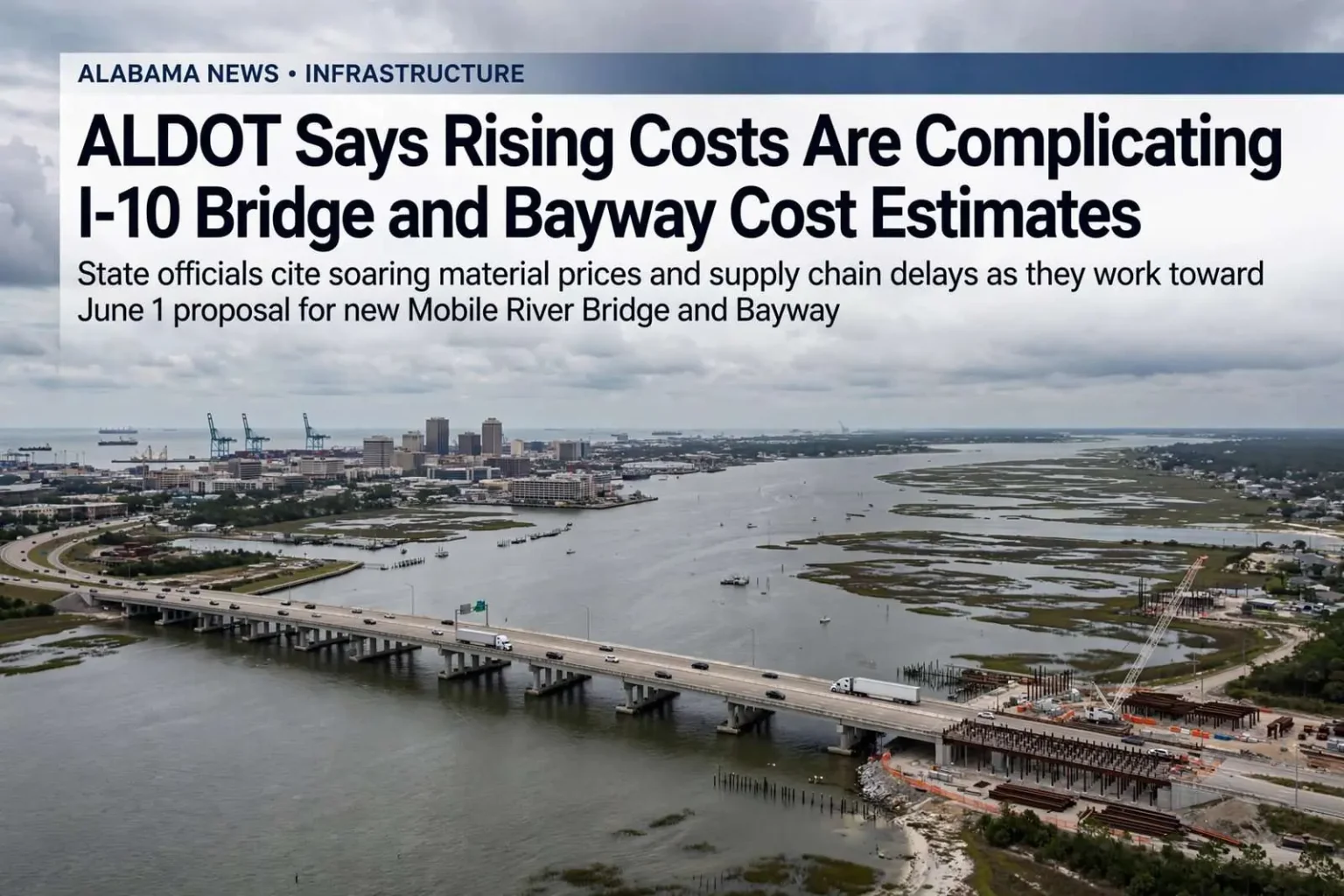
State transportation officials say they are making headway on planning for a new Interstate 10 bridge over the Mobile River and a rebuilt Bayway across Mobile Bay, but soaring material prices and supply chain problems are making it harder to pin down a final price tag for the long-awaited project. In a joint update issued this week, the Alabama Department of Transportation and the region’s two metropolitan planning organizations said market volatility and construction cost increases are slowing the process of finalizing estimates, even as the underlying planning work continues to move forward.
The difficulty is familiar to every large transportation agency in the country. Steel, concrete, asphalt and lumber have all climbed sharply in price, and long-lead items — structural steel, specialized equipment, the components of a cable-stayed or tied-arch span — can sit months in a supply chain before delivery. A project estimated one year ago and built three years later can carry a number that has moved by hundreds of millions of dollars, which is precisely the problem ALDOT faces as it tries to give the region a figure it can finance.
A decade of starts and stops
The project has been studied for more than a decade and has gone through several different funding proposals. A $2.1 billion toll-based financing plan collapsed in 2019 amid strong public backlash over toll costs, after the Eastern Shore Metropolitan Planning Organization voted to remove the project from its long-range transportation plans.
Local officials have since worked through multiple alternative proposals, and in December 2021 sent ALDOT a formal framework outlining the terms under which the region would support moving forward again. The framework was the product of months of negotiation between the two MPOs — the bodies through which Mobile and Baldwin County local governments formally bless major road projects — and it set conditions designed to answer the objections that killed the 2019 plan.
Under the current concept, ALDOT would build the project in a single phase, constructing a new six-lane bridge over the Mobile River along with a new six-lane Bayway spanning Mobile Bay. Tolls on the new lanes would be capped at $2.50 per passenger vehicle, while existing routes, including the Causeway, the George C. Wallace Tunnel, the Bankhead Tunnel and the Cochrane-Africatown Bridge, would remain toll-free. The toll-free guarantee addressed the most persistent complaint from 2019 — that commuters who avoided the tolls would flood the older free crossings, which cannot carry the added load.
The framework also calls for the state to contribute at least $250 million toward the project, on top of $125 million in federal funding already committed. Officials say any additional state or federal dollars that become available would go toward paying down project debt more quickly, which would in turn shorten the length of time tolls would need to remain in place. That linkage — every new dollar shortening the toll era — was written into the framework deliberately, so that public money buys down the burden rather than expanding the project’s scope.
Despite the cost uncertainty, ALDOT says it is aiming to deliver a formal proposal to local officials by June 1. ALDOT Chief Engineer Edward N. Austin said in a written message to the MPOs that the agency is hopeful, based on conversations with outside financial experts and federal partners, that a draft plan will be ready for review by that date, if not sooner.
Austin said that once a draft is complete, ALDOT intends to sit down with each MPO to walk through construction details, updated cost estimates, financing options and the potential for additional state or federal funding. He said the goal is to build a plan consistent with the framework local officials approved in December.
The sequencing matters. A draft delivered by June 1 gives the two MPO boards — whose votes proved decisive in 2019 — the summer to review cost, tolling and traffic assumptions before any formal endorsement is requested. ALDOT’s pledge to walk through the numbers with each body separately acknowledges that the Mobile and Eastern Shore boards have distinct constituencies: one answers to a city that lives with tunnel congestion daily, the other to the Baldwin County communities whose commuters bear the Bayway’s traffic.
Under that framework, toll revenue collected on the new bridge and Bayway would be used strictly to pay down the cost of building the project and would end once the debt is retired. ALDOT has also said the completed infrastructure would be owned and operated by the State of Alabama, with no private concessionaire involved in financing or operating the toll system, and that construction is expected to take about five years once it begins.
Public ownership was itself one of the framework’s negotiating outcomes. Private toll concessions — in which an investor finances a road in exchange for decades of toll revenue — have been used elsewhere in the country but drew resistance in Alabama, where officials concluded that keeping the asset and the toll stream in state hands would preserve public control over rates and the schedule for retiring the debt.
Local leaders weigh in
Mobile MPO Chairman and Mobile Mayor Sandy Stimpson said he was encouraged that the process is advancing, even as inflation and rising material costs complicate the numbers. He noted that Mobile is not alone in facing those pressures, since the same economic conditions are affecting infrastructure projects across the country.
Eastern Shore MPO Chairman Jack Burrell said local officials want to see a plan that both sides can stand behind, emphasizing that decision-makers need confidence not just in the design of the project but in the region’s ability to pay for it over the long term given its size and cost.
The two chairmen’s remarks framed the test ahead of the June proposal. Stimpson’s point — that cost inflation is national — defends ALDOT against the charge that rising estimates reflect poor planning, while Burrell’s point — that both boards need confidence in the financing — sets the standard the proposal must clear. A project of this size cannot be approved twice on faith; after the 2019 collapse, both boards have said in advance what they intend to examine.
The Mobile River Bridge and Bayway project has long been considered one of the most significant infrastructure undertakings facing the Mobile and Baldwin County region, aimed at easing chronic congestion on the existing Bayway and through the downtown Mobile tunnels.
The congestion problem is structural. Interstate 10 is the principal east-west freight corridor of the Gulf Coast, connecting Florida’s panhandle, Baldwin County’s fast-growing suburbs, the Port of Mobile and the Mississippi state line, and every through truck and beach-bound tourist funnels into the same two-lane tunnels under downtown Mobile. The George C. Wallace and Bankhead tunnels carry traffic built for a different era, and a single stalled vehicle in either bore can back up I-10 for miles on both sides of the bay.
The existing Bayway — the elevated crossing of Mobile Bay — carries the same load, and its bottleneck geometry means the crossing routinely slows to a crawl during summer weekends and daily rush hours alike. Planners have long treated a new crossing as the only way to add capacity to a corridor that cannot be widened in place without demolishing blocks of downtown.
Local leaders and ALDOT are expected to continue exchanging updates on cost estimates and financing details in the coming months as the agency works toward its self-imposed June deadline.
If the draft holds together, the region would move from a decade of studies to a construction timeline measured in years: roughly five years of building once work begins, with the new lanes open and tolls running to retire the debt. The June 1 proposal is the next gate — the moment when the decade’s arguments over tolls, tunnels and toll-free tunnels are either answered with numbers both counties accept, or reopened once more.
What the June proposal will have to reconcile is the tension between the project’s fixed scope and its moving cost. The six-lane bridge and six-lane Bayway cannot be quietly downsized without reopening the framework itself, so if materials and labor push the estimate upward, the options narrow to additional funding, higher initial toll revenue assumptions, or a longer toll period — each of which the region’s officials have already shown they will scrutinize.
The $2.50 cap on tolls for passenger vehicles, the toll-free status of the Causeway and the downtown tunnels, the state’s $250 million floor and the $125 million already committed from Washington give the draft a defined box to work within. What remains open — the final price, the debt structure, and how quickly tolls retire the borrowing — is exactly what Austin’s meetings with the MPOs are meant to settle.
Regional officials have described the framework as a contract of expectations: ALDOT delivers a plan the boards can defend, and the boards in turn deliver the votes that put the project into the long-range plans and the federal process. Whether that exchange produces a groundbreaking schedule by summer is the question the coming weeks of cost-estimate exchange will answer.