ALDOT Reviews Bids From Four Groups Vying to Build Mobile River Bridge
Four teams of firms have submitted qualifications to design, build and finance the proposed Mobile River Bridge, keeping alive a timeline that could see construction begin in 2019.
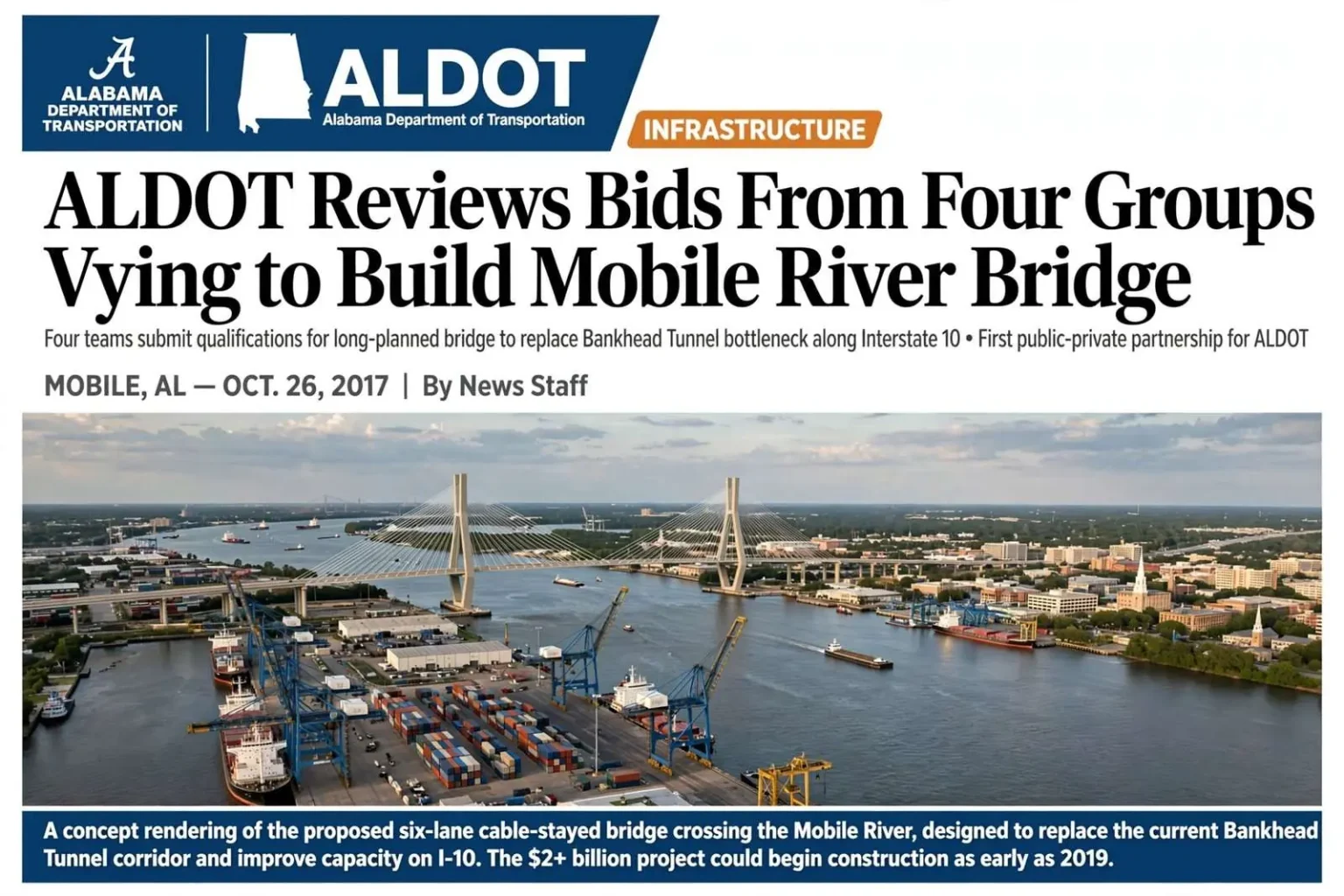
The Alabama Department of Transportation has received statements of qualifications from four teams of firms interested in designing, building and financing a new bridge across the Mobile River, a milestone in a project that has been discussed for more than a decade.
The four submissions signal that the long-planned Mobile River Bridge and Bayway project, which would replace the aging Bankhead Tunnel corridor’s traffic bottleneck along Interstate 10, has drawn serious national and international interest from firms capable of financing major infrastructure work.
Mike Lee, chairman of the Build the I-10 Bridge Coalition, said the response from ALDOT means the project remains on a timeline that could see construction begin as early as 2019. “It’s what we’ve been working toward,” Lee said. “There’s a timetable now.”
ALDOT Mobile Division spokeswoman Allison Gregg confirmed the agency is moving along a similar schedule, though she cautioned it is still too early to say exactly what construction might look like by 2019. Gregg said the strength of the response was not something ALDOT could take for granted when the project was first announced, given how few firms in the country are equipped to take on a project of this scale.
“In the big picture for these projects … so few firms can come together and deliver it,” Gregg said. “To have four different groups of firms come forward is really exciting.”
Why the bottleneck matters to Mobile
The problem the project addresses is familiar to anyone who has driven through Mobile at the wrong hour. Interstate 10 funnels cross-country traffic onto a corridor that must squeeze through the Bankhead Tunnel, a four-lane structure cut beneath the Mobile River that cannot be widened and backs up daily as freight from the port region mixes with commuter and beach traffic heading toward the Eastern Shore. For Baldwin County commuters, the crossing is the difference between a manageable drive and an hour lost; for the trucking industry, it is a choke point on one of the nation’s most important east-west freight routes.
A new bridge would allow Interstate 10 to clear the river above it rather than beneath it, adding capacity that the tunnels physically cannot provide. The Bankhead and George Wallace tunnels were built for a Mobile far smaller than the one that now depends on them, and no amount of repaving or ramp reconfiguration can manufacture the lanes the corridor lacks.
Tolls on the table
Each of the four groups has also been asked to propose financing options for the bridge, addressing a funding gap that has long complicated the project. One option under serious consideration is charging tolls to drivers who use the new span.
“We’re looking at tolls,” Gregg said. “We’re studying it right now to determine how much a toll would be.”
Gregg said tolls would shift more of the cost onto drivers using the bridge, including tourists passing through the area. ALDOT plans to keep the Bankhead Tunnel open as a free alternative route, she said, while the Wallace Tunnel would carry a toll.
The free-versus-tolled split is a design choice with daily consequences. Keeping the Bankhead Tunnel toll-free gives budget-conscious drivers and local residents a no-cost crossing, while the tolled route — the new span and the Wallace Tunnel — would carry the traffic willing to pay for the faster trip. Toll rates had not been set, and ALDOT’s study of how much a toll would be was still underway; the number ultimately chosen would shape not just revenue but how traffic distributes between the tolled and free crossings.
Tourist traffic gives the financing question a seasonal dimension. The corridor funnels vacationers from I-10 toward Florida’s beaches, and a toll on the crossing would collect from many drivers who contribute nothing else to Alabama’s roads budget — one of the arguments tolling advocates make — while critics counter that it taxes the same route Mobile area residents depend on every day.
A public-private partnership, ALDOT’s first
Structuring the project as ALDOT’s first public-private partnership could also open the door to federal funding that would ease the financial burden on both the private developers and future travelers, according to Lee. Lee said that during a meeting in Washington, D.C. last year, the coalition and other project backers were told to return with a concrete plan, after which the Federal Highway Administration might be able to help identify funding. He said the coalition and ALDOT now have that plan in hand.
“This public-private partnership gives us a way to get federal help,” Lee said.
The P3 model pairs a public agency with private teams that design, build and often finance a project, then recoup their investment through tolls or availability payments over a contract term measured in decades. For a project the size of the Mobile River Bridge — one of the largest single undertakings ALDOT has contemplated — the model offers something traditional appropriations cannot: a private consortium’s balance sheet standing between the state and the full cost of construction on day one.
Grant funding remains a possibility as well. Gregg said ALDOT recently applied for a grant through the U.S. Department of Transportation to help cover project costs.
What the project actually includes
According to ALDOT, the proposed project includes three major components: a new, aesthetically designed cable-stayed bridge spanning the Mobile River, replacement of the existing Bayway, and modifications to five interchanges along the corridor.
The Mobile River Bridge itself would be a six-lane structure with a minimum vertical clearance of 215 feet over the river, a height intended to protect the viability of the Port of Mobile’s maritime traffic.
That clearance figure is the project’s quiet concession to the port. A span tall enough for the largest vessels calling at Mobile means no moveable machinery, no channel restrictions and no coordination between ship movements and highway traffic — the same constraint that drove the bridge designs proposed across other port cities. For a port whose cargo volumes have been growing, the height requirement effectively dictates a cable-stayed structure rising high above the river’s working waterfront, and it is why the bridge would become one of the tallest structures on the Gulf Coast.
The rebuilt Bayway would carry eight lanes of travel across 7.5 miles and would be elevated above the 100-year storm surge level. The existing Bayway, the low-lying earthen causeway that carries I-10 across Mobile Bay to the Eastern Shore, floods in major storm events and offers no redundancy when it closes; elevating the replacement above surge levels is intended to keep the region’s primary evacuation and freight route open when it matters most.
The interchange work is meant to ensure safe, efficient access between the interstate and the surrounding local road network. Five interchanges along the corridor would be rebuilt or reconfigured to connect the new elevated alignment with downtown Mobile, the Eastern Shore communities and the local streets that currently absorb much of the tunnel’s spillover traffic.
The road from four teams to one builder
ALDOT will now review the qualification submissions to determine which of the four teams advance to the Request for Proposal stage. Gregg said the agency expects to release both a short list of selected proposers and a draft RFP in early 2018. The formal RFPs are expected to go out by Jan. 1, giving the qualifying teams most of 2018 to prepare detailed responses.
The two-step process is standard for mega-projects of this kind. The statements of qualifications tell ALDOT which teams have the engineering capacity, the financing relationships and the track record to deliver a project measured in billions; the RFP responses are where the real numbers arrive — design proposals, toll and financing structures, and the price a team will commit to. By limiting the RFP stage to a short list, ALDOT concentrates its evaluation effort on teams that can realistically perform.
For the four teams, most of 2018 to prepare detailed responses represents a substantial investment of their own. Assembling a proposal for a P3 mega-project requires engineering firms, contractors, investors and toll operators to align behind a single bid before any contract exists — a commitment that only firms expecting to compete seriously will make.
The timeline ahead
If that timeline holds, construction could begin as early as the first quarter of 2019, Lee said, kicking off what is expected to be roughly a four-year construction window.
A four-year build would mean the region would live with construction alongside the existing tunnels and Bayway through the early 2020s — lane shifts, barge operations, pile driving visible from downtown and the Eastern Shore — before the new crossing opened. The coalition’s decade of advocacy has been aimed at exactly this sequence: a short list, a formal proposal, a signed contract and steel in the water.
Whether every date holds is the open question, and Gregg’s own caution — that it is still too early to say exactly what construction might look like by 2019 — acknowledged as much. Mega-projects of this scale routinely see timelines stretch as financing closes and permits are secured. But for the first time in the project’s long history, there is a competitive field of firms bidding for the work, a federal path to funding and a timetable with dates attached.
For Mobile and Baldwin County residents, the submissions mark the point where the bridge stops being an abstraction discussed for a decade and starts being a project with designs, tolls and a construction window — the stage at which the details begin to affect the daily drive.