

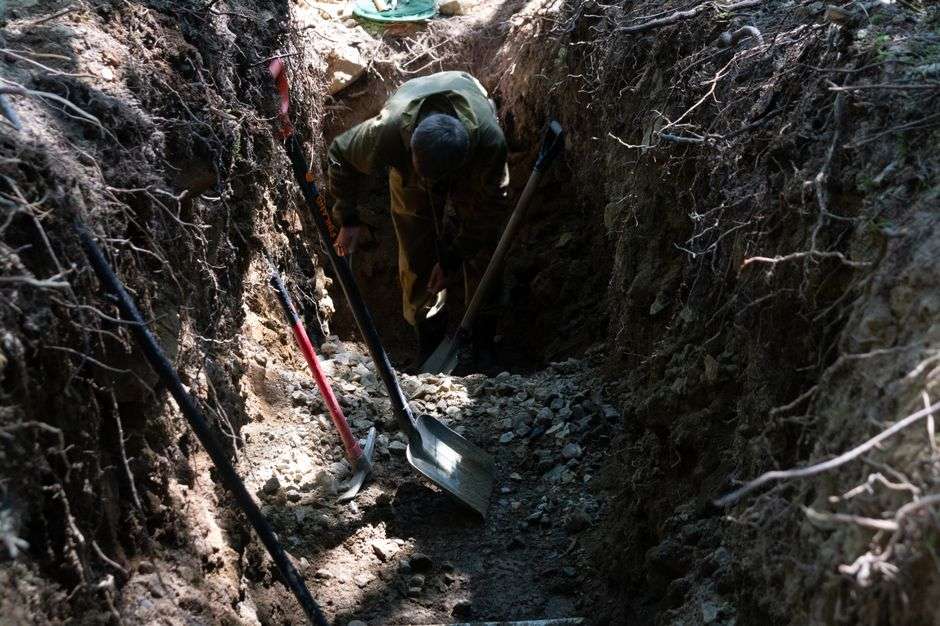
Long before Mobile stood where it does today, French colonists built a fort and a small town on a bluff above the Mobile River, about 27 miles north of the current city. More than three centuries later, archaeologists and student volunteers are still combing through that ground, piecing together the daily lives of the earliest European settlers in what would become Alabama. The work has outlasted plows, industry and the passage of three centuries, and it continues to turn up evidence of a community most Alabamians have never heard of.
The site, known today as Old Mobile, sits on the western bank of the Mobile River on property that also hosts a DuPont agricultural chemical plant. Teams from the University of South Alabama’s Center for Archaeological Studies have worked the location on and off since it was rediscovered in 1989, slowly exposing the footprints of houses that have not seen daylight in more than 300 years. The industrial tenant and the colonial-era dig share the same acreage — an arrangement that works only because access to the site is tightly controlled and excavation is coordinated around the plant’s operations.
Work at the site looks nothing like the swashbuckling image of archaeology popularized by movies. Crews spend long hours on their knees, scraping hard-packed dirt away with small handheld tools in hopes of finding fragments of pottery, tools, or other everyday items the settlers carried with them from France and left behind when they abandoned the site. Progress is measured in inches and fragments: a sherd of French faience, a gunflint, a bead. It is slow, unglamorous labor, and it is the only way a site like this yields its record intact.
Gregory Waselkov, director of the Center for Archaeological Studies, oversees the excavation and controls the limited access to the property. Occasionally, though, a busload of visitors is granted a rare tour of the grounds, including a recent group organized through Historic Blakeley State Park, the preserved battlefield and riverfront park just across the Tensaw delta. Those tours typically begin at 27-Mile Bluff, where the original fort once stood — the name a remnant of the distance markers that once measured travel up the river from Mobile Bay.
A monument at the bluff marks the 200th anniversary of the Old Mobile settlement, and a smaller marker nearby commemorates its 300th anniversary, observed in 2002. Together they bracket the site’s place in local memory: first as a vanished colonial capital, later as an archaeological treasure that survived precisely because everyone else forgot it.
A Colony Built on a Miscalculation
The settlement, once called La Mobile, was anchored by Fort Louis de la Louisiane and founded by French explorers Pierre Le Moyne d’Iberville and Jean-Baptiste Le Moyne de Bienville, the brothers whose expeditions claimed the lower Gulf Coast for France around the turn of the 18th century. Waselkov said the location made sense at the time: it kept the French relatively close to Spanish forces who had settled in Pensacola, and it supported the smuggling trade that was common in the region during that era, when rival colonial powers traded with one another across official lines as readily as they fought.
The bluff itself sat on high ground, which made it seem like a safer bet than another nearby French outpost, Port Dauphin, the low-lying settlement on the barrier island at the mouth of Mobile Bay. But the swampy land just behind the bluff proved to be the settlement’s undoing. Floodwaters did not come in over the high ground facing the river — they crept in from behind, filling the low-lying swamps that backed up toward the settlement.
“So there are swamps back there that back up,” Waselkov said, describing how quickly the surrounding terrain could flood even though the fort itself sat on higher ground. The geography that looked protective from the river turned treacherous from the rear, and the colonists discovered it season after season.
Historical records left behind by the colony’s priest describe just how miserable those conditions could be. According to accounts Waselkov has studied, the priest wrote frustrated letters back to his superiors in Quebec complaining that his house was ankle-deep in water for much of the year. The correspondence is among the documentary threads that let archaeologists connect the physical evidence in the ground to the lived experience of the people who left it.
Mosquitoes made matters worse. Yellow fever outbreaks plagued the settlement, and researchers today still contend with the same insects that tormented the original colonists. Waselkov said modern excavators frequently have to time their digs around dry spells, since the same low ground that flooded the settlers can still leave excavation units waterlogged. Three centuries of drainage engineering downstream have not changed the hydrology of the floodplain itself.
The End of the First Mobile
The settlement’s fate was sealed in the early 1710s. In 1710, an English raiding party captured and burned Port Dauphin, a demonstration of how exposed France’s Gulf holdings were to seaborne attack. The following year, a flood overwhelmed Fort Louis so suddenly that residents had to climb trees to escape rising water, and buildings remained submerged for weeks afterward.
French leaders decided to abandon the site entirely, moving the settlement downriver to the location that would become present-day Mobile, and burning what remained of the fort and houses before they left. The destruction was deliberate: rather than leave usable structures for rivals or renegades, the French torched their own capital as they withdrew. Because the buildings were burned and the land was largely left undisturbed afterward, little physical evidence of the fort itself remains today, Waselkov said. It had been built shallowly out of logs set into thin topsoil, materials that do not preserve well over centuries.
Even so, the site offers archaeologists an advantage rarely found at other early colonial locations. In Mobile and New Orleans, later generations built new structures directly on top of earlier settlement sites, burying and disturbing artifacts in the process. Because the Old Mobile settlement was abandoned outright and never built over, researchers have been able to work with a largely undisturbed record — an entire colonial town preserved in place beneath farmland.
“Because the town moved, we had this amazingly ideal situation where it’s all still here, essentially,” Waselkov said. The comparison with the later Mobile and New Orleans is what makes Old Mobile valuable to scholars beyond Alabama: it is one of the few places where the material culture of a French colonial town on the Gulf frontier can be studied without the complications of three centuries of urban construction above it.
Since excavations began, USA teams have investigated ten different house sites at Old Mobile. Researchers believe as many as 55 individual house sites are scattered across roughly 80 acres of the property, meaning decades of fieldwork likely remain ahead for future generations of students and volunteers. Each newly opened house site adds another household to the community’s ledger — its artifacts mapping trade networks, diet, architecture and the small economies of a frontier settlement that numbered only in the hundreds of people.
The artifacts themselves tell the story of a colony at the far edge of France’s American empire. Pottery imported from France sits alongside goods traded with Native neighbors whose towns lined the Mobile-Tensaw delta — the same peoples the French depended on for food, alliances and intelligence about the interior. Items the settlers carried across the Atlantic, from ceramics to tools, turn up in contexts that show how quickly a colonial household improvised once European supply lines thinned.
The dig has also become a standing field school for the university. Students who work the site learn the full discipline — mapping, cataloging, conservation and the patience to record context before collecting — and several generations of Alabama archaeologists have come out of the trenches at 27-Mile Bluff. That training pipeline is itself part of the site’s legacy: Old Mobile has been studied longer and more systematically than almost any other French colonial site in the region, and the methods refined there now inform work across the Gulf South.
Access remains the limiting factor. The property’s industrial use means research happens in windows negotiated with the plant, and the standing rule is that nothing is collected without documentation and coordination. The arrangement has nevertheless held for more than three decades, allowing the university to return season after season rather than lose the site to a single interruption.
The ongoing work at Old Mobile comes as the state marks its bicentennial, a celebration of Alabama’s 200 years of statehood, attained in 1819. But the settlement predates that milestone by more than a century, offering a reminder that the region’s European colonial history — and the effort to understand it — stretches back well beyond 1819. Before Alabama was a territory or a state, it was the western edge of French Louisiana, and the first capital of that claim sat on a bluff up the river, ankle-deep in water, waiting three centuries to be read.
For South Alabamians, the site is also a physical argument about the region’s identity. Mobile dates its founding to 1702 — the year the French established the settlement now being excavated — making it older by founding than New Orleans and one of the oldest continuously identified communities on the Gulf. The dig at Old Mobile supplies the evidence for that claim, one house site at a time, and the 55 sites believed to remain unexplored guarantee that the story is nowhere near fully told.