Bill Johnson Asks State Prosecutors to Investigate the Governor He Once Served
Gubernatorial candidate Bill Johnson, a former Riley cabinet member, asked Alabama's attorney general and a district attorney to investigate Gov. Bob Riley over contracts, a special session and casino money.
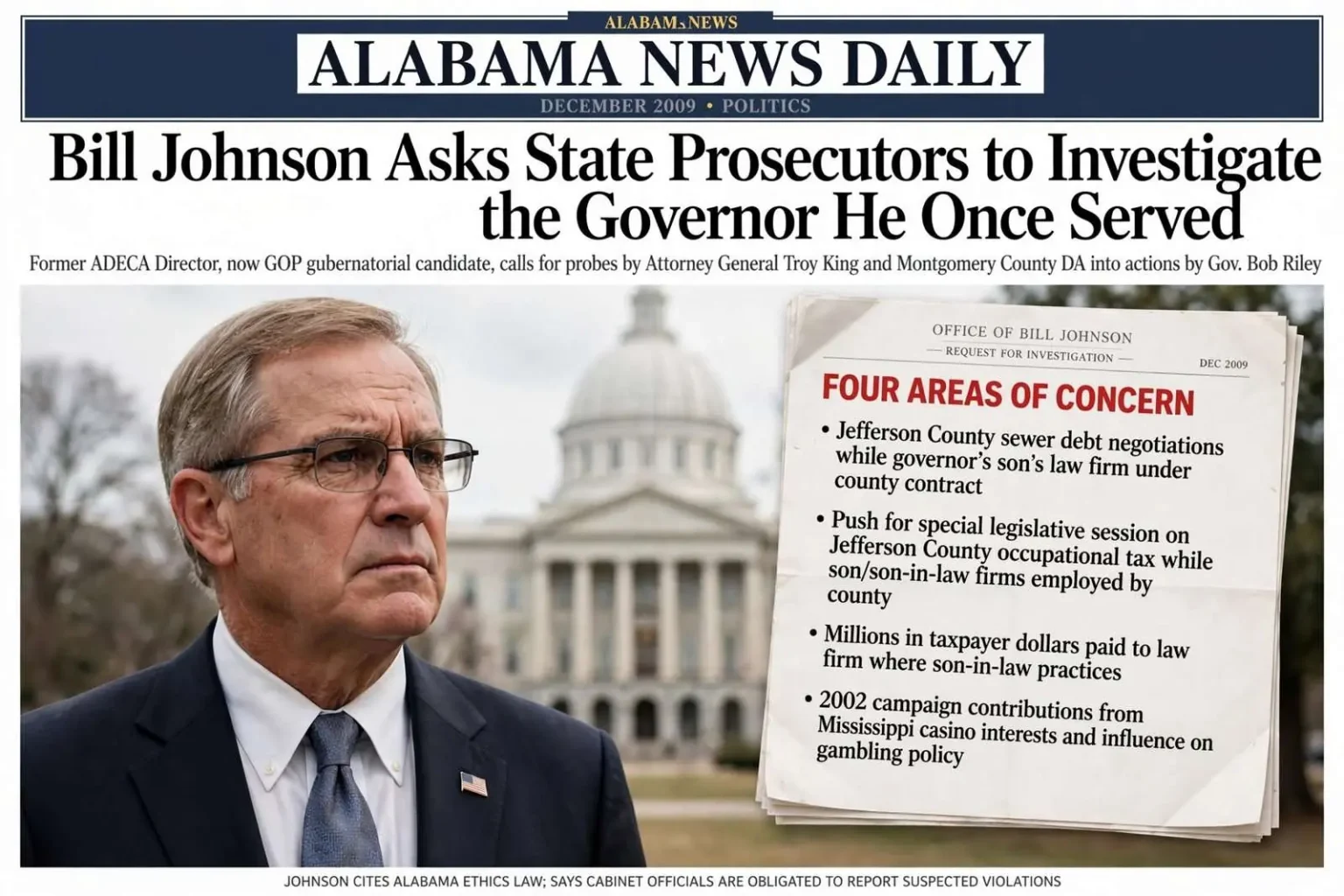
A Republican candidate for governor who once sat in Bob Riley’s cabinet asked Alabama’s attorney general and the district attorney in Montgomery County in December 2009 to open investigations into the governor himself. Bill Johnson, the former director of the Alabama Department of Economic and Community Affairs, announced that he had sent a letter to Attorney General Troy King and Montgomery County District Attorney Ellen Brooks requesting inquiries into what he described as possible violations of law by Riley.
The move was extraordinary on its face: a member of the governor’s own party, and until recently a member of his own administration, formally asking the state’s top prosecutors to examine the state’s chief executive. Johnson, who had resigned his ADECA post to run for governor, had spent years inside the administration directing one of the state’s largest agencies, and he was now converting that insider’s vantage into the central argument of an insurgent campaign.
ADECA, the agency Johnson had led, administers hundreds of millions of dollars in state and federal funds — grants, law enforcement funding, energy programs and community development money — and its director sits in the governor’s cabinet with a window into how the administration’s legal, financial and political decisions are made. Johnson argued that what he had seen from that window obligated him to speak.
Four Areas of Concern
Johnson’s letter identified four specific matters he said warranted examination:
Riley’s service as lead negotiator on the Jefferson County sewer debt while the law firm where his son practices was under contract with Jefferson County.
Riley’s call for a special legislative session to approve a new occupational tax for Jefferson County while the law firms of his son and his son-in-law were employed by the county.
The payment of millions of taxpayer dollars for other state legal matters to the firm where his son-in-law practices.
Contributions to Riley’s 2002 gubernatorial campaign from Mississippi Indian casino owners and their agents, and the influence Johnson said those contributions may have had on public policy in Alabama.
The first three items all turned on the same set of relationships: Riley’s son and son-in-law were both lawyers whose firms did business with Jefferson County at the very moments the governor was steering the county’s crisis, first through the sewer debt negotiations and later through the legislative effort to salvage the county’s collapsed occupational tax. The fourth reached back to the beginning of Riley’s political career, and to a source of money — Mississippi casino interests — whose public policy positions on gambling in Alabama had been a running controversy of the Riley years.
Jefferson County’s sewer debt had grown into the largest municipal finance debacle in American history by the late 2000s, a multibillion-dollar obligation built through a series of complicated interest-rate swaps and refinancings that collapsed as credit markets soured. The county’s finances teetered toward the largest municipal bankruptcy filing in U.S. history, and every attempt to fix the problem — court rulings, legislative proposals, negotiated settlements with Wall Street creditors — passed through the governor’s office.
The Legal Framework He Invoked
Sons and sons-in-law are considered family members under Alabama’s conflict-of-interest law, Johnson noted. That law also requires state cabinet officials to report any matter coming to their attention in an official capacity that constitutes a violation.
The statute Johnson pointed to is among the more demanding in the state’s ethics code: it does not merely forbid officials from voting on matters involving family members’ employers, it affirmatively requires disclosure and reporting. A cabinet director who believes a violation has occurred is, under the letter of the law, supposed to act on that belief — which is how Johnson framed the journey from cabinet room to prosecutor’s letter. His critics could read the same statute and argue it imposed no such duty on a departing cabinet member turned rival candidate; the law required reporting of what an official witnessed, not a campaign-season interpretation of negotiations he had not personally witnessed.
A Former Insider’s Case
Johnson framed his letter as a duty rather than a campaign tactic, pointing to the ethics pledge he signed as a member of the administration.
“I signed the Governor’s ‘Code of Ethics’ pledge in November 2005, stating that I pledged ‘my actions to always reflect first and foremost what is in the best interest of the State of Alabama and her taxpayers,'” he said.
In January 2009, he added, he reported concerns about potential conflicts of interest relating to the Jefferson County sewer negotiations directly to the U.S. attorney’s office for the Northern District of Alabama — nearly a year before his candidacy existed, he noted, and months before the Republican primary field took shape. The federal office, which had jurisdiction over the county’s Wall Street dealings, was the natural venue for the finance questions; the state prosecutors he was now petitioning held jurisdiction over the ethics questions the federal inquiry did not reach.
Johnson also said he had received threatening letters since announcing his candidacy, and he attributed them to his public and private criticism of the governor. “No state official is above the law,” he said. “The people deserve to know whether or not their Governor has violated the law. The next Governor should be someone who is committed to telling the truth no matter how uncomfortable that might make people in power.”
He added that he refused “to be bullied by the cowards who are anonymously threatening me and my family.”
Turning the administration’s own words back on it, Johnson quoted Riley press secretary Todd Stacy, who had said on Nov. 26 that “we hope law enforcement will investigate this, find out who is responsible and prosecute them to the fullest extent of the law.”
The citation was a deliberate piece of political jujitsu. The administration’s statement, issued in connection with the threatening letters Johnson had reported, had called for law enforcement involvement; Johnson’s letter took the administration at its word and supplied a target. If law enforcement investigation was appropriate when an unknown antagonist sent threats, his argument ran, it was equally appropriate when the question involved the conduct of the state’s most powerful officeholder.
Why It Landed Where It Did
The request was aimed at two officials with complicated relationships to the governor’s office. Troy King, the attorney general, had by 2009 broken openly with Riley, most visibly over the enforcement of Alabama’s gambling laws, and was himself facing a primary challenge from Luther Strange with backing from much of the party establishment.
The King-Riley feud had become one of the defining Republican quarrels of the decade. Riley had pressed for aggressive action against electronic bingo operations around the state, while King had insisted the decision belonged to local district attorneys and courts, a dispute that spilled into public letters and rare open warfare between a governor and his own attorney general. Any request for investigation that ran to King therefore carried political freight in both directions: the attorney general had every institutional reason to scrutinize a rival administration, and every political reason to expect accusations of a vendetta if he did. Strange’s primary challenge, meanwhile, gave King a second reason for caution — an investigation of Riley would be read, fairly or not, as a campaign document.
Ellen Brooks, the Montgomery County district attorney, held jurisdiction over conduct in the capital, where the governor’s office sat and where the ethics pledge had been signed. Brooks was one of the longest-serving district attorneys in Alabama, a veteran of prosecutions that reached into state government, and her office had historically been the venue for matters touching Montgomery-based officials. Her reputation for deliberateness made her, in practical terms, the less politicized of the two recipients — and the one whose decision would be watched most closely for its legal rather than political reasoning.
For south Alabama voters, the episode mattered chiefly as a window into the 2010 Republican primary, then shaping up as one of the most crowded and least predictable in memory. Johnson, Bradley Byrne, Tim James and State Treasurer Kay Ivey were all competing for the same conservative electorate, and the Jefferson County sewer crisis — a multibillion-dollar debt debacle that had pushed the state’s largest county to the edge of bankruptcy — had become a byword statewide for what happens when public finance and private interest are allowed to blur.
Each of the candidates was positioning against the establishment in his or her own way — Byrne as the reform-minded former two-year college chancellor, James as the blunt-talking businessman son of a governor, Ivey as the constitutional officer running on her treasury record — and Johnson, the least known of the field, needed an issue that could vault him into the conversation. The letter did that in a single news cycle, forcing every rival to answer a question about Riley’s conduct that none of them had chosen to raise, and forcing the Riley administration to defend itself during a primary season it had hoped to control.
Johnson’s letter, whatever its legal fate, ensured that the question would be asked out loud in a Republican primary rather than left to the federal courthouse in Birmingham. Whether it produced investigations or only headlines, it marked the moment when the sewer crisis ceased to be a Birmingham financial story and became a statewide political one — with a former cabinet insider, citing the administration’s own ethics pledge, as its witness.