Brewton’s Parks, Timber History and Football Rivalry Featured in 2007
A 2007 community tour highlighted Brewton's parks, historic timber-era homes, downtown art and the long-running Battle of Murder Creek football rivalry with East Brewton.
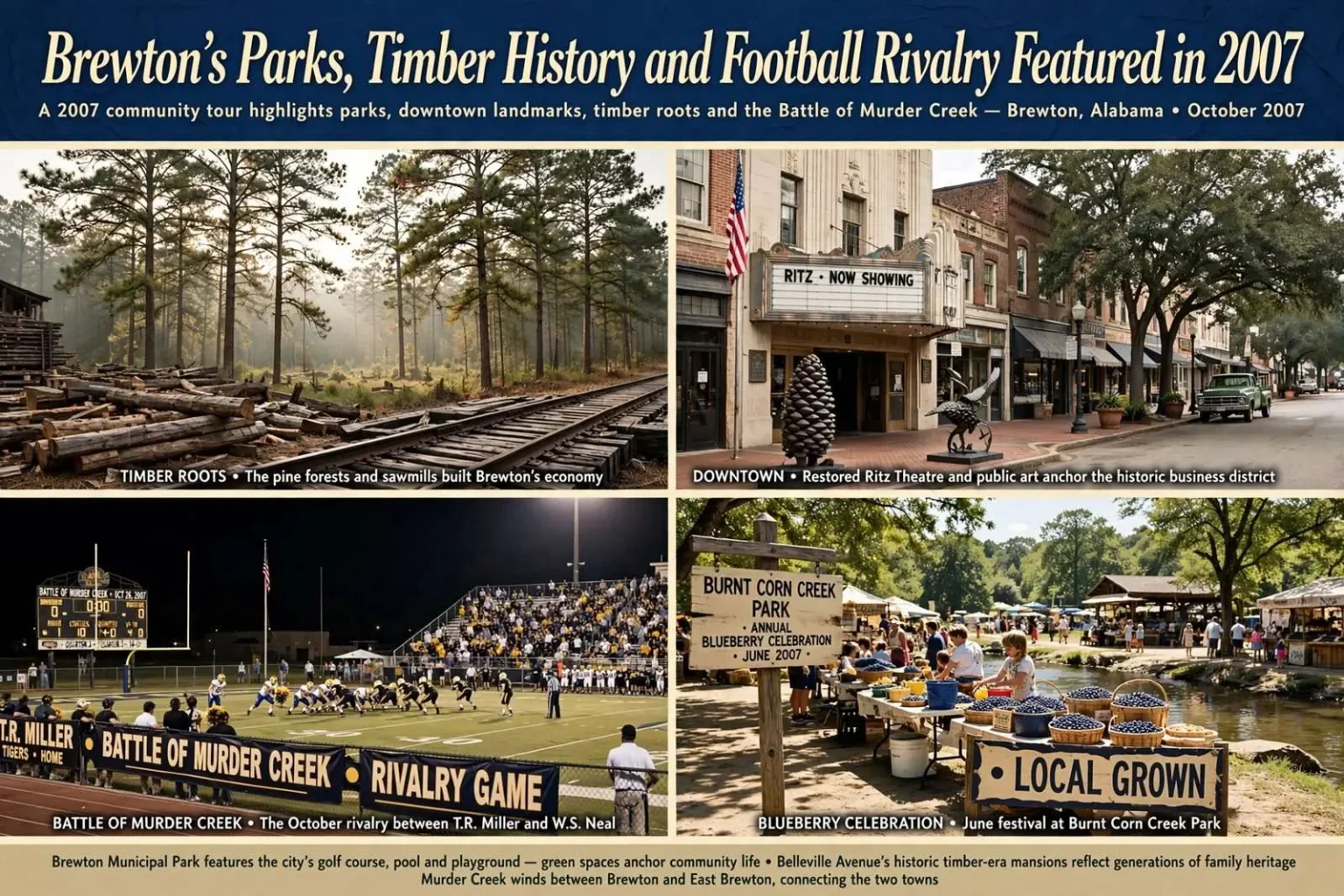
A 2007 community tour of Brewton highlighted the Escambia County city’s parks, downtown landmarks, timber history and celebrated rivalry with neighboring East Brewton, painting a portrait of a south Alabama town whose identity grew out of the pine forests that surround it.
The report pointed to Brewton Municipal Park, with its golf course, pool and playground, as one of the city’s recreational anchors, along with public art downtown and the restored facade of the old Ritz Theatre. For a city of its size, Brewton’s investment in green space and downtown presentation stood out, and the 2007 tour treated the park system as central to how the city saw itself.
Brewton sits in south central Escambia County, where Murder Creek and Burnt Corn Creek wind through terrain of longleaf pine and hardwood bottoms on their way toward the Escambia River. The county line with neighboring Conecuh and Monroe counties lies close by, and the city functions as a commercial hub for a rural stretch of south Alabama that stretches toward the Florida line.
Timber Town and Historic Homes
Brewton grew through the timber business and railroads. The forests of longleaf pine that blanketed south Alabama drew sawmills and the rail lines that served them in the late nineteenth century, and the city became a shipping point for lumber, turpentine and naval stores moving out of the region. Timber remains central to the area’s economy, with the mill and the forests around Brewton supporting generations of families whose work is measured in acres and board feet.
The report described large homes built by lumber barons along Belleville Avenue, some still occupied by descendants of the families who built them. That avenue, shaded and residential, holds a collection of early twentieth-century houses whose scale reflects the wealth the timber trade created, and the fact that many remain in family hands gives Brewton a continuity rare in towns that rose and fell with a single industry.
The city also celebrated a local blueberry crop each June at Burnt Corn Creek Park. South Alabama’s climate and sandy, acidic soils suit blueberries well, and the region’s farms produce a commercial crop alongside backyard patches, giving the early summer festival both its timing and its reason. The annual celebration drew the community to the creek-side park for the fruit that had become a local point of pride.
Battle of Murder Creek
Every October, Brewton’s T.R. Miller and East Brewton’s W.S. Neal played their annual football game, the Battle of Murder Creek. The communities are separated by the stream and united by a strong local rivalry, one of those small-city traditions that outlasts coaching changes, classification shuffles and the passage of decades.
T.R. Miller High School, named for the pioneering Miller family whose timber company shaped the city, carried a football tradition with state championships to its credit, and W.S. Neal brought its own pride across the creek from East Brewton. The October game filled stands on both sides and gave the week its energy, with the name of the contest itself borrowing from the creek that divides, and in the manner of all such rivalries, connects the two towns.
Rivalry games like this one do more than settle scores. They are the annual occasion when alumni return, when the towns’ histories are retold and when two school communities that share a county, a workforce and in many cases a family tree, get one Friday night each year to be adversaries.
Downtown, Parks and the Ritz
Brewton’s downtown preserved the bones of a timber-era commercial center, and the 2007 tour noted the public art placed around the business district alongside the restored Ritz Theatre facade. The Ritz, like the movie houses of countless small Southern towns, once anchored downtown entertainment, and its restoration was part of the city’s effort to keep the historic core alive as retail patterns shifted toward the highway.
The park system carried its own story. Brewton Municipal Park’s golf course, pool and playground made it a daily destination for families, and the city’s habit of building its public life around its creeks and green space reflected the terrain it inherited. Burnt Corn Creek Park, home of the June blueberry celebration, gave the community a second gathering place and a venue for the festivals that mark the south Alabama calendar.
This account records a 2007 community profile and does not represent a current guide to Brewton’s facilities, events or schools.
How Timber Built the Town
The story of Brewton is, in large measure, the story of the pine belt. In the decades after the Civil War, the vast longleaf forests of south Alabama attracted northern and local capital alike, and sawmills rose wherever railroads and rivers met. Brewton’s position on the waterways and on the rail lines that pushed south toward Pensacola’s port made it a natural center for the trade, and by the turn of the twentieth century the city’s economy, its banks and its grandest residences all traced back to lumber.
The men who led that industry put their stamp on the town. Company leaders funded churches, schools and civic institutions, and the mansions along Belleville Avenue announced the prosperity of the trade in the same way that courthouse squares announced county seats. The timber economy’s cycles, booms, wartime demand, the depletion of old-growth stands and the shift to managed pine plantations, shaped the city’s twentieth century, but the industry never left. Forestry, milling and the businesses that serve them remained the backbone of local payrolls, and the Managed Forests that surround Brewton today are the grandchildren of the forests the first mills cut.
Railroading followed the timber and served it, carrying logs in and lumber out, and the lines through Brewton tied the town to Mobile, Montgomery and the ports beyond. Passenger service faded long ago, but freight rail and the traces of the old lines remain part of the landscape the 2007 tour passed through.
Murder Creek and the Lay of the Land
The creek that gives the football rivalry its name runs between Brewton and East Brewton, one of the dark-water streams that drain the piney woods toward the Escambia River and, eventually, Escambia Bay. The creek’s name predates the towns, inherited from the colonial era when the area sat on the edges of Spanish and American frontier, and by the twentieth century the waterway had become less a boundary than a shared landmark, the thing everyone in both communities used to orient themselves.
That geography shaped daily life. East Brewton grew up as its own municipality across the stream, with its own schools, churches and commercial strip, close enough to walk to and distinct enough to sustain a century of friendly separation. The two towns share a newspaper, a workforce and an economy, and their high schools’ annual October meeting is the ritualized expression of a proximity that never quite merges.
Blueberries and the South Alabama Calendar
The June blueberry celebration at Burnt Corn Creek Park fit a wider pattern in south Alabama, where communities build festivals around what their land produces. Blueberries thrive in the region’s acidic soils, and Alabama’s commercial blueberry industry grew substantially in the late twentieth century, with south Alabama farms among the state’s producers. A festival gave local growers a market, gave families a June outing and gave the town one more tradition on the civic calendar alongside the football game and the Christmas events that anchor small-town life.
Festivals like it do quiet work for a community. They give civic clubs their fundraisers, churches their booths and the town’s younger generations a reason to be downtown on a summer morning. The 2007 profile counted the blueberry celebration among the city’s distinguishing events precisely because it was local in a way no imported event could be, grown from an actual crop and an actual park.
A Portrait With a Date on It
The 2007 tour captured Brewton at a moment when its core institutions, the parks, the Ritz facade, the Belleville Avenue homes and the October rivalry, were being consciously maintained rather than merely remembered. Towns that survive the end of an era usually do so by choosing what to keep, and Brewton’s choices were visible in the restored theater, the public art and the festivals that kept the calendar full.
This account records a 2007 community profile and does not represent a current guide to Brewton’s facilities, events or schools.
Schools as the Center of Town Identity
In communities the size of Brewton and East Brewton, the high schools function as the town squares of Friday night, and everything else organizes around them. T.R. Miller’s athletic tradition and W.S. Neal’s own history gave each community a shared identity that cuts across generations, and the annual Battle of Murder Creek concentrated that identity into a single October evening. Band members, cheerleaders, student sections and the alumni who fill the end zones make the game the largest public gathering either town holds most years.
The schools also carry the towns’ histories in their names. Naming a school for T.R. Miller tied the institution to the family whose timber enterprise built so much of the city, a common pattern in mill towns across the South. Generations of families passed through the same classrooms and played on the same fields, and the rivalry’s continuity, game after game across the decades, is what makes an annual football meeting feel like a civic institution rather than a sport.
What the Creeks and Parks Mean Today
The green space the 2007 tour highlighted, the municipal park with its golf course and pool, the creek-side park that hosts the blueberry celebration, represents the side of Brewton that visitors remember. South Alabama towns that invest in parks tend to hold their populations better than those that do not, and the creeks that run through the city, sometimes a flood concern, are also its most distinctive amenity, giving neighborhoods shade, water views and the walks that make a small city feel lived in.
Between the parks, the restored Ritz facade and the downtown public art, the 2007 portrait showed a city curating its own story: timber wealth in the mansions, recreation in the parks, culture in the theater and rivalry on the football field. Every element the tour recorded tied back to the same sources, the pine forests, the creeks and the families who stayed.
This account records a 2007 community profile and does not represent a current guide to Brewton’s facilities, events or schools.