Newcomer Outraises Veteran 10 to 1 in the Special Election for Mobile’s District 7 Council Seat
First-time candidate Rick Collins raised $31,600 to John Peavy's $2,800 in the opening filing period of the 2004 special election for Mobile City Council District 7, left vacant by Stephen Nodine.
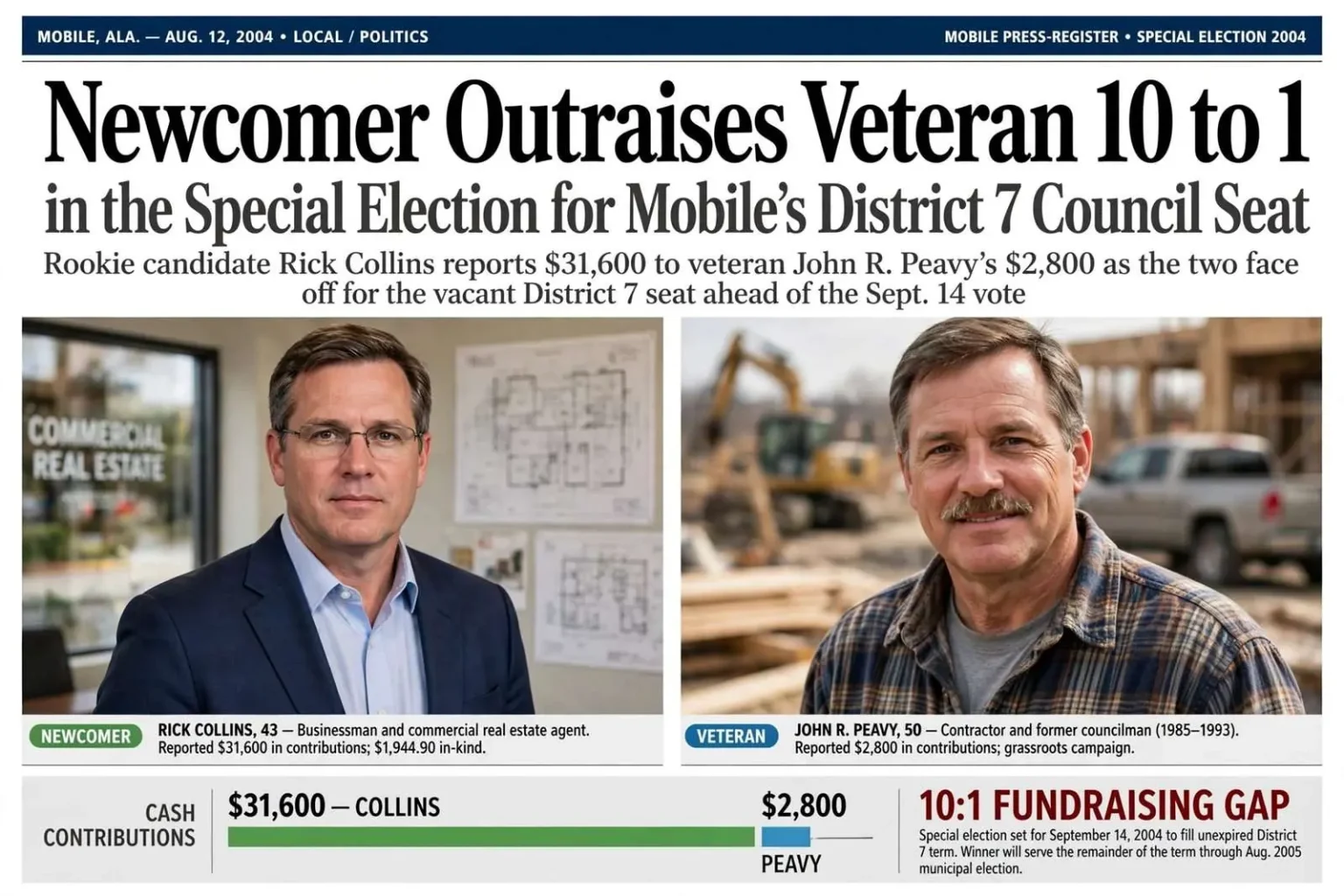
Rookie candidate Rick Collins opened a commanding fundraising lead over political veteran John R. Peavy in the summer of 2004 as the two prepared to meet in a special election for the Mobile City Council’s District 7 seat. Through the first filing period, Collins reported $31,600 in cash contributions and another $1,944.90 in in-kind support. Peavy reported $2,800 — a gap of better than ten to one.
The filings, made public as the campaign entered its final stretch before the September vote, gave the district its first hard look at the shape of the race: a well-connected newcomer with immediate access to the city’s development and business circles against a former councilman running a deliberately low-dollar, door-to-door campaign.
How the seat came open
The special election, set for Sept. 14, 2004, was called to complete the unexpired term of former City Councilman Stephen Nodine, who had won the Republican nomination for Mobile County Commission District 2 and had been appointed to that seat by Gov. Bob Riley. Nodine was set to face Democratic nominee Milton Morrow in the general election that November.
Under state law, a vacancy on the council required a special election when the next regular municipal election was more than a year away. Mobile’s next city elections were scheduled for August 2005 — barely a year out but not close enough to let the seat ride, leaving the council without a District 7 voice for months if no election were called.
The vacancy created an unusual political moment. Nodine’s move from City Hall to the county commission had been in the works since his nomination, but the appointment accelerated everything, and within weeks candidates were lining up for a seat that would only be worth holding for a partial term. Whoever won would inherit a district office midway through the council’s term, with committee assignments already settled and a budget already passed.
The candidates
Rick Collins, 43, was a businessman working in commercial real estate. He was the son of the late Fred Collins, who served for many years as the city’s attorney — a name that carried real recognition in Mobile civic life.
That lineage mattered in a district where politics and property have long been intertwined. Commercial real estate work put Collins in regular contact with the developers, title men and land-use attorneys whose contributions showed up all over his filing, and the family name gave instant credibility with older west Mobile voters who remembered his father’s years in the city’s legal office.
John Peavy, 50, owned a construction company with his brother and had already served two terms as District 7’s council representative, from 1985 to 1993. He chose not to seek re-election in 1993.
His father, the late Tom Peavy, was for many years the city’s engineer and public works director. Between the two families, the ballot in District 7 amounted to a reunion of Mobile municipal government’s institutional memory.
The matchup gave voters a clear contrast in style if not necessarily in substance. Both men came from families with deep roots in city government; both knew the district’s streets and drainage ditches and annexation history. What separated them was the decade Peavy had spent on the council and the quarter-century of fundraising relationships Collins was only now beginning to draw on.
The veteran shrugs at the money gap
Peavy said he was neither surprised nor alarmed by his opponent’s early advantage. “I anticipate the other side out-spending us 2-to-1,” he said. “It doesn’t bother me. Honestly, ours is a grass roots effort. Signs don’t vote. It’s a matter of reaching out to people individually and getting to as many personally as you possibly can.”
Council races, Peavy noted, typically generate contributions in the $100 to $250 range. “He’s getting $500 and $1,000 ones and it adds up pretty quick that way,” he said. “Maybe developers relate to him as a real estate guy. But we’ve had good luck with them also whenever I’ve made a call.”
His read on the district’s mood was generous toward his opponent. “My impression is that people feel fairly comfortable with two honest, decent, well-intentioned people running,” he said. The issues, he said, were the ordinary ones: streets and parks, with some mention of friction among council members.
“They talk about basic things like streets and parks, the things Mr. Nodine did a pretty good job with — I should say a real good job with,” Peavy said. “They want to see a continuation with that, which is on our agenda also.”
The praise for Nodine was more than rhetorical positioning. Nodine had represented the district through a period of rapid growth on Mobile’s western edge, and residents who turned out at civic club meetings in the summer of 2004 talked less about ideology than about drainage, resurfacing and the pace of development along the Schillinger Road corridor. Peavy, who had held the seat during the district’s earlier growth boom, framed his return as continuity with that record.
Inside the filings
Peavy reported $2,800 in itemized cash contributions and no expenditures as of the filing deadline. His donors included James L. and Ann Mason, Airland Corporation, B&B Trucking, Matt Metcalfe and Midway Materials at $500 each, and Charles W. and Cynthia Warner at $300.
The donor list read like the Rolodex of a working contractor: a trucking firm, a materials supplier, individuals tied to the local construction trade. There were no political action committee checks on Peavy’s report, no in-kind support and no spending, a combination that reflected a campaign still assembling itself around its candidate’s personal contacts rather than an organized finance operation.
Collins reported $31,600 in cash and $1,944.90 in in-kind support. He had spent only $1,392.83, leaving $30,207.17 on hand.
RSVP PAC gave $2,500 and MOJO Partnership $2,000. Checks of $1,000 came from W.D. Bolling Jr., Logan Gewin, Pat McAleer and Madge Rody.
Dozens of others arrived in the $250 to $600 range from real estate firms, title companies, law firms, insurance agencies and members of the Collins family. Contributions ranged all the way down to a $25 check — a reminder that even a heavily financed council campaign runs partly on small gifts from neighbors.
The pattern was unmistakable. Collins’s report was built on the professional economy of west Mobile — the people who buy, sell, finance, insure and develop property — supplemented by PAC money from groups active in city races. The in-kind figure meant still more of the campaign’s early costs, from printing to event expenses, were being covered by supporters directly rather than through the committee.
Collins did not immediately return a call seeking comment.
What was at stake
District 7 covers Mobile’s western reaches, the fastest-growing part of the city in that era and the area whose voters had grown most skeptical of the downtown establishment.
The district’s boundaries swept in the subdivisions and commercial strips west of I-65, territory that had been annexed and developed in waves from the 1960s onward and that by 2004 anchored much of the city’s retail growth along Airport Boulevard and Schillinger Road. Its civic associations were among the most organized in the city, quick to turn out on annexation questions, zoning fights and school issues, and candidates ignored them at their peril.
The district also carried a habit of sending to City Hall representatives who emphasized constituent service over citywide ambition. Nodine had fit that mold, keeping a visible office presence and a running list of pothole and drainage complaints even as he built a countywide political profile. Whoever replaced him would be measured against that standard from the first week.
The special election’s timing shaped the race as much as anything. A win in September meant serving only a few months before facing the same voters again in the regular August 2005 municipal election, which meant the special campaign was effectively the opening round of a full campaign rather than a separate contest. Money raised in the summer of 2004 would not be spent down before the next filing period rolled around, giving whoever won the September vote a built-in financial head start for the following summer.
For Peavy, the math made a grass-roots strategy a necessity and a virtue at once: he could not match Collins dollar for dollar, so the campaign had to be won at doors and civic meetings in the weeks before Sept. 14. For Collins, the early cushion allowed a media-heavy race — yard signs, direct mail and advertising — that could introduce him to voters who knew the family name but not the candidate.
Money, signs and the mechanics of a special election
Special elections in Mobile tend to be decided by turnout as much as money, and everyone involved in the District 7 race understood that reality. Without a mayor’s race or countywide contest on the ballot, the Sept. 14 vote drew only the voters with a direct stake in the outcome, which in practice meant the district’s most reliable participants: the retirees, civic association regulars and neighborhood activists who vote in every election the city schedules.
That dynamic favored the kind of campaign Peavy was promising. A grass-roots operation that can identify supporters and deliver them to the polls matters enormously in a low-turnout special, where a few hundred votes can separate the candidates. Yard signs and word of mouth carry disproportionate weight in a race with no television advertising budget to speak of, which is why the veteran’s dismissal of the fundraising gap — signs don’t vote, in his phrasing — was more than bravado.
Collins’s operation, meanwhile, was designed for scale. A warchest built before the first vote is cast gives a campaign the freedom to mail every household in the district, blanket the commercial corridors with signage and run phone banks in the final week, and the filings showed that investment was already banked by midsummer.
The candidates also spent the summer working the same small stages. West Mobile’s civic clubs, church anniversaries and subdivision meetings provided a rolling schedule of appearances through July and August, and both men worked those rooms, answering the same questions about drainage, speeding, annexation and growth that had defined district politics for a generation.
By the last filing period before the vote, the contrast was set: one campaign with more than ten times the money and a plan to spend it, and another with an experienced candidate, a deep personal network and the argument that in District 7, relationships had always outweighed receipts.
Whoever won would serve out Nodine’s term and then, less than a year later, face the voters again in the regular 2005 municipal election — making the September special election as much an audition as a victory.