Creola councilman acquitted after gun-pointing accusation goes to trial
A Creola city councilman has been acquitted of a misdemeanor menacing charge after a Mobile County judge ruled prosecutors failed to prove he pointed a gun at a fellow councilman during a heated dispute last November.
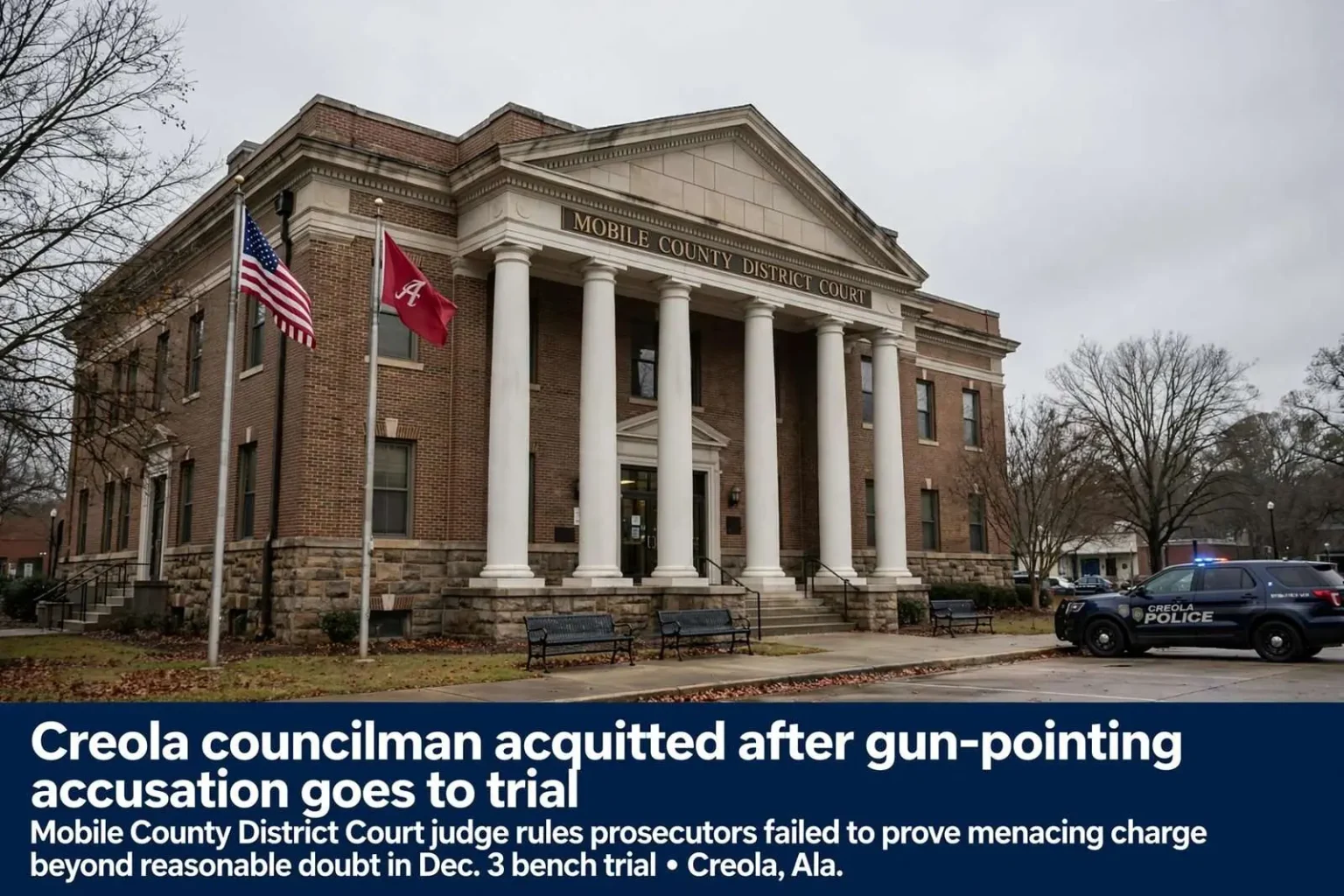
A Creola city councilman has been cleared of a misdemeanor menacing charge stemming from an altercation with a fellow council member outside the Creola Police Department last November, after a Mobile County District Court judge ruled that prosecutors failed to prove their case beyond a reasonable doubt. Councilman Harold Martin was acquitted following a bench trial held Dec. 3, after the state declined to call a man once expected to be a central witness against him. Mobile County District Court Judge Jill Phillips delivered the not-guilty verdict after roughly an hour of testimony, finding that prosecutors had not met their burden of proof.
The charge grew out of a confrontation between Martin and fellow Creola Councilman Ralph Avis Walker on Nov. 30, 2017, outside the police department.
Both men agreed in court that the conversation centered on Martin’s wife, but their accounts diverged sharply from there. Walker testified that Martin, while seated in his truck, pulled a handgun from his pocket and rested it in his lap, pointed in Walker’s direction, while telling him to stop “bullying my wife.” Martin, testifying in his own defense, denied ever touching a gun during the exchange.
He told the court that although he owns firearms, he does not own the nickel-plated .22 caliber pistol Walker described and would not carry such a weapon in his pocket. No physical evidence tying Martin to a weapon was ever introduced at trial, and no security footage from outside the police station was available to corroborate either account.
Creola Police Chief Harold D. Kirkland testified that any camera footage from the day of the incident would have already been recorded over by the time defense attorneys subpoenaed it, and that the cameras likely would not have captured the alleged incident clearly regardless.
Martin’s attorney, Buzz Jordan, argued that Alabama’s legal definition of menacing — requiring a physical action that places or attempts to place another person in fear of imminent serious physical injury — could not be satisfied without stronger evidence than one man’s word against another’s. “I feel very relieved,” Jordan said after the verdict. “[Martin] is committed to the city of Creola as a councilman. He and Mr. Walker were friends, and they haven’t had any incidents before or after. I think everything is going to be fine going forward.”
Under cross-examination by Jordan, Walker gave shifting answers when repeatedly asked how he felt in the moment he says Martin displayed the gun.
At one point he redirected a question back to Assistant District Attorney Beth Stepan, asking, “How would you like for one of your friends to pull a gun on you?”
He later said the incident “made me a little angry,” and at another point told Jordan, “I’m not interested in answering your questions anymore,” prompting Judge Phillips to remind him that as a sworn witness he was required to respond. Walker ultimately testified, “No, I wasn’t scared of Martin,” and said he had continued attending council meetings regularly since the incident occurred.
The case had initially appeared headed toward more direct corroboration. Former Creola Police Sgt. Donald Turberville signed the criminal complaint that led to Martin’s charge and was expected to be a key prosecution witness. He attended the trial but was never called to testify.
Jordan told reporters afterward that he believes prosecutors chose not to put Turberville on the stand because of recent, separate allegations that Turberville had fabricated a report claiming he was fired upon by an unidentified motorist during a Creola traffic stop in the early hours of Nov. 12.
An outside investigation by the Mobile County Sheriff’s Office raised immediate doubts about that account. Turberville initially stood by his story after declining two opportunities to take a polygraph test, but days later acknowledged that events “did not happen the way [he] said” they did.
He resigned from the Creola Police Department shortly afterward. “As those incidents have occurred recently with the [Mobile County Sheriff’s Office] investigation, I think the DAs realized he wouldn’t be a very believable or credible witness,” Jordan said. “So, they did not want to call him.”
Trial testimony also cast doubt on the basis for Turberville’s involvement in the case in the first place. Under Alabama law, an officer generally may only make a misdemeanor arrest for an offense committed in his presence.
Because Turberville signed the sworn complaint against Martin and later told reporters he had witnessed the confrontation, he had long been presumed to be an eyewitness. But Walker testified that Turberville was not actually present at the truck when the alleged gun display occurred, and only learned of it afterward when Walker told him directly.
Walker said he was asked at the time whether he wanted to press charges against Martin and declined. Jordan described the case as one of the more unusual he has handled.
“I’m suspecting that somewhere along the line this has some political background, and we may never be aware of how this came about,” he said. “This whole thing has been strange from the first day, and you’d have to ask Mr. Turberville about that.”
Martin did not take questions from reporters following the verdict. Walker spoke briefly, saying he still “can’t believe” Martin’s alleged conduct that day.
Walker added that he does not intend to let the incident or the trial affect city business, though he said he plans to keep his distance from Martin going forward.
How the Case Was Decided
Under Alabama law, menacing is a Class B misdemeanor. In a bench trial like the one in Mobile County District Court, the judge rather than a jury decides the verdict. Because Martin was acquitted, the verdict is final: the state cannot appeal an acquittal.