Eastern Shore MPO Vote Kills Toll Plan, Gov. Ivey Declares Mobile River Bridge Project Dead
Facing overwhelming public opposition to tolls, the Eastern Shore Metropolitan Planning Organization voted to drop the Mobile River Bridge project from its transportation plan, prompting Gov. Kay Ivey to declare the $2.1 billion project dead.
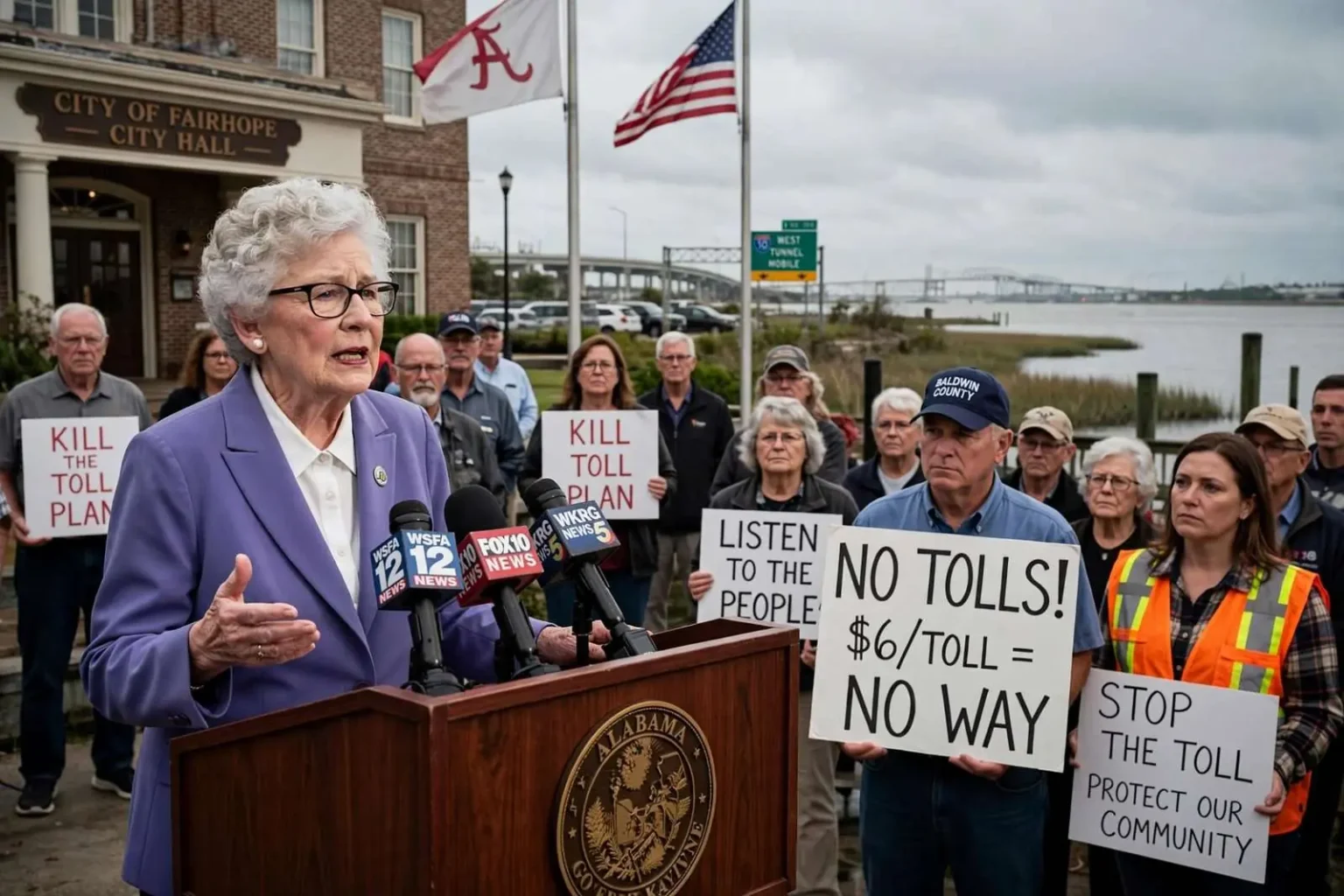
The long-debated plan to add tolls to a new Mobile River Bridge collapsed last week after the Eastern Shore Metropolitan Planning Organization voted to strip the $2.1 billion project from its regional transportation plan, prompting Gov. Kay Ivey to declare within minutes that “this project is dead.”
The ESMPO’s Policy Board reached its decision after nearly three hours of public comment in Fairhope, where more than 30 speakers spoke out against the toll-funded proposal and, according to those in the room, not a single person rose to defend it. The board then voted to remove the bridge and Bayway project from its 2020-2023 Transportation Improvement Plan, a procedural move that effectively cut off the project’s path to federal approval.
Ivey, in a statement issued shortly after the vote, said the ESMPO’s “failure to prioritize” the project left “no pathway forward.” She also canceled an October meeting of the state Toll Road, Bridge and Tunnel Authority that had been expected to weigh funding alternatives for the crossing.
A Two-Decade Push to Ease Interstate 10 Congestion
The project traces back more than two decades, aimed at relieving chronic congestion at the George Wallace Tunnel, where Interstate 10 traffic backs up for miles on peak days. In recent years, Ivey’s administration and the Alabama Department of Transportation had pushed a public-private partnership model that would have handed a private equity firm a 55-year contract to design, build and maintain the bridge in exchange for tolls starting around $6 per car — with terms that critics said could let the firm collect returns worth several times its initial investment.
That financing structure fueled sustained opposition across coastal Alabama, and it showed at Wednesday’s meeting. Eight of the nine ESMPO commissioners — every member except the ALDOT representative on the board — voiced objections to the plan before the panel voted it down.
Policy Board Chairman Dane Haygood, the mayor of Daphne, said he did not set out to kill the project outright but felt he had no other option. “I’m trying to represent all of our citizens and all of our leaders, and we have no choice but to fight to protect ourselves from tolls that are not imposed anywhere else in the state,” he said before casting his vote. “If anything, I’m trying to resuscitate something that is already dead.”
Earlier the same day, Haygood and Mobile Mayor Sandy Stimpson, who chairs Mobile’s separate MPO, each received a letter from Ivey urging them to keep the project on their respective improvement plans. Fairhope City Council President Jack Burrell, an ESMPO member, told those gathered at the meeting that the letter also carried what he called a “veiled threat” — a suggestion that the state might pull back support for other southwest Alabama transportation projects if local boards did not fall in line on the toll plan.
That message did not sit well with members of Baldwin County’s legislative delegation who attended the meeting, including two state senators, three state representatives and two former state senators, all of whom said they were prepared to accept any political fallout from opposing the tolls. “All of us are opposed to this toll,” said state Rep. Chris Pringle, who is also seeking Bradley Byrne’s congressional seat. “Baldwin and Mobile counties are tied together economically, socially and politically, and this toll will tear our community apart. Every person on my construction sites has told me we cannot afford this.”
Local Officials and Lawmakers Speak Out
Speakers cited a range of concerns beyond the toll amount itself, including potential harm to economic development, existing businesses, the medical community, tourism, working-class commuters and students, as well as unease about outside investors controlling a piece of local infrastructure. The timing also struck a nerve, coming as a new state gas tax was about to take effect and two Eastern Shore communities were weighing separate school tax referendums.
Foley resident Chris Allen told the board a toll amounts to another tax and argued the Ivey administration “has proven to be the most untrustworthy of our lifetime,” criticizing the state for waiting until the project’s final stages to address funding after 22 years of planning.
Allen also connected his criticism to ALDOT Director John Cooper directly, arguing that Cooper’s appointment had stripped local communities of meaningful protections and a system of checks and balances over the project. “This project has been 22 years in planning, but nobody ever planned on budgeting money and now it’s an emergency,” he said. “A lack of planning on your part does not constitute an emergency on mine.”
Business Owners and Officials React to the Vote
Mobile’s MPO opted to table its own vote on the project until its next monthly meeting, though the bridge could not move forward without approval from both boards. In a statement following ESMPO’s vote, Stimpson struck a more conciliatory tone toward the governor’s office. “Gov. Ivey asked for more time to find alternatives to the toll model. I believe that, given time, she would have been successful,” he wrote. “Our region is growing, tourism is booming and the city of Mobile is adding jobs like never before. We need new infrastructure to accommodate that growth.”
Baldwin County Commissioner Billie Jo Underwood, who also sits on the ESMPO Policy Board, said she was not willing to accept the toll plan as the only option. “I don’t accept there is no other way to do something,” she said. “Unfortunately as it stands, it is no toll and no bridge. There may be consequences to our vote, but we are willing to stand up to those consequences.”
Matt Erickson, ALDOT’s representative on the ESMPO board, defended the agency’s approach, telling the board “if funding and financing was available to ALDOT, we wouldn’t be sitting here today talking about tolls.” Officials say the state spent decades securing federal highway and environmental approvals before cost projections and financing options came into sharper focus only recently.
The state has already spent close to $60 million on preliminary work for the bridge, including roughly $40 million on alignment studies, engineering and the federal environmental review, and about $19.6 million on right-of-way acquisition. Among those affected was Ralph Atkins, who ran Southern Fish & Oyster at the foot of Eslava Street in downtown Mobile for 52 years before selling the site to ALDOT through the state’s condemnation process. He was paid $675,000 for the 83-year-old business, a sum he believes fell well short of its worth. “They came and took it and then walked away,” Atkins said. “They spend money like it’s unbelievable.” He said he is now considering legal action against the state and is looking at nearby property downtown where he might relocate.
Atkins, 76, said his frustration was less about his own finances than about the people who helped him run the business for decades — a bookkeeper who worked there for 25 years and his son, who spent a decade at the company after finishing college. “I need to get some of it for them,” he said. Despite his anger at the state, Atkins said he actually supported building the bridge and objected only to the tolls, describing the situation as “one of those catch-22 deals” in which “they’re going to get their money” regardless of the outcome. He said he has been looking at property near St. Louis Street in downtown Mobile as a possible new home for the seafood business, though he cautioned any move would hinge entirely on price. “It would have to be a hell of a good deal for us to do it,” he said.
Local attorney Jason Darley, who relocated his law practice away from the proposed bridge corridor in 2018 after years in the same office, called the outcome “politics as usual” and said the project suffered from “poor planning” from the outset, even though the move ultimately worked out for him professionally.
Mobile Area Chamber of Commerce President and CEO Bill Sisson said he remains hopeful a workable plan can still emerge, pointing to worsening traffic congestion and aging infrastructure as drags on business recruitment, tourism and port commerce. “Once the dust settles and clear heads come together, I think we’ll find solutions because we have to,” he said, adding that the chamber wants a seat at the table in any future discussions.
ALDOT spokesperson Tony Harris said it is too early to say what happens next, noting only that the bridge project “can’t move forward after being removed from the Eastern Shore MPO’s Transportation Improvement Program.” U.S. Rep. Bradley Byrne, who is running for the U.S. Senate, said on social media that state officials need to pursue real alternatives that eliminate tolls, shrink the project’s scope or find other funding sources rather than “just say ‘my way or no highway’ and walk away.”
Calls to Remove ALDOT’s Director
State Auditor Jim Zeigler, who has organized an anti-toll Facebook group that has grown to more than 50,000 members, has separately called on Ivey to remove ALDOT Director John Cooper, citing what he described as five failures by the agency, including the money already spent on the stalled project and what he called a loss of public credibility.
In an email sent from his office on Aug. 29, days before the ESMPO vote, Zeigler pressed Ivey to remove Cooper, writing, “We need a taxpayers’ advocate who will listen to the local officials and the public as the next head of ALDOT.”
An Old Idea Resurfaces: A Mobile Bay Ferry
Amid the bridge fallout, officials from Fairhope and Mobile also confirmed they met earlier in the day to discuss a long-dormant idea: passenger ferry service across Mobile Bay linking the two cities. Fairhope Director of Economic and Community Development Jessica Walker described the concept as “super preliminary” but said it could fit naturally with growth on both sides of the bay. “It seems like Mobile is in a renaissance right now, and the downtown area especially is kind of the place to be,” Walker said. “With the city of Fairhope and Baldwin County growing as much as they are growing, it is a natural fit that we would pair together in some way, shape or form to make this a reality. But this is a long game.”
Also involved in the day’s ferry discussions were Mobile officials George Talbot and Paul Wesch, along with Fairhope Councilman Wilson and Richard Johnson. The 2004 feasibility study put hourly operating costs for the ferries at roughly $56 to $241, a range officials said would need to be weighed against ridership projections and available grant funding before any modern ferry proposal could move forward.
Officials involved in the discussion, which included Stimpson and Fairhope representatives, said key questions remain, including whether a ferry would primarily serve tourists or daily commuters, since each use would call for different terminal size, parking and staging needs. Steamboats once carried passengers across the bay routinely before the Battleship Parkway causeway was built in the 1930s, and officials suggested a modern ferry route could echo that history while also tying into a $6 million “working waterfront” grant Fairhope recently received through the RESTORE Act, funded by penalties from the 2010 Deepwater Horizon oil spill.
Wilson, who also serves on the state’s RESTORE Act advisory council alongside Stimpson, said a passenger ferry route would likely qualify as an economic development project eligible for additional RESTORE Act funding on top of the $6 million working waterfront grant Fairhope had already secured. Walker noted that existing plans for the city’s bayfront already call for pier upgrades, a rebuilt living waterfront and bluff stabilization work, and suggested those improvements could be expanded to make the area more of a “town center,” echoing its historical role as the hub of Fairhope’s commerce, leisure and tourism. She said the city could also look at incorporating the BRATS public transportation system into those plans, particularly if a stop were added near a new facility planned at the city’s parking garage.
A 2004 feasibility study by the South Alabama Regional Planning Commission found a Mobile-to-Fairhope ferry route was the most promising of several options studied, with possible later expansion to Orange Beach and Point Clear. That study projected 17 to 19 weekday round trips in the route’s first year, with fewer trips on weekends, and estimated a two-ferry fleet would cost about $5.4 million to launch, with roughly 80 percent of that potentially eligible for federal grants. The same study projected the service would run an annual operating loss of close to $467,000 based on fares between $4.50 and $6 one way, and suggested a 1 percent increase in local lodging taxes could generate about $500,000 a year to help offset the gap.
The 2004 study also priced out the vessels themselves, estimating that smaller 24-passenger ferries could run around $300,000 while larger boats cost closer to $4 million, and it projected Fairhope alone would need to invest more than $300,000 in dock and terminal upgrades to support a Mobile Bay route.