FDLE finds hidden recording device in Escambia County administrator’s office
The FDLE has closed an investigation after a hidden video and audio recording device was found in the Escambia County administrator's office in Pensacola.
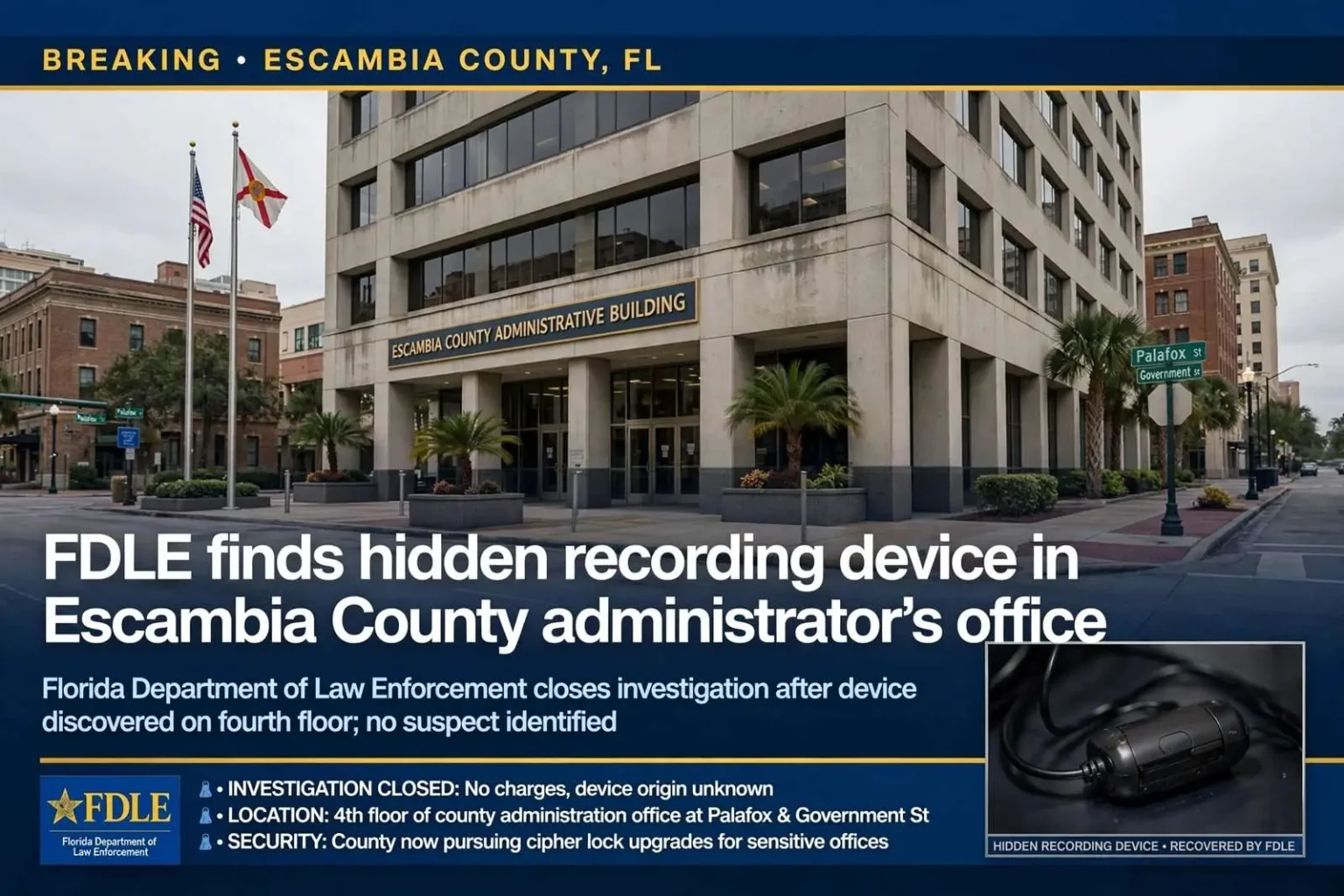
The Florida Department of Law Enforcement has closed an investigation that began after a hidden recording device was found inside the Escambia County administrator’s office in Pensacola, ending the inquiry without identifying who planted the device or what, if anything, it captured. The case had hung over county government since the discovery, raising questions about security and privacy inside one of the most sensitive offices in county administration.
County Administrator Janice Gilley said she first became concerned when details of a private conversation in her office began circulating publicly. The concern prompted a request for a security sweep, and FDLE agents responded, bringing specialized equipment to examine the office for surveillance devices.
FDLE agents swept her office on the fourth floor of the county building at Palafox and Government streets and discovered a device capable of recording both video and audio. The location — in the heart of downtown Pensacola, in the county’s administrative headquarters — underscored how close the device sat to the county’s most sensitive deliberations, including personnel matters, contract negotiations, and budget discussions.
“I’d hate for someone’s personal information to be inappropriately released,” Gilley said. “We don’t have any top secret conversations in my office but there are private sensitive issues that are discussed. I mean we have employee issues, we have disciplinary issues, union issues.”
Commissioners’ offices were also swept, but no additional devices were found. The county-wide sweep gave commissioners their own assurance that the device was limited to the administrator’s suite, though it did little to answer the central question of how it got there.
Discussion in a public forum
Gilley joined Commissioner Jeff Bergosh for his virtual “Coffee With A Commissioner” session, where some viewers suggested the device may have been planted by someone with easy access to her office. The online sessions, which Bergosh has used to take questions from constituents on county issues, became an unlikely venue for a discussion of an active law enforcement matter.
Bergosh agreed that whoever placed it would have needed access to the space. The observation pointed investigators and county staff toward the practical reality of the case: the fourth-floor office is not a public area, and reaching it requires passing through building security and navigating a floor occupied by county administration.
Gilley said surveillance cameras are limited on the fourth floor, though the building is monitored and access is tracked for anomalies such as late-night or weekend entries. That tracking, common in government buildings with card-reader systems, gives security staff a record of who entered the floor and when — a potentially critical trail in an investigation into who had access during the period the device was placed.
The limits of that coverage are also part of the story. With few cameras on the fourth floor itself, the county’s visibility into movement within the administrative suite is limited to entry logs, meaning anyone with legitimate access during business hours would leave little record of where they went inside the suite.
The county has taken bids and is awaiting a vendor to install cipher locks with keypads on some office doors. The upgrade would add a layer of access control that the fourth floor currently lacks, requiring a code to enter sensitive offices rather than relying on the building’s general security perimeter.
Cipher locks have become a common security measure in government offices that handle confidential personnel, legal, and financial matters. Unlike card readers, keypad locks do not require issuing and managing credentials for every user, but they also create their own challenges — codes must be changed regularly, and any code shared among a suite’s staff offers little forensic value after the fact.
The decision to pursue the locks came after the discovery, as county staff reviewed what changes could reduce the risk of a repeat. For Gilley’s office, which handles employment matters and private discussions with commissioners, the added control is as much about privacy as security.
FDLE’s role and the unanswered questions
FDLE ended its investigation without determining who placed the device or what information, if any, was captured. The closure leaves the central questions of the case unanswered, and it means no arrest will follow unless new information emerges that would justify reopening the inquiry.
The agency, which handles major investigations for local governments across Florida, typically declines to detail the limits of a closed case. In this instance, the outcome — a device found, an investigation conducted, and no suspect identified — leaves county officials to draw their own conclusions from the evidence that was gathered, including the access logs and the device itself.
Hidden-recorder cases present difficult evidentiary challenges. Devices of this kind are small, widely available commercially, and often configured to store recordings locally or transmit them remotely. Determining whether a device actually captured material — and where that material went — can be impossible when the hardware is recovered without the storage media or when the recordings were streamed and not saved.
For Escambia County’s government, the case has been an unusual intrusion of criminal-investigation territory into routine administration. The county administrator answers to the five-member Board of County Commissioners, and the office handles the county’s day-to-day operations, including budget preparation, department oversight, and implementation of board decisions — all of which involve conversations that were never intended for public distribution.
Gilley has continued in her role throughout the investigation, and the county’s response has focused on prevention: the sweeps of the commissioners’ offices, the bid process for the cipher locks, and the review of the building’s camera coverage. Whether those measures are enough to prevent a repeat is the question the closed investigation leaves behind.
For Pensacola residents, the episode has been a rare public glimpse at the security posture of the buildings where county business is conducted — and a reminder that the privacy of government offices depends on the same basic measures, from cameras to door locks, that any business relies on. The county’s upgrades will proceed on the vendor’s schedule, closing the practical chapter of a case whose central mystery remains open.
The county building at Palafox and Government streets sits in the center of downtown Pensacola’s civic district, blocks from the waterfront and the city’s historic core. The facility houses county administration alongside other government functions, and the fourth floor where the device was found is the working home of the administrator’s staff and the county’s executive operations.
Government office security has evolved across Florida in recent years, driven in part by increasing attention to threats against public officials and staff. Many counties have added screening at entrances, restricted floor access, and upgraded cameras. The discovery of a recording device inside an administrator’s suite is rarer still, and it lands differently than an external threat because it implies proximity and access.
The “Coffee With A Commissioner” sessions where the case was discussed are part of a broader effort by Escambia County’s board to conduct business in public view. Bergosh has used the virtual format to answer constituent questions on everything from road projects to the county budget, and the discussion of the recording device gave residents a look at how officials themselves were processing the breach of privacy.
Florida’s broad public-records and open-meetings laws shape how county business is conducted, but they also sharpen the significance of what happens in private offices. Conversations that fall outside the open-meetings requirements — personnel matters, litigation strategy, contract negotiations — are still expected to remain within the government’s own walls, and a hidden recorder collapses that expectation entirely.
The unanswered questions extend to the device’s operational history. Investigators did not establish whether the recorder ever captured usable material, how long it operated, or whether it transmitted anything off-site. Those gaps mean Gilley and the county cannot know whether private conversations were actually recorded — an uncertainty that county officials described as unsettling even without proof of capture.
The county’s bid process for the cipher-lock installation will add the door-level control that was missing when the device was discovered. Until the vendor completes the work, the fourth floor’s security remains as it was: building-level screening, limited cameras, and access logs that record entries but not movements within the suite.
The sweeping process itself offered a lesson in modern counter-surveillance. FDLE agents use specialized detection equipment to find recording devices hidden in everyday objects, and the thoroughness of the searches — first the administrator’s suite, then the commissioners’ offices — reflected standard practice for an investigation of this kind.
Commissioners have not indicated whether they will pursue further review of the matter, and the closed FDLE case file leaves the county without a formal accounting of what the investigation found. Any renewed inquiry would require new evidence, and no additional devices were identified in the sweeps that followed the original discovery.