Foley Adopts FY2027 Budget With $18 Million in Projects and $48 Million in Reserves
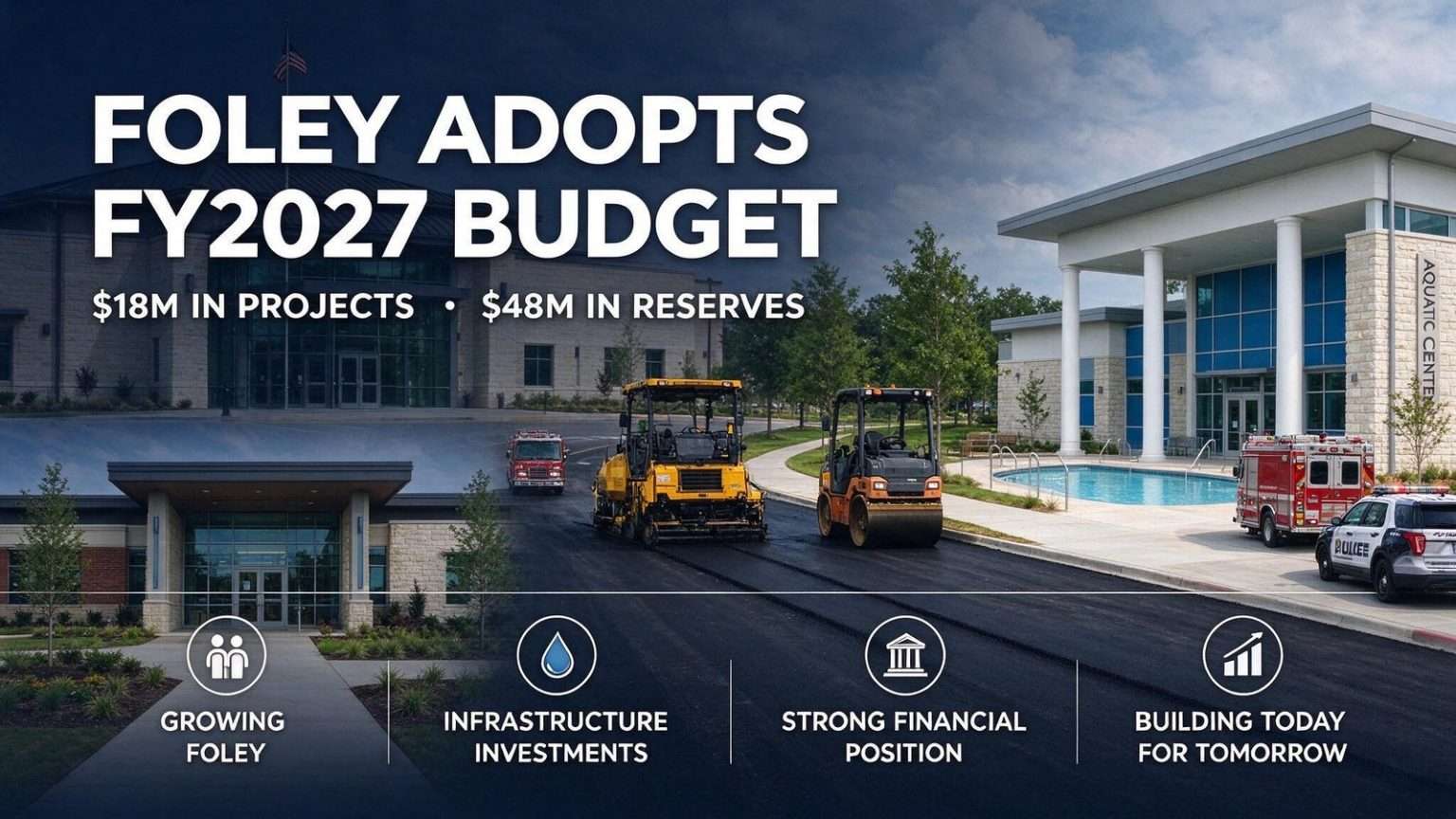
The Foley City Council approved its FY2027 budget Sept. 8, funding about $18 million in projects including a new Aquatic Center and Senior Center, $7.2 million in equipment, and drainage and road work — while keeping debt low amid 70% population growth.
Foley’s population has grown 70% in a decade. Its debt has not kept pace — and that, city officials say, is the most remarkable thing about the budget the City Council adopted Tuesday, Sept. 8, for the fiscal year beginning Oct. 1.
The FY2027 spending plan funds roughly $18 million in projects, including a new Aquatic Center and Senior Center, and carries a General Fund balance well above the city’s self-imposed floor.
“The goal is not simply to keep up with growth, but to prepare for it,” Mayor Ralph Hellmich said. “The decisions we make now will shape how Foley functions five, 10 and 20 years from now.”
Coming Off a $38 Million Year
The new budget follows an unusually heavy one.
“In last year’s budget, we finished two major projects that cost approximately $38 million, the library and the Public Works Campus, which are outstanding facilities,” Hellmich said. “This year’s projects amount to about $18 million. That includes the new Aquatic Center, Senior Center, redoing the old library building, redoing the former public works for horticulture and our parks division and generally making our city more efficient.”
Two of those items are reuse rather than new construction — repurposing the old library and the former public works site. Cities that grow fast often end up with a trail of vacated buildings; Foley is putting them back to work.
The Debt Picture
City Administrator Mike Thompson framed the fiscal position as the story behind the numbers.
“The fact that we’ve been able to keep our debt at such a relatively low limit for a city of our size is extraordinary. Most of the time, they’re doing it with debt,” Thompson said. “Those ratios just get better and better because of what we’re able to do.”
The alternative model is familiar: a growing city borrows against future revenue to build ahead of demand, and debt service becomes a permanent line item. Foley has been paying cash for a larger share.
Reserves, and What They’re For
The city expects to close the current budget year with more than $48 million in its General Fund balance — money saved from prior budgets.
Some of that will be spent on capital equipment, bringing the balance to $34.4 million. The city’s self-imposed minimum is $25.7 million.
“We’re well above our minimum fund balance that we self-impose, but it also indicates our intention to use some of our excess general fund money to fund portions of our capital projects,” Thompson said.
Drawing reserves down to $34.4 million against a $25.7 million floor leaves roughly $8.7 million of cushion above the line — a deliberate spend-down, not a shortfall.
$7.2 Million in Equipment
The FY2027 budget calls for $7.2 million in capital equipment purchases:
- $1.9 million — police equipment
- $1.8 million — fire equipment
- $1.8 million — public works equipment
- $800,000 — sanitation equipment
- About $900,000 — other city departments
Public safety accounts for more than half. Sanitation and public works together reflect the unglamorous arithmetic of growth: more households mean more routes, more trucks and more road miles to maintain.
Foley anticipates approximately $75.1 million in recurring General Fund revenue, an increase of about $3.8 million over the current year’s projection.
180 Miles of Road
The city maintains about 180 miles of roads, and the capital plan funds both design and paving under its ongoing resurfacing program.
The long-range approach is aimed at establishing a sustainable resurfacing cycle as the network keeps expanding — meaning every mile gets rebuilt on a predictable schedule rather than when it fails. Deferred pavement maintenance is among the most expensive mistakes a growing city can make, because a road allowed to deteriorate past a certain point requires reconstruction rather than resurfacing.
Pedestrian and street projects
The capital plan includes connectivity work across the city:
- Pedestrian improvements on West Peachtree Avenue, Ninth Avenue and South Pecan Street near Parish Lakes
- A sidewalk along Riviera Boulevard
- A pedestrian crossing and traffic-calming improvements as part of the South Pecan Street project
- A Ninth Avenue path connecting Alabama 59 and Pine Street
- Continued work on Cedar Street and Wilson/Equestrian Park Road
- Planning for West Lawson and Pine streets
Drainage
Drainage work is spread across several neighborhoods:
- The Graham Creek Estates Drainage Project will address structural flooding along Palmetto Way, with design in FY2027 and construction anticipated in FY2028
- Replacement of aging pipes in Bay Forest
- Specialized lining of existing storm drain pipes where standard equipment cannot reach the lines
- Drainage improvements in the Mills community, alongside sidewalk work
- Continued upgrades in Beulah Heights following completion of the downstream detention basin
“Structural flooding” is the phrase that distinguishes a nuisance from a hazard — it means water reaching buildings, not standing in a street.
Public Safety Beyond Equipment
The budget funds technology integration for the city’s Communications Center to improve operational awareness, dispatch functions, communications analysis and training.
Looking further out, the capital plan identifies a future new Police Headquarters and continued planning for a Northeast Quadrant Fire Station. The fire station is explicitly tied to anticipating service needs as development pushes into new areas — response times are a function of station placement, and a city that adds neighborhoods without adding stations discovers the gap during an emergency.
Facilities
Work on the new Public Works campus remains among the city’s major capital investments, a multi-year project representing approximately $17.9 million in total planned investment.
The five-year plan also includes a new Civic Center, with planning funds identified ahead of construction. The former library building will be repurposed as an administrative annex, adding office space without new construction.
Streetscapes and Community Spaces
The West Orange Avenue Streetscape will extend from Alston Street to Pine Street, with planning underway for streetscape improvements elsewhere.
The city is also developing a larger streetscape concept around the Baldwin Health area in north Foley, covering portions of Alston, Peachtree, Rosetta, Camellia and Pine streets and Alabama 59. The design is the first step in a multi-year project.
Recreation and accessibility investments include equipment and transportation purchases supporting parks, nature parks, sports facilities and the Foley Senior Center.
Planning Past the Fiscal Year
Foley uses a multi-year capital planning process that identifies not only construction and equipment costs but the personnel and operational costs those investments will generate in future budgets.
That second half is what distinguishes capital planning from a wish list. A new fire station is not a one-time expense; it is a permanent addition to payroll, insurance, fuel and maintenance. Cities that budget only the building frequently find the staffing later.
The approach shows up in plans for future fire and police facilities, road resurfacing, drainage, airport development, streetscapes, pedestrian connectivity and community facilities.
At the Foley Municipal Airport, the capital program includes continued work toward a new terminal building along with future hangar, drainage, runway, lighting and signage improvements.
The Long View
Hellmich closed on the timeframe the city says it is actually budgeting for.
“We want to make those decisions carefully and continue investing in the things that make Foley a strong community,” he said.
For residents, the practical test arrives sooner than five years: whether the Aquatic Center and Senior Center open on schedule, whether the resurfacing cycle holds, and whether Palmetto Way floods again before the FY2028 construction money is spent.