Foley council weighs pause on data centers and crypto mines while adopting FY2027 budget
A rescheduled Tuesday meeting put a temporary moratorium on high-demand computing facilities alongside adoption of Foley's fiscal year 2027 budgets and employee pay plans. The council also considered General Obligation Warrants for capital work and a state grant application for a new airport terminal. Rezonings, nuisance abatements and equipment purchases filled out a long agenda.
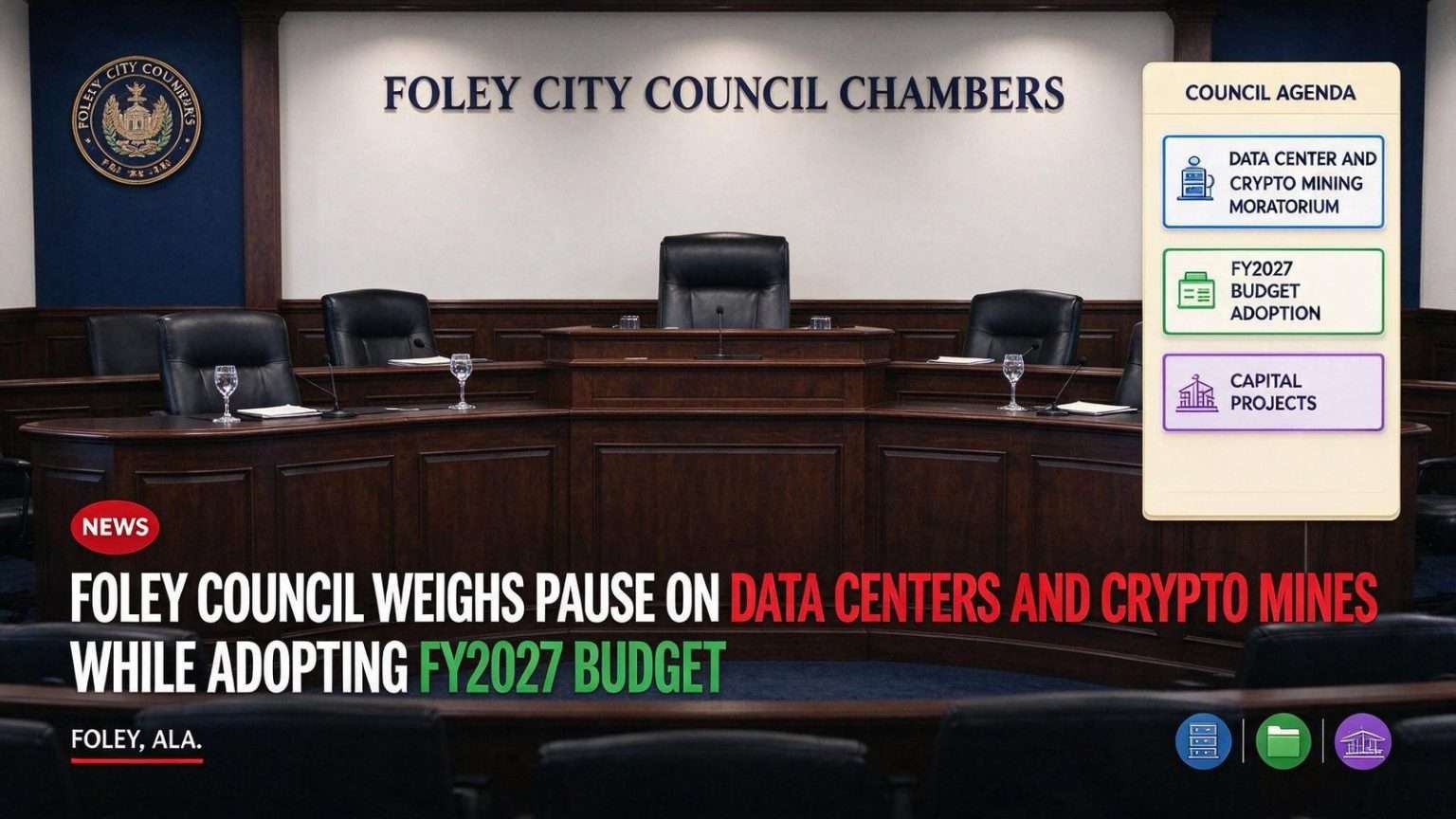
FOLEY, Ala. — The Foley City Council worked through one of its densest agendas of the year Tuesday evening, a docket that paired a temporary moratorium on data centers and cryptocurrency mining operations with the formal adoption of the city’s fiscal year 2027 budget, a bond-style borrowing authorization, and a grant application to build a new terminal at the city’s airport.
The work session and regular meeting began at 4 p.m. in the council chambers at Foley City Hall. The meeting had been moved from its usual Monday slot — Sept. 7 — because of the Labor Day holiday.
Taken together, the agenda covered the full range of what a growing Baldwin County city does in a single sitting: setting the ground rules for a new industry it has not yet accepted, adopting the spending plan that governs the next twelve months, borrowing for capital work, and clearing overgrown lots.
The data center and crypto mining moratorium
The most consequential policy item was a proposed ordinance imposing a temporary moratorium on the acceptance, processing, approval and consideration of applications for data centers, Bitcoin and cryptocurrency mining facilities, server farms and similar technically oriented uses.
The ordinance language is deliberately broad. As described on the agenda, it reaches any use, facility or operation primarily used for computing, data processing, data storage, cryptocurrency generation or similar technological functions, and that is characterized by high electrical demand and/or high water consumption.
That last clause is the operative one. The moratorium is not defined by what a facility calls itself but by what it consumes. Writing the definition around electricity and water demand rather than around business type is a drafting choice that makes the ordinance harder to sidestep by relabeling a project, and it points to what the city says it is actually concerned about: the strain such operations can place on public utilities.
City leaders framed the measure as protecting public resources by allowing time to evaluate operations with high electrical demand and elevated water use.
The item appeared twice on Tuesday’s agenda, in two distinct procedural forms: a public hearing to consider the ordinance, and a second reading of the same ordinance. That is not duplication. It reflects how Alabama municipalities move ordinances toward adoption.
What a moratorium actually does
A moratorium is a pause, not a prohibition. It suspends a city’s acceptance and processing of applications in a defined category for a defined period, and it exists to buy time.
The reason cities use them is straightforward. Zoning codes are written against the land uses that existed when the code was drafted. When a genuinely new type of development appears — and large-scale computing facilities are new to most municipal codes — a city can find itself in the position of having to approve or deny an application under rules that were never designed to address it. A moratorium stops the clock so that standards can be written before, rather than during, a live application.
Because a moratorium restrains what property owners may do with their land, it is generally expected to be temporary and tied to a stated purpose. The Foley ordinance is described as temporary on its face.
The concerns driving these ordinances nationally are consistent with what Foley’s language targets. Large data centers and cryptocurrency mining operations draw electrical loads that can rival those of substantial industrial users, and many cooling designs consume significant volumes of water. For a city that operates or contracts for utility service and plans capacity years in advance, a single facility of that scale can reshape long-range planning assumptions. The high-demand language in the ordinance is what ties the pause to that specific concern.
The fiscal year 2027 budget
The council also took up adoption of the city’s fiscal year 2027 budgets. The plural is meaningful: municipalities typically adopt several linked budgets at once, covering general government operations alongside separate enterprise or utility funds that are accounted for independently because they are supported by user fees rather than general tax revenue. Employee pay plans were part of the same review.
Alabama’s municipal fiscal year runs from Oct. 1 through Sept. 30, which is why cities across the state finalize budgets in September. Adopting in early September rather than at the end of the month gives departments a few weeks of lead time before the new year’s spending authority takes effect.
A municipal budget is more than a forecast. Once adopted, it is the legal authorization for departments to spend, and departures from it generally require the council to formally amend it. Tuesday’s agenda illustrated that mechanism in action even as the new budget was being adopted: separate items proposed transferring Engineering operational funds to Public Safety for City Hall bollards, and amending the budget in connection with awarding the bid for the 2026 fiscal year resurfacing project to Asphalt Services Inc.
Another item proposed transferring funds from a capital project to an operational account for the Main Street Cat Alley Phase 2 project, along with permission to solicit bids and award within the operational budget threshold. Those threshold provisions are common: they let staff handle smaller purchases administratively while reserving larger awards for council votes.
Borrowing, and what the warrants would fund
The council considered authorizing the issuance of General Obligation Warrants, Series 2026, and making provision for their payment. Leaders described the warrants as a way to fund capital improvements across the city.
Warrants are the instrument Alabama municipalities commonly use for long-term borrowing, functioning much as municipal bonds do elsewhere. A general obligation warrant is backed by the full faith and credit of the issuing city, which typically means a lower interest rate than a revenue-backed issue would carry, because the investor is relying on the city’s general taxing power rather than on the income of a single project.
The trade-off is that repayment becomes a fixed claim on the general fund for the life of the issue. That is why the authorizing resolution must make provision for payment at the time of issuance: the council is not only approving the borrowing but committing to the schedule that services it. Borrowing for capital improvements is standard practice for infrastructure with a long useful life, on the reasoning that assets serving residents for decades should not be paid for entirely by the taxpayers of a single year.
An airport terminal and road projects
Among the infrastructure items, the council considered submitting a grant application to the Alabama Department of Transportation’s Aeronautics Bureau to construct a new terminal building at the city’s airport.
State aeronautics programs typically provide matching funds for airport capital projects, meaning a successful application generally commits the city to a share of the cost as well. A grant application is an early step, not a construction decision; approval, funding levels and local match all follow later.
Several road and pedestrian projects appeared on the agenda:
- Approving a professional engineering design services proposal from Kimley-Horn for improvements at the West Pride Boulevard intersection.
- Approving a contract addendum with Thompson Engineering for ALDOT permitting related to access roads for the Foley Beach Express Industrial Park.
- Awarding the bid for the Mills Community Pedestrian Improvement Project to Trenchline Civil.
- Amending the budget and awarding the resurfacing bid for the 2026 fiscal year to Asphalt Services Inc.
The sequence visible across those items is the ordinary life cycle of a public works project: design services are procured first, permitting follows, and construction bids are awarded last. A council agenda in a growing city will typically contain projects at every stage of that pipeline simultaneously.
Rezonings, nuisances and the routine business of a city
Two rezoning ordinances received first readings. One would rezone property owned by the City of Foley from extended business, B-1A, and residential single family, R-3, to planned industrial, PID. The other would rezone property owned by Rolling Stones LLC from extended business, B-1A, to local business, B-3. The council also set public hearings on both.
Zoning classifications determine what may be built and operated on a parcel. A change from business and single-family residential designations to planned industrial is a substantial shift in permitted use, which is why such changes require published notice, a public hearing and multiple readings before taking effect.
A significant block of the agenda concerned nuisance abatement. The council held public hearings to declare weeds a public nuisance on West Carolyn Avenue and to declare an accumulation of junk a public nuisance on East Michigan Avenue, and it considered authorizing employees to enter properties on West Carolyn Avenue, East Michigan Avenue and Cedar Court to abate nuisances. A further item set a public hearing on weeds at a property on South Hickory Street north of the Crown Walk subdivision entrance.
The two-step structure — first declare, then authorize entry — is a due process requirement. Before a city may send crews onto private property, it must give the owner notice and an opportunity to be heard, then act by formal vote. Costs of abatement are typically assessed back to the property.
Purchases, permits and proclamations
The remainder of the agenda covered the operational work that keeps a city running:
- A proclamation for National Voter Registration Day.
- A Main Street Alabama awards presentation.
- A special events retail liquor license for the Tacos and Tequila Festival at 200 N. McKenzie St.
- Accepting a donation of IRIS biometric identification equipment.
- Authorizing the mayor to sign a letter of intent for a sweeper truck in the Street Department.
- Authorizing the mayor to sign a letter of intent to purchase a 2028 custom fire pumper for the Foley Fire Department.
- Changing pharmacy benefit managers.
- Authorizing the mayor to sign a contract with Vermont Systems.
- Discussion of bid results for the Foley Farmers Market kitchen.
- Rental of Heritage Park to Lisa Yeaster to host the Gumbo and Alabama Slammer Festival, with a variance to allow alcohol sales.
- Rental of Heritage Park for the Mudbugs and Margaritas Festival, also with an alcohol variance.
Two of those deserve a note. The letter of intent for a 2028 fire pumper reflects the lead times in emergency apparatus manufacturing, where custom fire trucks are frequently ordered years ahead of delivery; committing now is how a department secures a place in a production queue. And the pharmacy benefit manager change is an employee benefits decision — pharmacy benefit managers administer prescription drug coverage on behalf of health plans, and changing one affects the cost and structure of coverage for city employees.
What to watch next
The moratorium is the item with the longest tail. If adopted, the pause itself settles nothing permanently; the substantive question is what standards Foley writes for high-demand computing facilities during the window the moratorium creates, and whether those standards ultimately permit such uses under conditions, confine them to particular zoning districts, or effectively exclude them.
The FY2027 budget sets the city’s spending authority beginning Oct. 1. The General Obligation Warrants, if issued, will determine which capital projects move forward and will add a fixed repayment obligation to future budgets. And the airport terminal grant application is the beginning of a process whose outcome rests with the state aeronautics program rather than with the council.