University of South Alabama Mobile
Mobile marks Sickle Cell Awareness Month with rides, red towers and a blood drive
Mayor Spiro Cheriogotis has proclaimed September 2026 as Sickle Cell Disease Awareness Month, with the proclamation accepted at the Sept. 1 City Council meeting. USA Health's comprehensive sickle cell center and the Sickle Cell Disease Association of America Mobile Chapter have lined up events all month, from a transition planning open house to a Sept. 26 blood drive.
MOBILE, Ala. — The City of Mobile has formally designated September 2026 as Sickle Cell Disease Awareness Month, a recognition that arrives alongside a full calendar of local events built around education, blood donation and support for the families who manage a lifelong inherited illness.
The proclamation was issued by Mayor Spiro Cheriogotis and accepted by leaders from the comprehensive sickle cell center at the Mobile City Council meeting on Tuesday, Sept. 1. Representatives from USA Health and from the Mobile chapter of the Sickle Cell Disease Association of America attended the presentation.
The document recognizes the effect of sickle cell disease on individuals and families across the region and points to the importance of education, advocacy and access to specialized care. It also acknowledges the work of the health care providers, community organizations and advocates who support people living with the condition.
‘More than what mere words can express’
For Ardie Pack-Mabien, Ph.D., FNP-BC, director of the USA Health Johnson Haynes Jr., M.D. Comprehensive Sickle Cell Center, the recognition carries weight well beyond its ceremonial form.
“This means more than what mere words can express for the more than 500 children and adults with this chronic illness and their families and/or caregivers who receive care at USA Health,” Pack-Mabien said. “By issuing a proclamation recognizing September as National Sickle Cell Awareness Month, the City of Mobile formally and publicly acknowledged the importance of sickle cell awareness, education, prevention and treatment for a population that often goes unrecognized or is marginalized.”
That figure — more than 500 children and adults receiving care through USA Health — is a useful anchor for readers trying to understand the scale of the condition locally. It represents patients treated within a single health system, and it describes a community large enough to fill a good-sized school, spread across Mobile and the surrounding counties.
What a proclamation does
A mayoral proclamation is a ceremonial instrument. It does not create a program, appropriate money or change any ordinance. What it does is place the city’s name and the mayor’s signature behind a public statement, usually read or presented at a council meeting, that a particular issue deserves the community’s attention during a set period.
For advocacy organizations, that formal acknowledgment has practical value. It gives them a public occasion around which to organize, a document to cite when approaching partners and sponsors, and a moment of visibility in a news cycle that rarely makes room for chronic illness. For patients and families, particularly those living with a condition that is frequently misunderstood, seeing the city say the words out loud in a public meeting can matter in a way that is difficult to quantify.
Pack-Mabien framed the point directly in her remarks, noting that the recognition applies to a population that, in her words, often goes unrecognized or is marginalized.
Understanding sickle cell disease
Sickle cell disease is an inherited disorder of the blood. It affects hemoglobin, the protein inside red blood cells that carries oxygen from the lungs to the rest of the body. In people with the condition, an alteration in the hemoglobin causes red blood cells that would normally be round and flexible to become rigid and to take on a curved, crescent-like shape — the shape that gives the disease its name.
Those stiffened cells do not move through small blood vessels as easily as healthy ones. They can clump and block blood flow, which deprives tissue of oxygen and can cause episodes of severe pain, often called pain crises. Sickled cells also break down faster than normal red blood cells, which leads to chronic anemia and the fatigue that accompanies it. Over time, repeated interruptions of blood flow can affect organs throughout the body, and people with the condition carry an elevated risk of certain infections and other complications.
Because the disorder is inherited, it is present from birth and lasts a lifetime. A child develops sickle cell disease by inheriting the relevant gene from both parents. A person who inherits the gene from only one parent has what is known as sickle cell trait; people with the trait generally do not have the disease itself but can pass the gene to their children. Newborn screening in the United States identifies affected infants early, which allows care to begin in the first months of life.
Treatment has changed considerably over the decades and is now organized around comprehensive, long-term care: managing pain, preventing infection, monitoring organ function and addressing complications as they arise. Blood transfusion is an important part of treatment for many patients, a fact that connects directly to one of the events on this month’s local calendar.
None of the above is a substitute for medical advice. People with questions about sickle cell disease, sickle cell trait or their own risk should speak with a physician or another qualified health care provider.
The month’s local calendar
Throughout September, the Johnson Haynes Jr., M.D. Comprehensive Sickle Cell Center is joining the Sickle Cell Disease Association of America Mobile Chapter and community partners for a series of events intended to educate the public, celebrate people living with the disease and encourage support for patients and families.
PACT Transition Planning Open House — Wednesday, Sept. 9, 4 to 6 p.m.
One of the month’s signature events is the PACT Transition Planning Open House, scheduled from 4 to 6 p.m. It is designed to help adolescents and young adults with sickle cell disease prepare for the move from pediatric care to adult health care services, and to connect families with resources and support systems.
That transition is a genuinely difficult passage for young people with any chronic condition. A patient who has been seen since infancy by the same pediatric team, in an environment built around children and their parents, must at some point move into adult medicine, where the patient is expected to manage appointments, medications and communication independently. Programs that walk families through that shift in advance exist precisely because the handoff, if unplanned, can result in missed care at exactly the age when consistency matters most.
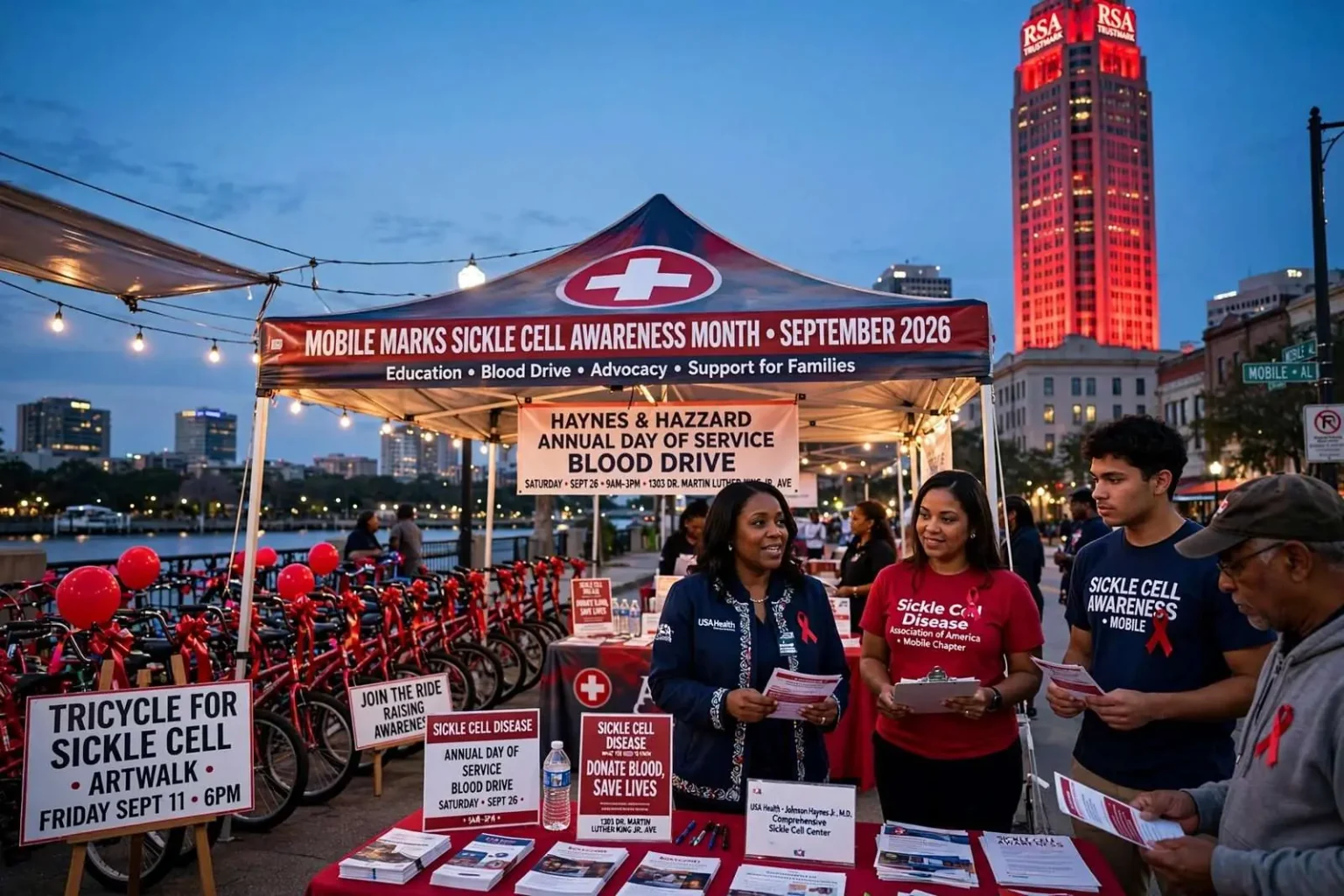
Tricycle for Sickle Cell during ArtWalk — Friday, Sept. 11, from 6 p.m.
On Friday, Sept. 11, community members will take part in the Tricycle for Sickle Cell ride as part of ArtWalk in downtown Mobile, beginning at 6 p.m. Folding an awareness ride into ArtWalk places it in front of an audience that is already downtown for the evening, and gives organizers a chance to reach people who might never seek out a health event on its own.
Towers turn red — Saturday, Sept. 12
On Saturday, Sept. 12, the RSA Trustmark Tower in Mobile and the RSA Tower in Montgomery will be lit red to raise awareness of the disease and to honor those affected by it. Building illuminations are among the most visible forms of awareness campaigning: two of the tallest structures on the Alabama skyline, one on the coast and one in the capital, carrying the same message on the same night.
Haynes & Hazzard Annual Day of Service Blood Drive — Saturday, Sept. 26, 9 a.m. to 3 p.m.
On Saturday, Sept. 26, community members are asked to support the Haynes & Hazzard Annual Day of Service Blood Drive from 9 a.m. to 3 p.m. at 1303 Dr. Martin Luther King Jr. Ave. Organizers point to the critical need for blood donations, which play an essential role in the treatment of many individuals living with sickle cell disease.
Of all the events on the calendar, the blood drive is the one with the most direct line between an individual act and a patient’s care. For readers who want to do something concrete during the awareness month and are eligible to donate, this is the most practical option on the schedule.
Education, myth and misunderstanding
Pack-Mabien said the events are meant to give the public a clearer picture of the disease and of what it means for the people who live with it.
“These activities help strengthen community support, share facts and dispel myths through social media campaigns and community events that allow the broader community to learn about this disease, its genetic aspects and its impact on the lives of affected individuals and their families,” she said.
The reference to dispelling myths is not incidental. Sickle cell disease is a condition whose central symptom — severe, episodic pain that is invisible to an observer — is easily misread by people who do not understand it, including in settings where patients seek help. Public education aimed at explaining what a pain crisis is, and that the disease is inherited rather than acquired, addresses a specific and long-standing gap in general knowledge.
A long-running partnership
The awareness campaign also reflects a durable working relationship between USA Health and the Sickle Cell Disease Association of America Mobile Chapter, which have collaborated on outreach and patient support.
“There is a synergistic relationship between the two entities that is long-standing and unique through a shared mission of education, community engagement and promotion of specialized comprehensive and holistic care for those affected by this disease and their families,” Pack-Mabien said.
The pairing is a common and effective model in chronic disease care. A clinical center brings medical expertise and continuity of treatment; a community organization brings reach into neighborhoods, family networks and civic life, along with the ability to organize events like a downtown ride or a Saturday blood drive. Neither easily does the other’s work alone.
How readers can take part
The September calendar offers several entry points for people in Mobile and Baldwin counties who want to engage with the awareness month:
- Attend. The PACT Transition Planning Open House runs from 4 to 6 p.m. on Sept. 9 for adolescents, young adults and families navigating the move to adult care.
- Show up downtown. The Tricycle for Sickle Cell ride begins at 6 p.m. on Sept. 11 as part of ArtWalk in downtown Mobile.
- Look up. The RSA Trustmark Tower in Mobile and the RSA Tower in Montgomery go red on Sept. 12.
- Give blood. The Haynes & Hazzard Annual Day of Service Blood Drive runs from 9 a.m. to 3 p.m. on Sept. 26 at 1303 Dr. Martin Luther King Jr. Ave.
Event details and times can change, and readers planning to attend should confirm arrangements with the organizing groups in advance.
The proclamation itself expires with the month. The care, the advocacy and the more than 500 patients Pack-Mabien described do not, and the events on this September calendar are, in the end, an argument that the attention should not either.