Michael Norton testifies he had no other choice as court weighs self-defense immunity
A judge heard testimony Tuesday from Michael Norton, his wife and his stepson before deciding whether Norton can claim pre-trial immunity in the shooting death of his longtime friend David Adams. The judge did not rule, and the hearing was cut short just after 4:30 p.m. following an outburst by a member of Adams' family. Testimony resumes Sept. 21.
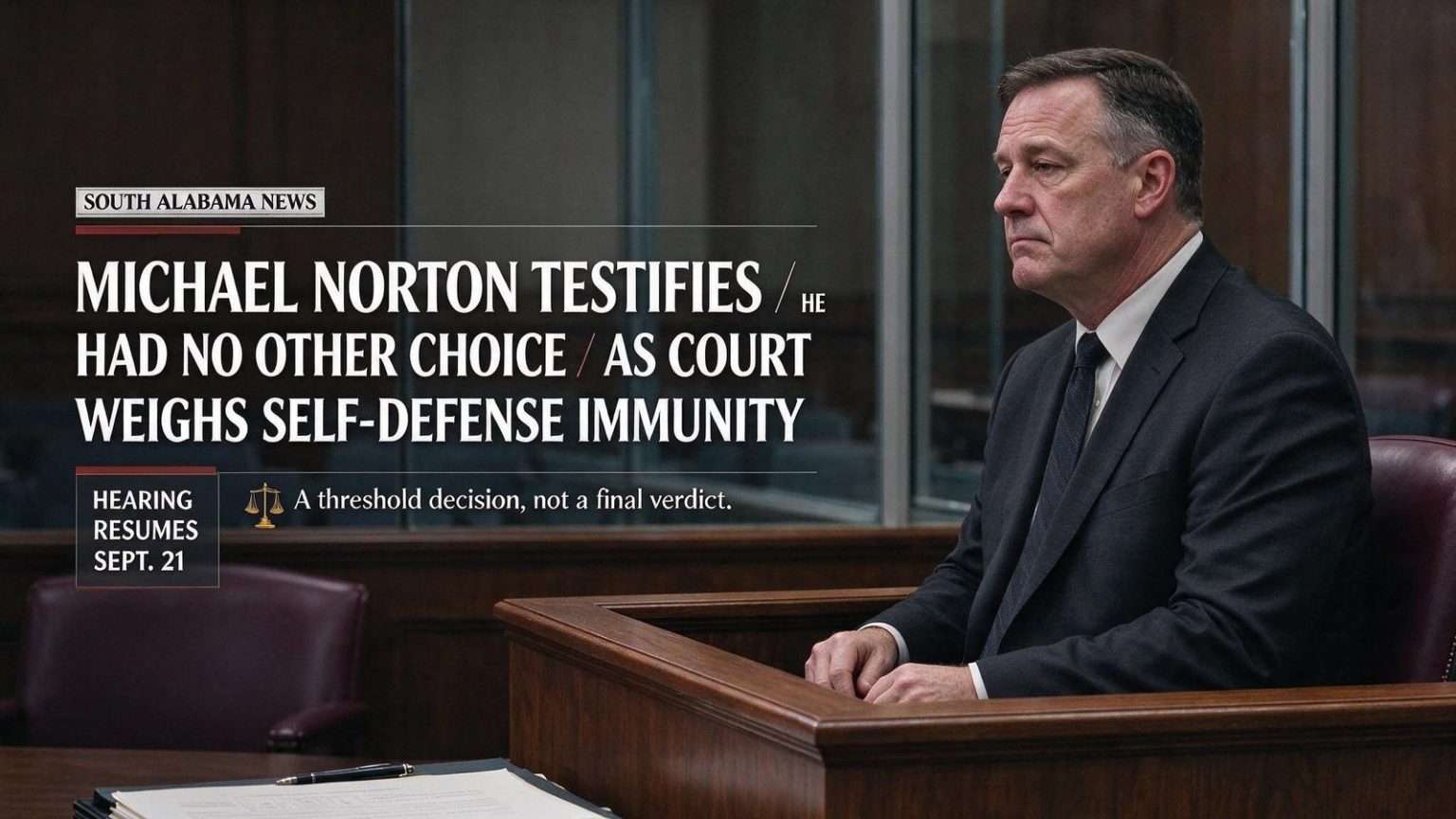
A judge has not yet decided whether Michael Norton must stand trial in the shooting death of David Adams, a longtime friend who died after a fight outside Norton’s home, following a hearing this week in which Norton took the stand and described the night in detail.
Norton’s attorney has asked the court to dismiss the case before trial, invoking the pre-trial immunity that Alabama law makes available to a person who claims to have used deadly force in lawful self-defense. The judge heard testimony Tuesday but did not rule. The hearing was cut short just after 4:30 p.m., after a member of Adams’ family had an outburst in the courtroom, and it is set to resume on Sept. 21.
Norton has not been convicted of anything, and the charges against him are allegations. He is presumed innocent unless and until the state proves its case beyond a reasonable doubt. At the same time, the account summarized below is Norton’s own sworn testimony and that of witnesses called on his behalf. It is one side of a contested matter, and the state has not yet had the opportunity to present its full case to a jury.
What the court heard
The judge heard testimony from Norton, from his wife and from his stepson about the events of the night Adams died.
Witnesses testified that Norton and Adams had spent the evening at a restaurant watching the Alabama football game before returning to Norton’s house. According to the testimony, Adams was noticeably drunk by that point and became aggressive toward Norton’s stepson.
The confrontation then moved outside. Norton testified that Adams swung at his stepson, grazing him on the top of the head, and that Norton and Adams then became involved in a physical altercation of their own.
Norton told the court that Adams knocked him down four or five times, punching him in the side of the head. He described one of those blows as the hardest he has ever been hit.
After the last time he went down, Norton testified, he could not feel his right leg. He said he used a car tire to pull himself up, took a gun from his pocket and told Adams, “It’s over. It’s time for you to leave.”
Adams then came toward him, Norton said, almost running. That, Norton testified, is when he fired. He told the court he felt he had no other choice.
Describing the episode more broadly, Norton called it the “worst thing that’s ever happened to me,” and said Adams was his friend.
What a pre-trial immunity hearing is
The proceeding that unfolded this week is not a trial, and it is easy to mistake one for the other. No jury was seated. No verdict was possible. What the judge is being asked to decide is a threshold legal question: whether the case should go to a jury at all.
Alabama’s self-defense statute, the provision commonly described as the state’s stand-your-ground law, does more than give a defendant an argument to make at trial. It also provides that a person whose use of force was justified under the statute is immune from criminal prosecution — not merely entitled to an acquittal, but shielded from being tried in the first place. To give that immunity practical effect, the law provides for a hearing before trial at which a defendant may ask the court to find that the immunity applies and to dismiss the charges.
Three features of that framework are worth understanding.
- The judge, not a jury, decides. At this stage the court sits as the finder of fact. The judge weighs the testimony, assesses credibility and reaches a conclusion without a jury present.
- The burden generally rests with the defense. Unlike at trial, where the state must prove guilt, a defendant seeking pre-trial immunity ordinarily must persuade the court that the immunity applies. The standard is a preponderance of the evidence — more likely than not — which is substantially lower than the beyond-a-reasonable-doubt standard that governs a criminal trial.
- Denial is not a finding of guilt. If a judge declines to grant immunity, that ruling means only that the defendant did not carry the burden at this stage. Self-defense remains fully available as a defense at trial, where the burden shifts back to the state.
That last point deserves emphasis, because it is the one most often lost in public discussion of these hearings. A defendant can lose an immunity motion and still be acquitted by a jury applying the higher standard. The two questions are asked at different times, by different decision-makers, under different rules.
Why a defendant testifies
It is relatively unusual for a criminal defendant to testify under oath before trial. At trial, a defendant has a constitutional right to remain silent, and defense lawyers frequently advise clients to exercise it.
An immunity hearing changes that calculus. Because the defense typically bears the burden of showing that the use of force was justified, and because the defendant is often the only living witness to the decisive moment, the defendant’s own account is frequently the centerpiece of the motion. That is what appears to have happened here: Norton took the stand and walked the court through the sequence of events as he recalls them.
The choice carries risk. Testimony given at an immunity hearing is sworn testimony, and it can be used later. Prosecutors will have a transcript, and any inconsistency between what a defendant says at such a hearing and what he says at trial can become material for cross-examination. Defense lawyers weigh that risk against the possibility of ending the case months or years earlier and sparing the client a trial.
What the judge will be weighing
Self-defense analysis in a case like this turns on a set of familiar questions. Was the defendant the initial aggressor, or was he responding to force initiated by someone else? Did he reasonably believe he faced an imminent threat of death or serious physical injury? Was the level of force he used proportionate to the threat he faced? And where the encounter occurred matters as well, because the law treats a person’s own home and its immediate surroundings differently from a public place.
Several elements of the testimony described above map directly onto those questions. The account of Adams swinging at the stepson goes to who started the physical confrontation. The account of Norton being knocked down repeatedly, and of the hardest blow he says he has ever taken, goes to the severity of the force he says was used against him. The testimony that he could not feel his right leg and had to pull himself up using a car tire goes to his capacity to retreat or otherwise avoid further harm. His statement to Adams — “It’s over. It’s time for you to leave.” — goes to whether he attempted to end the encounter without firing. And his testimony that Adams came toward him, almost running, goes to whether he reasonably perceived an imminent threat at the moment he pulled the trigger.
None of that means the judge will accept the account. Judges at immunity hearings routinely find that the evidence is genuinely disputed and conclude that the conflict is one for a jury to resolve. The state may present evidence of its own when the hearing resumes, and the court will consider the record as a whole.
The role of intoxication in the testimony
Witnesses described Adams as noticeably drunk. That testimony is relevant in a narrow, specific way, and it is worth being precise about what it does and does not mean.
Evidence about a person’s level of intoxication can bear on how the people around him perceived the situation and on whether their perception of a threat was reasonable. It is not a statement about the person’s worth, and it does not establish fault. Adams was, by Norton’s own testimony, his longtime friend. Nothing in the account presented at the hearing suggests otherwise, and Adams is not here to give his version of the evening.
Alabama, like other states, requires that a claim of self-defense be judged by what a reasonable person would have believed under the circumstances as they appeared at the time. That inquiry is inherently backward-looking and inherently contested, which is precisely why it so often ends up in front of a jury.
A courtroom under strain
The hearing did not end on schedule. A member of Adams’ family had an outburst in the courtroom, and the proceeding was cut short just after 4:30 p.m.
Courts are formal places, but the events they examine are anything but abstract. A family sat in that courtroom and listened to a detailed account of how a relative died. Judges have wide latitude to manage the courtroom and to recess a proceeding when circumstances require, and adjourning a hearing under emotional strain is a routine exercise of that authority rather than a sanction against anyone.
The practical consequence is a delay. Testimony that had not been completed will be taken up when the hearing resumes on Sept. 21, and the judge is not expected to rule until the record is closed.
What happens after the ruling
Once the hearing concludes, the court has two basic paths. If the judge finds that Norton has established his entitlement to immunity, the charges would be dismissed and there would be no trial. If the judge finds he has not, the case would return to its normal course toward trial, with self-defense still available to be argued before a jury under the state’s burden of proof.
Either outcome may be subject to further review. Rulings on pre-trial immunity are sometimes challenged by the losing side through appellate procedures, which can add months to a case’s timeline.
It bears repeating that a judge’s decision at this stage is a legal ruling about a threshold question. It is not a moral judgment about the men involved, and it is not the final word on what happened outside Norton’s home that night.
What is not yet known
Several things remain outside the public record as reported. The specific charges Norton faces have not been detailed here, and the account of the night comes from testimony given by Norton and by witnesses called at the hearing rather than from a completed adversarial trial record. The state’s evidence has not been laid out in full.
South Alabama News will continue to follow the case. The hearing is scheduled to resume Sept. 21, at which point the judge is expected to hear the remainder of the testimony before taking the immunity question under advisement.
Until a court rules, Norton stands accused and not convicted, and the presumption of innocence applies to him as it applies to every person charged with a crime.