Mobile Defense Attorneys Say A&E’s ‘First 48’ Cameras Are Poisoning Juries Before Trial
Mobile defense attorneys say the unprecedented access A&E's "The First 48" gets to homicide investigations is undermining defendants' right to a fair trial, even as the Mobile County District Attorney's office insists jury selection safeguards keep the show from tainting cases.
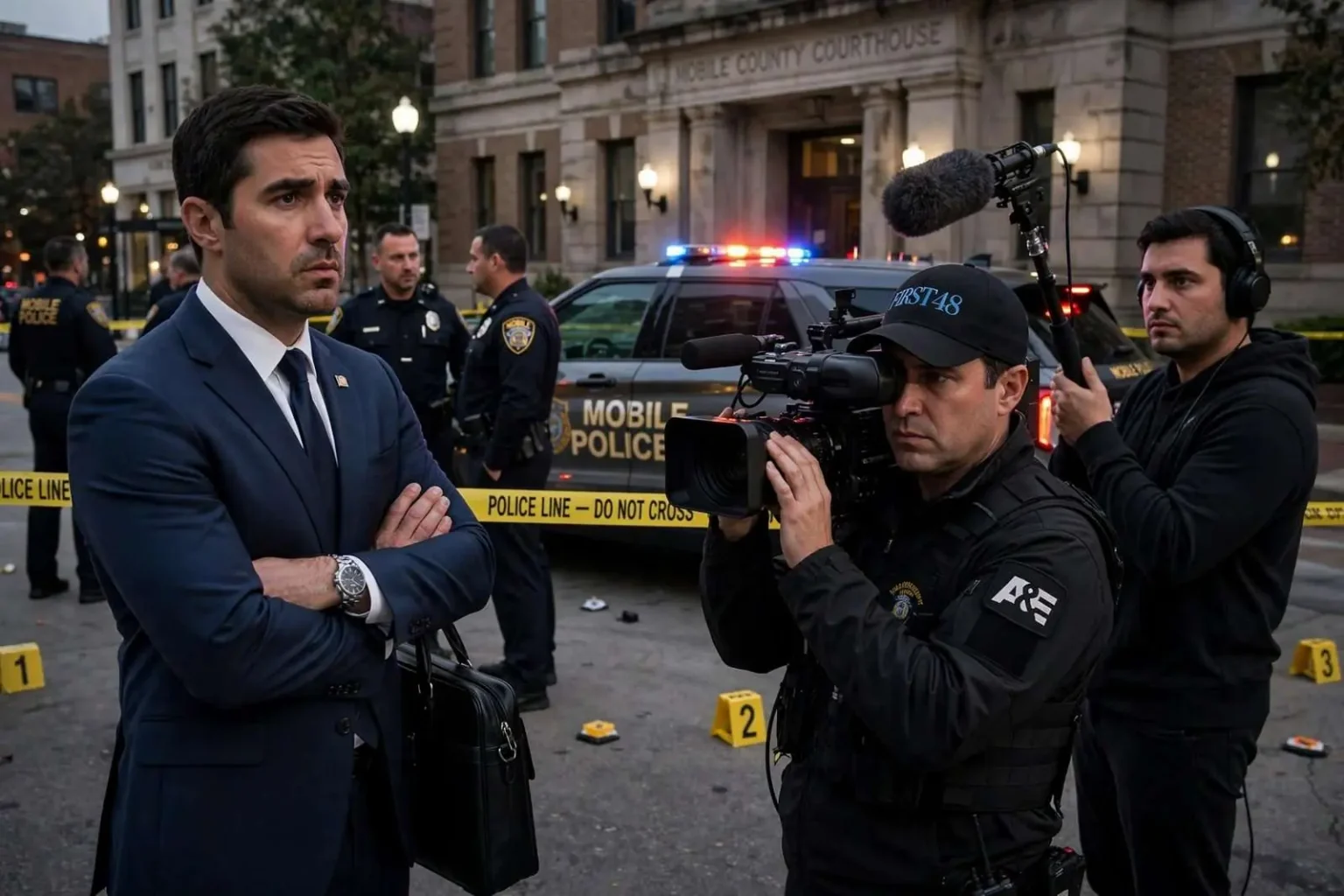
For more than two decades, A&E’s long-running documentary series “The First 48” has followed homicide detectives through the critical early hours of a murder investigation, and Mobile has become one of the show’s regular filming locations. Camera crews shadow Mobile Police Department detectives as they process crime scenes, interview witnesses and close in on suspects, with episodes often airing well before those same suspects ever set foot in a courtroom.
That timeline has become the center of a growing dispute between local defense attorneys and the police department that grants the show access. Attorneys say airing interrogations, 911 calls and surveillance footage on national television before a case goes to trial can shape public opinion in ways that are difficult to undo, regardless of what a jury ultimately hears in court.
The concern is not hypothetical for Mobile defense attorney Chase Dearman, whose client, Frederick Knight Jr., appeared in a First 48 episode that aired just over two weeks before Knight was scheduled to stand trial on a murder charge. Dearman said he did not learn his client had been featured until a reporter told him, and he described the episode’s framing as devastating to Knight’s presumption of innocence.
“They’re saying things that are really damning toward your client,” said Andrea Ramey, describing the tone of the broadcast.
Dearman pushed back on the idea that the show’s dramatic framing amounts to a verdict. “That’s entertainment. That is nothing more than a TV show. It is not a trial. He has not been proven guilty. As a matter of fact, he is presumed innocent,” he said.
He added that watching the episode air left him “horrified actually, because that does nothing but poison the jury pool.”
The dispute reflects a collision between two realities that were almost never in the same room before the true-crime boom. Television producers work on broadcast schedules; criminal courts work on trial calendars. When a producer’s deadline falls weeks before a defendant’s trial date, the public’s first and often only impression of a case arrives before the judge has ruled on a single piece of evidence — and no later broadcast correction ever reaches the audience that saw the original episode.
Access no other camera gets
Much of the attorneys’ frustration centers on the level of access the production receives compared to everyone else covering a crime scene, including local media. While reporters and bystanders are typically held behind police tape, First 48 camera crews have been allowed to move in close to victims and evidence in ways that go well beyond standard press access.
The show also broadcasts material that rarely reaches the public otherwise, including police interrogation footage, 911 recordings and surveillance video pulled directly from active investigations. An audience of millions thus sees raw investigative material — evidence, interrogations, admissions — that a Mobile County jury would hear only under the rules of evidence, after defense objections and judicial rulings have filtered what is actually admissible.
That access appears to run only in one direction. Requests for the same investigative material that has already aired publicly on the show have been denied by police on the grounds that the underlying cases remain pending trial, a policy that defense attorneys say highlights an uneven standard between what a television audience can see and what the public and press are told.
The asymmetry cuts against the defendants most directly. A defense attorney preparing for trial can be denied records that have already been broadcast nationally — records the prosecution’s own detectives appeared in — while prospective jurors can watch the same material from their living rooms the night before jury questionnaires go out.
‘If people make up their minds beforehand’
Defense attorney Jason Darley said the danger lies less in what jurors ultimately hear in the courtroom and more in what they may have already absorbed from a television screen months earlier.
“Some of what they hear may not be admissible in court. Some of what they hear may not be relevant at all to the case,” Darley said. “If people make up their minds beforehand, it can be problematic.”
The point speaks to a long-standing doctrine in American criminal law. Courts have treated prejudicial pretrial publicity as a threat to the constitutional guarantee of a fair trial for generations, and the remedy has always been imperfect: change of venue, postponement, extended questioning of the jury panel, and, in extreme cases, sequestration. None of those tools can unring the bell of a national broadcast — they only try to manage what the audience has already heard.
Prosecutors: the system filters it out
Prosecutors and police in Mobile reject the idea that the show compromises a defendant’s right to a fair trial. Mobile County District Attorney Ashley Rich said the jury selection process is specifically designed to weed out prospective jurors who have already formed opinions about a case, regardless of how they came to have them.
“It’s not tainting our jury pool,” Rich said, pointing to the standard vetting process used before any trial begins, in which potential jurors are asked directly whether they know anything about the case. “We certainly don’t want anyone who serves on jury duty to have some kind of preconceived notion about a case, and so if they do, then they are asked not to serve,” she said.
In her view, voir dire — the questioning that decides who serves — is precisely the mechanism the law built for this problem. A juror who saw a First 48 episode and admits it is excused; a juror who saw it and conceals it commits a different problem, but the process presumes that honest disclosure removes the taint. Defense attorneys respond that jurors cannot always recognize their own bias, and that a juror who says “I can be fair” after watching an interrogation broadcast may believe it sincerely and be wrong.
Police officials have generally defended the show’s presence as a legitimate record of investigative work and, in some departments nationally, as a tool that has documented confessions and reconstructed cases in the detectives’ own words. For MPD, the partnership has also meant national visibility for its homicide unit — a benefit that may explain why the department has been reluctant to curtail the access that generates it.
A cautionary tale from Miami
The debate over pretrial publicity generated by true-crime programming is not unique to Mobile. In 2018, city leaders in Miami approved a $1.3 million settlement with Taiwan Smart, who had been wrongly accused of murder in an episode of The First 48, a case that defense attorneys elsewhere have since pointed to as evidence of the risks the format can create for defendants.
The Miami case became the format’s best-known failure. Smart was featured in an episode built around a homicide investigation, spent time in custody, and was ultimately cleared — the accusations wrong and the television record of them permanent. The settlement money could compensate him, but no broadcast ever reached as many viewers with the correction as the original episode had reached with the accusation, a gap defense attorneys cite whenever a new filming partnership is proposed.
Dearman argued that the stakes go beyond any single case. “To film something in such a manner and to release it prior to trial, it cannot be said that it does not infringe upon his right to a fair trial, which is the most fundamental aspect of our constitution,” he said.
Questions without answers in Mobile
Questions about how Mobile Police Department leadership weighs those concerns against the access it grants to the production remain largely unanswered. The department’s chief has not agreed to an on-camera interview addressing the show’s presence in the city, and the debate over where entertainment ends and due process begins is likely to resurface each time a new episode airs ahead of a Mobile County trial.
What makes the question durable is that neither side’s argument is exaggerated. The show is genuinely popular television, with a devoted national audience that has followed it since the early 2000s, and the police work it documents is real. The Sixth Amendment guarantee is also real: a defendant accused of a crime is entitled to judgment by an impartial jury, on evidence tested in court, and the founding promise of the American trial system is that the verdict comes from the courtroom rather than the ratings.
The practical collision between those two commitments has no clean resolution. A police department can restrict crews to post-arrest filming; it can require that episodes air only after convictions; it can decline to participate at all. Each option trades away something the department values, and each has been adopted by some jurisdictions and rejected by others. Until Mobile’s leadership states its position publicly — something the chief’s silence has so far prevented — the city remains in the company of departments that host the cameras, and Mobile County’s defense bar remains in the company of attorneys who watch the air dates against their trial calendars.
Between those two camps stand the citizens who serve as jurors: summoned to the courtroom, asked whether they have formed opinions from television, and trusted to separate what they saw on A&E from what they will hear under oath. The dispute over the First 48 in Mobile is, at bottom, a question about whether that trust is well placed — one that each trial, and each new episode, puts to the test again.