Judy Belk Entered the District 22 Senate Race as a Republican; Sheldon Day Stepped Aside
The special election to succeed the late state Sen. Pat Lindsey took shape in February 2009, with Citronelle's Judy McCain Belk running as a Republican and Thomasville Mayor Sheldon Day declining to enter.
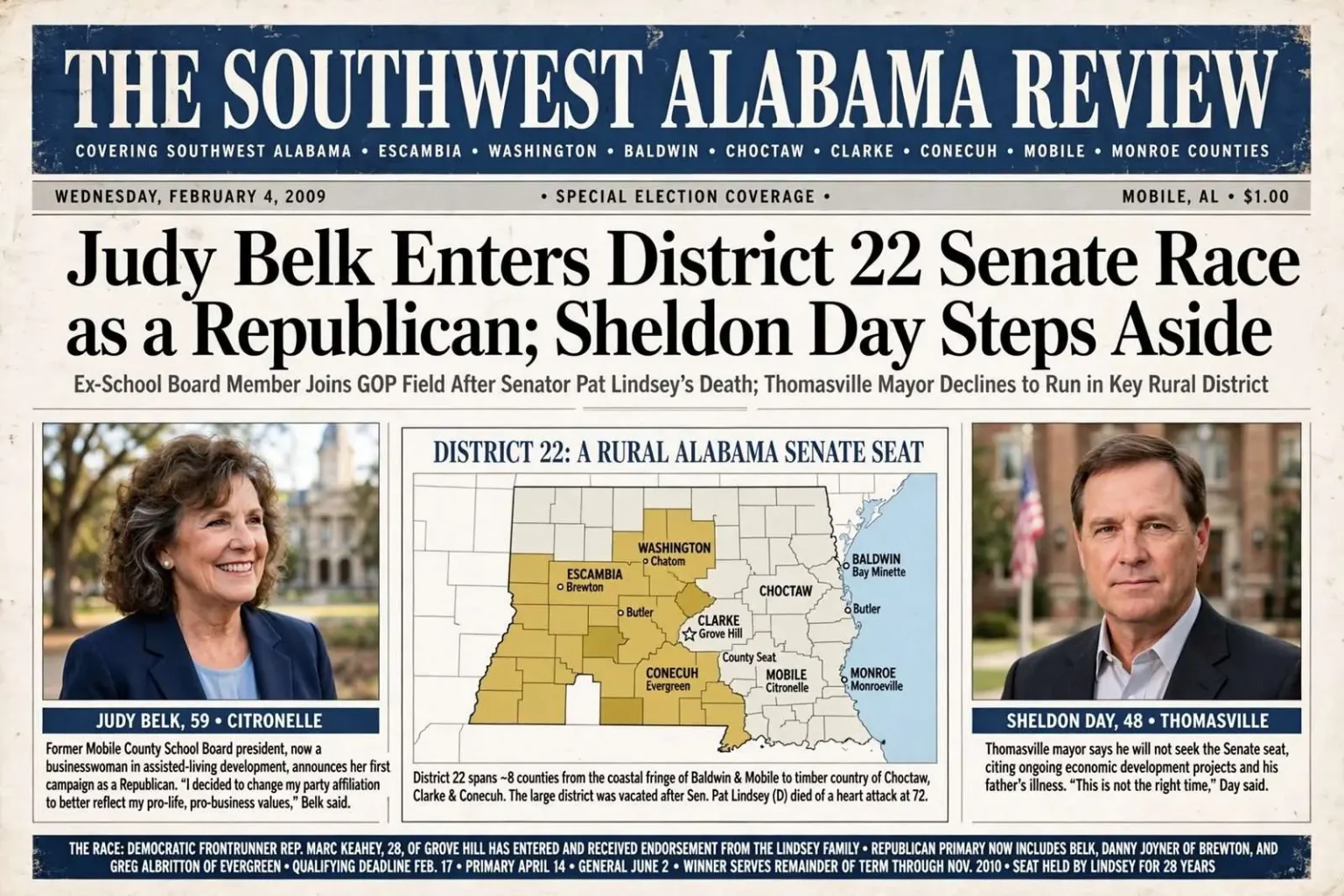
The scramble to fill the state Senate seat left vacant by the death of Sen. Pat Lindsey delivered two surprises to Alabama Republicans on Wednesday, Feb. 4, 2009, one at each end of the sprawling District 22. Thomasville Mayor Sheldon Day, widely expected to run, announced he would not. And former Mobile County School Board member Judy McCain Belk of Citronelle announced that she would — in her first campaign as a Republican. Within a matter of days, the contest for one of Alabama’s largest and most rural Senate districts had reshaped itself around a young Democratic frontrunner, a prominent convert to the GOP, and a mayor who surprised nearly everyone by staying home. The qualifying deadline was still two weeks away, and both parties understood that whoever won the seat would cast votes in a chamber balanced on a knife’s edge.
Lindsey’s death left a vacuum
Lindsey, a 72-year-old Butler attorney, had died after suffering a heart attack in his sleep at a west Alabama hunting camp. He had held the District 22 seat for seven terms and was a Senate mainstay, a senior member of the Democratic majority whose seniority translated into influence over budgets and local projects that reached far beyond his own district. News of his death landed hard in the small towns of southwest Alabama, where Lindsey had been a fixture of courthouse politics for a generation. Colleagues in both parties described him as a legislator who knew the rules of the Senate as well as anyone and was willing to use them.
His death came on the brink of the regular legislative session and threw an already bitterly divided chamber into further turmoil, narrowing the Democrats’ ruling coalition to perhaps a single vote over a Republican-led minority. The Senate had spent years riven by organizational fights, contested committee assignments and proxy battles between legislative leaders and the governor’s office, and Lindsey’s seat gave the Democrats no cushion to absorb the loss. Every contested vote, from budget battles to local legislation, now carried the weight of an election that had to be scheduled, financed and won. Lobbyists, county officials and school superintendents across the district all had a stake in who would fill the chair.
District 22 is one of the largest Senate districts in the state, taking in all of Escambia and Washington counties and parts of Baldwin, Choctaw, Clarke, Conecuh, Mobile and Monroe. It is a swath of timber country, small towns and coastal fringe that has rarely fit neatly into either party’s map. Voters in Brewton or Jackson might live a two-hour drive from a constituent in the remote reaches of Washington County, and the district’s economy rests on pine plantations, pulp mills, catfish ponds, hunting leases and the small downtowns that serve them. A senator who wants to represent it has to be as comfortable at a Conecuh County cattle sale as at a Baldwin County subdivision meeting.
Keahey the Democratic frontrunner
State Rep. Marc Keahey, 28, of Grove Hill, was the clear frontrunner for the Democratic nomination and the only Democrat to announce at that stage. An attorney and part-time assistant district attorney, Keahey had been elected to the House in 2006 and chaired the Contract Review Committee, serving also on the Judiciary and the Agriculture and Forestry committees. His two years in the House had given him a working knowledge of the state budget process and of the rural-agriculture issues that dominate life in the Black Belt and timber counties north of Mobile. At an age when most attorneys are still building their practices, he had already compiled a legislative record that included oversight of state contracts — one of the least glamorous and most consequential assignments in the Statehouse.
Keahey’s home base of Grove Hill, the seat of Clarke County, sat near the geographic center of the district, and his law practice and prosecutor’s work had put him in regular contact with clients and victims’ families across southwest Alabama. The part-time assistant district attorney’s post paid little but carried weight in a region where the district attorney’s office is among the most visible arms of state government. Party officials noted that he could run on both his record and his ties to the Lindsey family, an advantage no other candidate could match.
The strongest signal of Keahey’s position came from inside the Lindsey family itself. The senator’s children, Lori and Patrick Lindsey, endorsed him within days of his announcement. “I can think of no better person to pick up where my father left off,” Lori Lindsey said. “I see the same passion for public service in Marc that I saw in my father all my life.” Her brother said their father “would be proud to have Marc follow in his steps.”
In rural Alabama Senate districts, where name recognition and personal trust often matter more than party label, the blessing of the Lindsey family effectively capped off the Democratic field before it had even fully formed. Keahey accepted the endorsement with the kind of language that acknowledged the burden it carried. “I am humbled by the endorsement of Lori and Patrick,” Keahey said. “Without their encouragement and endorsement I would not be in this race.” He and his wife, Lara, lived in Grove Hill with their two children, and he campaigned as a young father with a stake in the schools, clinics and roads of the district he hoped to represent.
A convert joins the Republican field
Belk, a former Democrat, joined Brewton businessman Danny Joyner and Evergreen lawyer Greg Albritton in the Republican primary. Her entry changed the character of the contest. Joyner and Albritton were credible candidates with roots in the district’s eastern end, but Belk brought a resume that stretched across education, economic development and party politics, and a personal story that mirrored the way south Alabama was shifting. In communities that had sent Democrats to Montgomery for a century, Republicans had been quietly collecting offices and converts throughout the 1990s and 2000s, and Belk’s switch was a visible sign of that migration.
A businesswoman who owns Belk Development Company, she was then developing assisted living facilities in Alabama, Mississippi and Florida. The work had put her in the middle of one of the fastest-growing corners of the health care economy, as an aging population across the Gulf Coast created demand for facilities that small towns often could not attract on their own. It also meant she had spent years negotiating zoning boards, county commissions and state regulators in three states — experience she pointed to when voters asked what qualified her for the Senate.
Her public service record was long by any local standard. She served as president of the Mobile County School Board from 1983 to 1987, presiding over one of the largest school systems in the state at a time when Mobile County was wrestling with desegregation litigation, changing enrollment patterns and the perennial fight over school funding. She was a former director of the National Federation of Urban-Suburban School Districts, sat on the executive committee of the 2006 Alabama Judicial Campaign Oversight Committee, and chaired the board of the Alabama Restaurant Association. The judicial oversight post, in particular, gave her standing to speak to the ethics of campaigns in an era when Alabama judicial races had drawn national attention for their cost and tone.
Belk said she had concluded that her convictions no longer matched her old party. “As a pro-life, pro-business, pro-arms independent thinker who has reached out to the Democratic Party for many years, I decided to change my party affiliation,” Belk said. “My focus has always been, and will always be, improving our communities, state and country above partisan politics.” The statement was aimed squarely at voters in the district’s smaller communities, many of whom had spent their lives splitting tickets and did not think of themselves in strictly partisan terms. It also acknowledged, without apology, the ideological direction the Republican primary was heading.
Day’s decision to remain on the sidelines surprised many, because the Thomasville mayor had been mentioned for the seat almost from the day Lindsey died. He was one of the best-known municipal leaders in the district, a mayor who had spent years courting industry to his Clarke County city, and party leaders in both camps had assumed his fundraising network and name recognition would make him the Republicans’ strongest recruit. “This has been a very hard decision for me,” the Thomasville mayor said. “As mayor of Thomasville, I have dedicated myself to bettering our area with new jobs and investments in a safe, family-friendly community. While I believe that the state Senate would allow me to take my mission to the next level, this is not the right time.”
He cited ongoing projects in Thomasville and his father’s ill health as the reasons. The explanation rang true to anyone who had followed his tenure: Day had staked his mayoralty on landing employers for a city that had watched timber and textile jobs thin out, and stepping away mid-negotiation to spend two years in a special election campaign was a gamble he was not willing to take. His decision left the Republican primary to Belk, Joyner and Albritton, and left open the question of whether Thomasville’s business wing of the party would line up behind one of them or sit the race out.
The calendar and the map
Candidates had until Feb. 17 to qualify. Party primaries were set for April 14 and the general election for June 2, with the winner serving out the remainder of Lindsey’s term through November 2010. The compressed schedule meant a campaign of barely two months from qualifying to the primaries, forcing candidates to introduce themselves across a district that spans hundreds of square miles of rural country with little overlap in its media markets. Radio, courthouse-square yard signs and word of mouth would matter as much as any television buy, and the candidates who had spent years at fish fries and funerals in each county started with an advantage money could not quickly buy.
The geometry of the district shaped the race as much as the calendar did. All of Escambia and Washington counties and parts of Baldwin, Choctaw, Clarke, Conecuh, Mobile and Monroe fell inside its lines, stitching together suburban pockets near the coast with Black Belt towns on the prairie edge. A candidate could drive from Citronelle to Brewton and pass through three counties without seeing a traffic light. Whoever won would have to hold together a coalition of rural Democrats who had voted for Lindsey for years and coastal Republicans whose numbers were growing every cycle.
Keahey won the seat that spring and held it until 2014, building a record as one of the more conservative Democrats in the chamber even as his party’s margins shrank around him. Greg Albritton, defeated in this contest, was later elected to the same District 22 seat in 2014 and became one of the more prominent figures in the Alabama Senate, eventually chairing the committee that writes the state budget. Belk’s race, meanwhile, was remembered in Republican circles as an early example of the high-profile party switches that would reshape south Alabama’s political map in the decade that followed. For the residents of the district, the spring of 2009 marked the end of an era: the first election in twenty-eight years in which the name Lindsey was not on the ballot.