Last-Minute Legislative Compromise Averts Threat of Mobile Port Shutdown Over Bar Pilots Bill
Alabama lawmakers reached a last-minute compromise on legislation reauthorizing the licensing board for Mobile's bar pilots, averting the threat of disrupted operations at the Port of Mobile.
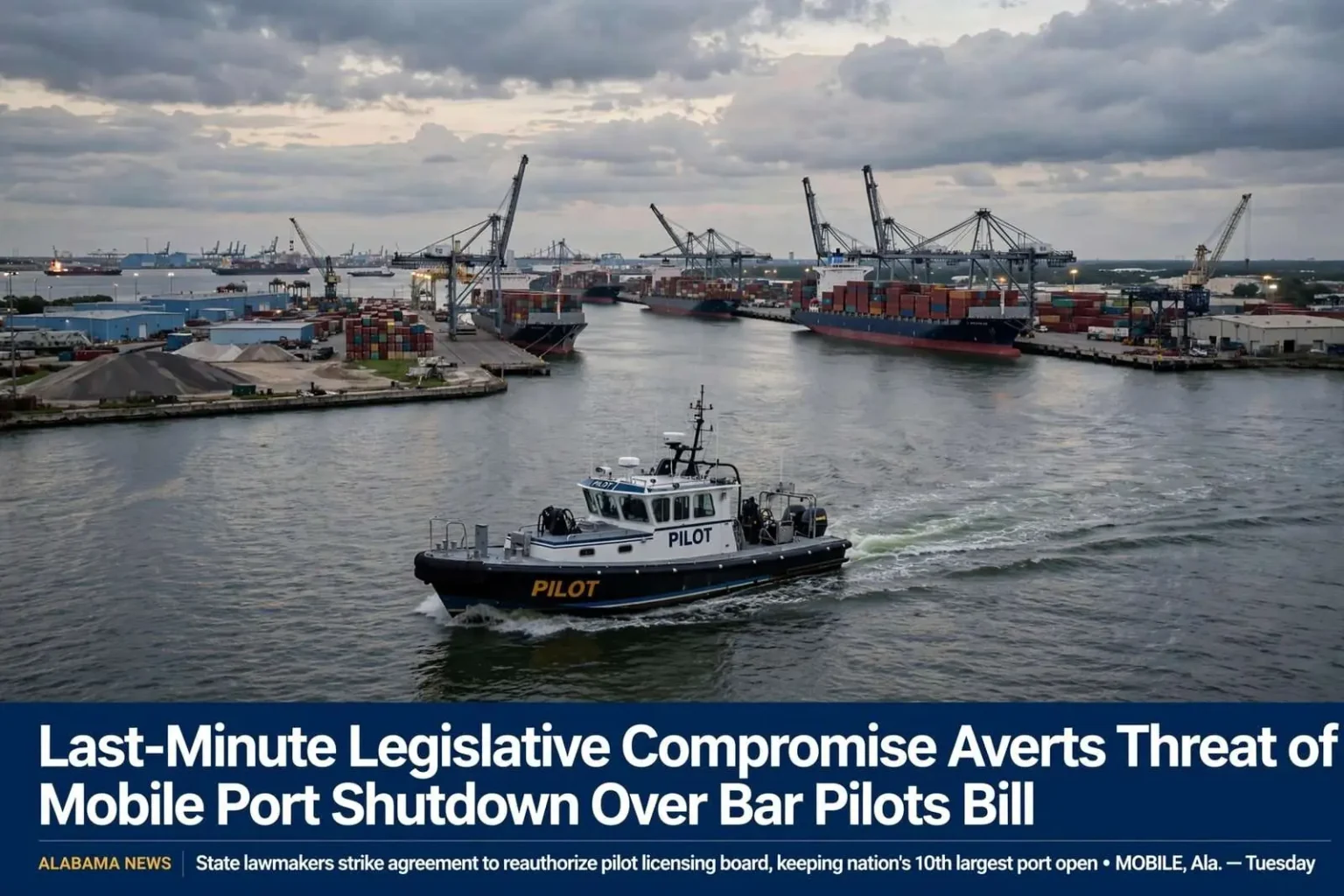
State lawmakers struck a last-minute compromise Tuesday night, clearing the way for operations at the Port of Mobile to continue without interruption after weeks of uncertainty over legislation governing the licensing board that oversees the port’s bar pilots.
The bill, sponsored by state Sen. Trip Pittman, R-Montrose, reauthorizes the licensing board responsible for bar pilots, the specially trained mariners who guide large commercial vessels safely through the Mobile shipping channel. The legislation also expands the board by adding a fourth member. Both chambers of the Alabama Legislature passed the measure, sending it to Gov. Kay Ivey’s desk for her signature, according to Pittman.
The version that ultimately passed included an amendment added in the House that changed how the board’s newly created fourth seat would function. Under the amendment, that member would serve in a non-voting capacity, and the Alabama State Port Authority would be given the authority to recommend to the governor who should fill the position — a structural concession that proved key to unlocking agreement between the parties on opposite sides of the issue.
Why the Stakes Were So High
The compromise removed the immediate risk that operations at the port, the nation’s 10th largest, could have been disrupted. Had the board’s authorization lapsed without replacement legislation, the legal framework for licensing the pilots who bring cargo ships in and out of the channel would have been thrown into doubt, with potentially immediate consequences for vessel traffic.
Bar pilots occupy a specialized and indispensable niche in maritime commerce. Every large oceangoing vessel entering or leaving a port relies on pilots with intimate local knowledge of the channel — its depths, currents, shoaling patterns and traffic — because no ship’s master can be expected to know every harbor’s quirks. In Mobile, pilots board vessels in open water at the sea buoy offshore and navigate them roughly 30 miles up Mobile Bay and the ship channel to the docks, and then guide outbound traffic back through the same route in all weather, day and night.
Without properly licensed pilots on duty, those movements legally cannot proceed, meaning a lapse in the licensing structure would not merely create paperwork problems. It could have stalled container ships, bulk carriers, tankers and the tug-and-barge traffic that moves through the port daily, rippling out to the terminals, rail yards, warehouses and manufacturers that depend on predictable sailings.
Averting a Federal Takeover
The compromise also headed off what officials described as a possible move by some parties to bypass the state licensing structure altogether by seeking federal control over the shipping channel, an outcome port and business officials had been working to avoid.
The possibility of federal intervention framed the debate for stakeholders across the region. A federal role in pilotage or channel operations would have shifted oversight of a core Alabama asset to Washington, unsettling arrangements that have governed the port for generations and raising questions about everything from pilot training standards to fee structures. Business leaders feared the uncertainty alone — even short of any actual change — could chill carrier confidence in Mobile at exactly the moment the port was working to grow its share of Gulf Coast cargo.
Keeping pilotage under state law preserved Alabama’s ability to manage its own maritime workforce and kept the port’s governance in local hands, which port officials and the business community treated as the most important outcome of the session’s final days.
“We appreciate the last-minute efforts of our legislators who affected the compromise language as well as our shipper and business stakeholders who weighed in on this critical issue,” Alabama State Port Authority spokeswoman Judy Adams said in a statement following the vote.
Adams’ statement captured the relief that ran through Mobile’s maritime community after weeks in which the legislation’s fate had been genuinely uncertain. The Port Authority, which manages the publicly owned terminals and facilities at the port, had watched the pilotage dispute from a position of acute exposure: its customers’ vessels are the ships the pilots move, and any disruption in licensing would have hit the Authority’s operations and revenues directly alongside those of private terminals.
The Business Community Mobilizes
The Mobile Area Chamber of Commerce relayed news of the bill’s passage to its members in an email Wednesday morning, following an earlier message earlier in the week that had urged members to contact lawmakers about the risks of the bill failing before the legislative session ended.
The chamber’s involvement illustrated how broadly the pilotage question reached beyond the docks. Its membership spans the region’s manufacturers, logistics providers, retailers and professional services firms — companies that may never load a container themselves but whose payrolls depend on cargo moving through the port on schedule. When the chamber tells hundreds of member businesses to call their legislators, the volume of constituent contact in the session’s closing hours can be decisive, and by all indications it was.
The episode also demonstrated the unusual leverage a legislative deadline creates. Because the session’s end fixed a hard cutoff for passing reauthorization, every day of delay pushed the port closer to operating without its legal pilotage framework, giving all sides strong incentives to trade hardline positions for compromise language that could actually clear both chambers.
The Fourth Seat and the Balance of Power
The fight over the board’s composition reflected deeper disagreements about who should hold influence over pilot licensing at the port. Adding a fourth member to what had been a smaller board changed the arithmetic of every future decision the panel makes — from licensing individual pilots to setting the rules that govern their work.
By making the new seat non-voting and giving the Alabama State Port Authority the power to recommend the appointee to the governor, the House amendment threaded a needle. The Port Authority gained a formal voice in the board’s deliberations without holding a vote, and the governor retained appointment authority, while the existing voting structure that pilots and other stakeholders relied upon remained intact.
For Sen. Pittman, the arrangement represented the kind of negotiated outcome that keeps essential state functions running when competing interests deadlock. Legislation reauthorizing regulatory boards rarely draws headlines, but the Mobile pilotage bill became an exception because so much of the region’s economy sat downstream of a single signing.
What It Means for the Port’s Future
With the reauthorization on its way to Gov. Ivey, port stakeholders could turn their attention back to growth rather than contingency planning. Mobile has invested heavily in recent years to compete for Gulf Coast cargo, from terminal expansions to the ongoing effort to deepen and widen the Mobile ship channel, and every one of those projects presumes a stable, state-recognized pilotage system moving vessels safely through bigger traffic volumes.
The port’s standing as the nation’s 10th largest reflects decades of steady gains in container traffic, breakbulk cargo and bulk commodities, and the business community’s fear throughout the debate was not simply that a shutdown would cost a few days of throughput. It was that even the appearance of governance instability could give carriers reason to route discretionary cargo to competing Gulf ports, a loss that lingers long after the immediate problem is fixed.
For local residents, the episode offered a civics lesson in how state law underpins everyday commerce. A licensing board most Alabamians have never heard of turned out to be the linchpin for the movement of goods that stock shelves, feed factories and keep the region’s freight economy running — and its continued existence required a compromise hammered out in the Legislature’s final hours.
A Model of Last-Minute Lawmaking
Close watchers of the Statehouse will recognize the pattern: contentious legislation that appears doomed for weeks, then resolves in a burst of amendment trading on the session’s final night. In this case, the combination of a hard deadline, an engaged business community and willing negotiators produced a bill that all sides could live with, if not one that any side got in full.
The compromise’s durability will be tested in how the reconstituted board operates with its new non-voting member in place. If the arrangement settles the dispute over pilot governance, the 2015-era fight will be remembered as a close call that strengthened the port’s institutional foundation. If not, lawmakers will likely find the issue back on their desks in a future session — with the same stakes and the same deadline pressure waiting.
For now, ships continue to move up and down the Mobile channel on schedule, pilots hold their licenses, and the state’s framework for managing them remains in Alabama hands. In Mobile, that is what winning looks like.
The resolution came as a relief to an industry that had spent weeks watching the calendar. Terminal operators, stevedoring companies, tug services and trucking firms all plan their work around vessel schedules published in advance, and the possibility that pilot licensing could lapse mid-session forced some of them to begin thinking about contingencies they hoped never to use.
Port officials had been careful in public comments throughout the debate, but privately the concern was consistent: the state’s pilotage framework had functioned for generations, and the only genuine emergency was the legislative deadline itself. The bill’s passage turned that emergency off with days to spare.