Milton Weighs $4.2 Million ‘Mill District’ to Reconnect Downtown With Blackwater River
Milton city leaders are reviewing design plans for a $2.4-$4.2 million 'Mill District' near the Blackwater River, a two-phase project pairing a public plaza with a small retailer village downtown.
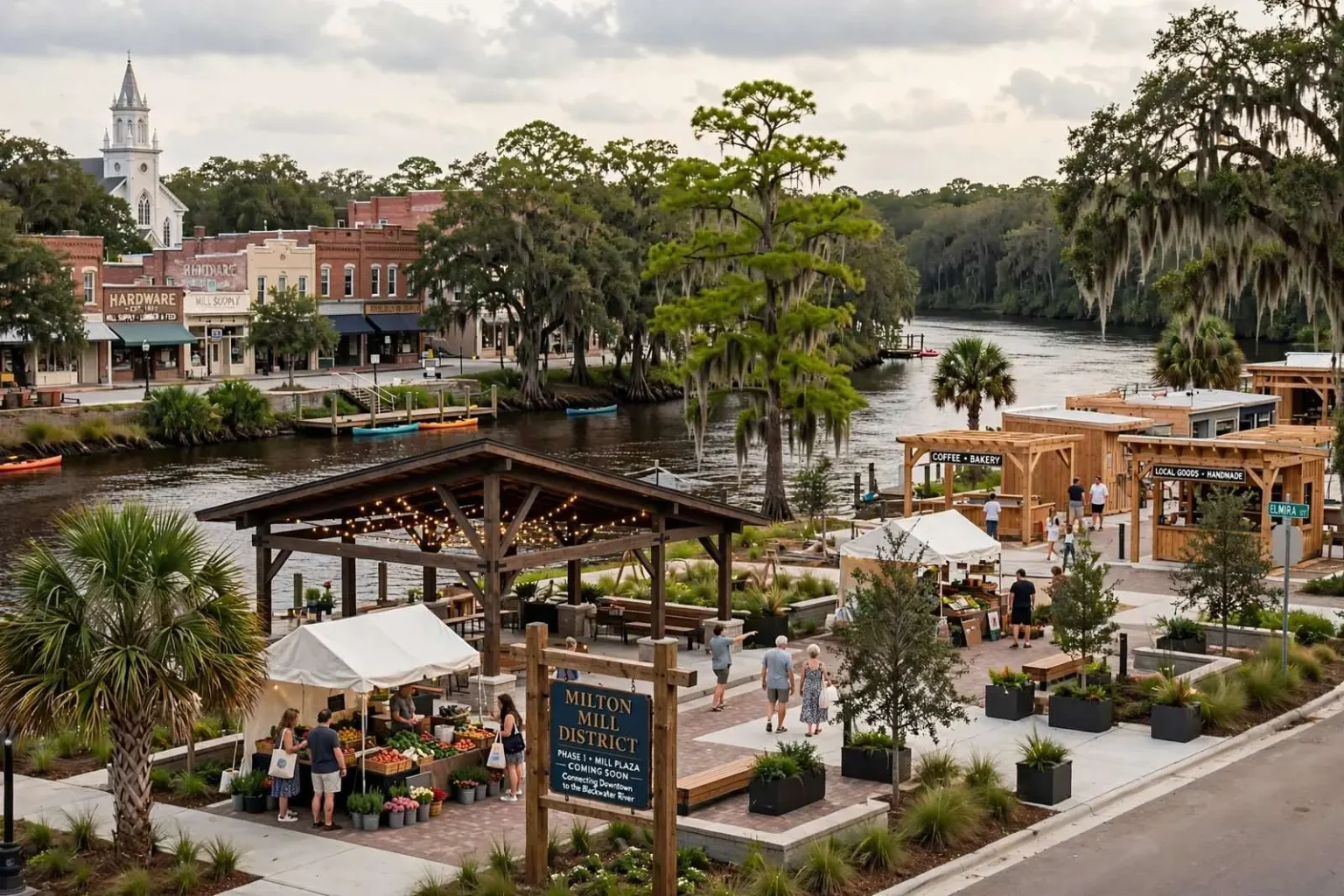
City officials in Milton, Florida are moving forward with plans for a new “Milton Mill District,” a multi-million dollar shopping and gathering space designed to blend the city’s historic identity with new economic activity just steps from the Blackwater River.
The Milton City Council is set to review design concepts for the project at an upcoming evening meeting, marking the latest step in a planning process that has been underway for roughly a year. The initiative aims to give Milton a clearer identity as a destination in Northwest Florida by leaning into the city’s roots as a milling and lumber town.
“What we are looking at is a new theme for Milton that embraces its history, focusing in on it being that Milton Milltown,” said Stephen Prestesater, the city’s economic development director.
The branding is more than marketing. Milton grew up on the timber trade that moved down the Blackwater River, and the sawmills and lumber operations that lined its banks built the downtown that still stands a few blocks from the water today. Reclaiming that story — in the name of a district, in its design and in the events it hosts — is the city’s answer to a question many small Florida downtowns face: what gives visitors a reason to come, and stay.
Milton serves as the county seat of Santa Rosa County, one of the faster-growing counties in the Panhandle, yet its historic core has watched nearby beaches and interstate corridors capture most of the region’s retail growth. The Mill District concept is an attempt to turn the city’s position on the river — long an industrial asset — into a leisure and destination asset that draws residents of Pace, Gulf Breeze and the beach communities inland for an afternoon.
A two-phase approach
The project is being planned in two phases. The first, known as “Mill Plaza,” would transform the lot currently used for public parking near the riverfront into a landscaped public space with a pavilion, intended to host farmers markets, community festivals and other gatherings.
“We’d be activating public space first in that first phase, trying to determine whether or not this could be a successful endeavor and move us into that second phase,” Prestesater said.
Starting with public space rather than shops is a deliberate sequencing choice. A plaza costs less than a commercial district, can open quickly and generates foot traffic that proves — or disproves — the concept before the city and private partners invest in the second phase. If farmers markets and festivals draw consistent crowds to the riverfront, the demand for permanent storefronts nearby becomes easier to demonstrate.
The second phase, called “Kiosk Village,” would take shape on privately owned land on the other side of Elmira Street from the plaza. That space is envisioned as a home for small-scale retailers renting kiosk-style storefronts, giving local entrepreneurs an entry point into a walkable commercial district.
“We believe it’s something that people want,” Prestesater said. “We can see the growth is there, and it is our charge and task to be able to support that.”
The kiosk model lowers the barriers that usually keep small businesses out of downtown retail. A startup vendor who cannot sign a multi-year lease on a building can rent a small footprint instead, testing a product line in front of real foot traffic. For the city, the result is a rotating mix of sellers that keeps the district fresh — and a pipeline of merchants who may grow into permanent spaces as they succeed.
Funding a multi-million dollar vision
Estimates for the full project range from $2.4 million to $4.2 million. City officials say funding would be drawn from a combination of sources, including Milton’s Community Redevelopment Agency (CRA), general city funds, and public-private partnerships.
A CRA is a local funding mechanism many Florida cities use to reinvest property tax growth from a designated district back into improvements within that same area, often to spur redevelopment in older downtown corridors. When property values inside a CRA district rise, the incremental tax revenue above the base year is captured and spent on projects within the district — streetscapes, facades, infrastructure and public spaces like the Mill Plaza would be. The mechanism lets a city fund revitalization without raising tax rates, and it ties the agency’s success directly to the appreciation of the very properties the district is meant to improve.
Public-private partnerships form the third leg of the funding plan, and the Kiosk Village phase in particular depends on one. The land across Elmira Street is privately owned, which means the second phase moves forward only if the city and the property’s owner find shared value in the concept. The city’s contribution would come in planning, infrastructure and coordination; the private side would carry development of the retail spaces.
The range in cost estimates — nearly $2 million from low to high — reflects how much design depends on decisions not yet made: the extent of landscaping, the size of the pavilion, utility relocations and the unknowns that surface when riverfront property is reworked. Officials have been careful to keep the flexible numbers flexible while the concept is still under review.
Neighbors welcome a walkable downtown
The project site sits next to First Presbyterian Church of Milton, one of the oldest churches in Santa Rosa County, founded in 1868. The church’s pastor, Deborah Potter, said the plan aligns with the kind of close-knit, pedestrian-friendly downtown many residents say they want.
“I’m excited about the walkability,” Potter said. “We’re trying to build serious communities, share life together, and you can’t do that if you’re not a walkable community that comes into contact with neighbors every day.”
Potter added that the Mill District concept fits with the broader vision residents have voiced for downtown Milton.
“We think that fits in with the whole downtown, what we want to be in terms of walkability, artists, people interested in a real vitality and diversity in life,” she said.
The church’s support carries weight in a downtown where institutions have deep roots. A congregation founded three years after the Civil War ended has watched Milton’s riverfront economy transform from sawmills to quiet streets, and its endorsement of a walkable, artist-friendly district signals that the city’s old guard and its planners are imagining the same downtown.
What’s next for the Mill District
No final decisions on the Mill District were expected at the upcoming council meeting. City staff said the review is part of an ongoing evaluation of funding sources, property needs and the broader impact the project could have on downtown Milton before any formal approvals move forward.
That deliberate pace is typical of projects funded partly through CRA money, which must be programmed through the agency’s budget and trust fund over multiple years. The council’s review of design concepts is an early milestone rather than a groundbreaking: concept, then funding plan, then property agreements, then construction documents, with public input possible at each stage.
The questions ahead are practical ones. How much of the existing parking near the riverfront can be converted to plaza space without stranding the businesses that rely on it? What staging of construction keeps downtown accessible during the work? And how quickly can the CRA’s incremental revenue grow to cover a project estimated between $2.4 million and $4.2 million without stretching the city’s general fund?
Why downtowns bet on public space
Milton’s approach follows a playbook that has worked in small downtowns across Florida and the Southeast: build the gathering place first, and the retail follows. A riverfront plaza with a pavilion gives the city a stage for the farmers markets, concerts and festivals that create habits — residents who come downtown every Saturday morning are customers a kiosk vendor can count on.
The walkability argument that Pastor Potter emphasizes is also an economic one. Downtowns compete with highway corridors on convenience and lose; they compete on experience and can win. A district where a family can park once and walk between the river, a market, a kiosk and a restaurant offers something a strip mall cannot, and the Mill District’s design — anchored on the river, connected across Elmira Street — is built around that difference.
For a city of Milton’s size, the project also represents a test of institutional patience. CRA-funded revitalization rarely shows its full effect in a single budget year; the sequence of plaza, vendors, private investment and rising property values plays out over many years. City officials say the year already spent planning has been spent deliberately — building the concept, testing it against public input and lining up the funding pieces before committing dollars.
If the council continues to move the concept forward, the next steps will refine the design, confirm the funding mix and prepare the agreements that turn a parking lot by the Blackwater River into Milton’s new front porch — a Mill District built, as its name promises, on the city’s own history.