Mississippi oystermen move oysters to cleaner waters to rebuild population
Mississippi oystermen and the Department of Marine Resources are relocating tens of thousands of oysters to cleaner waters to rebuild the population.
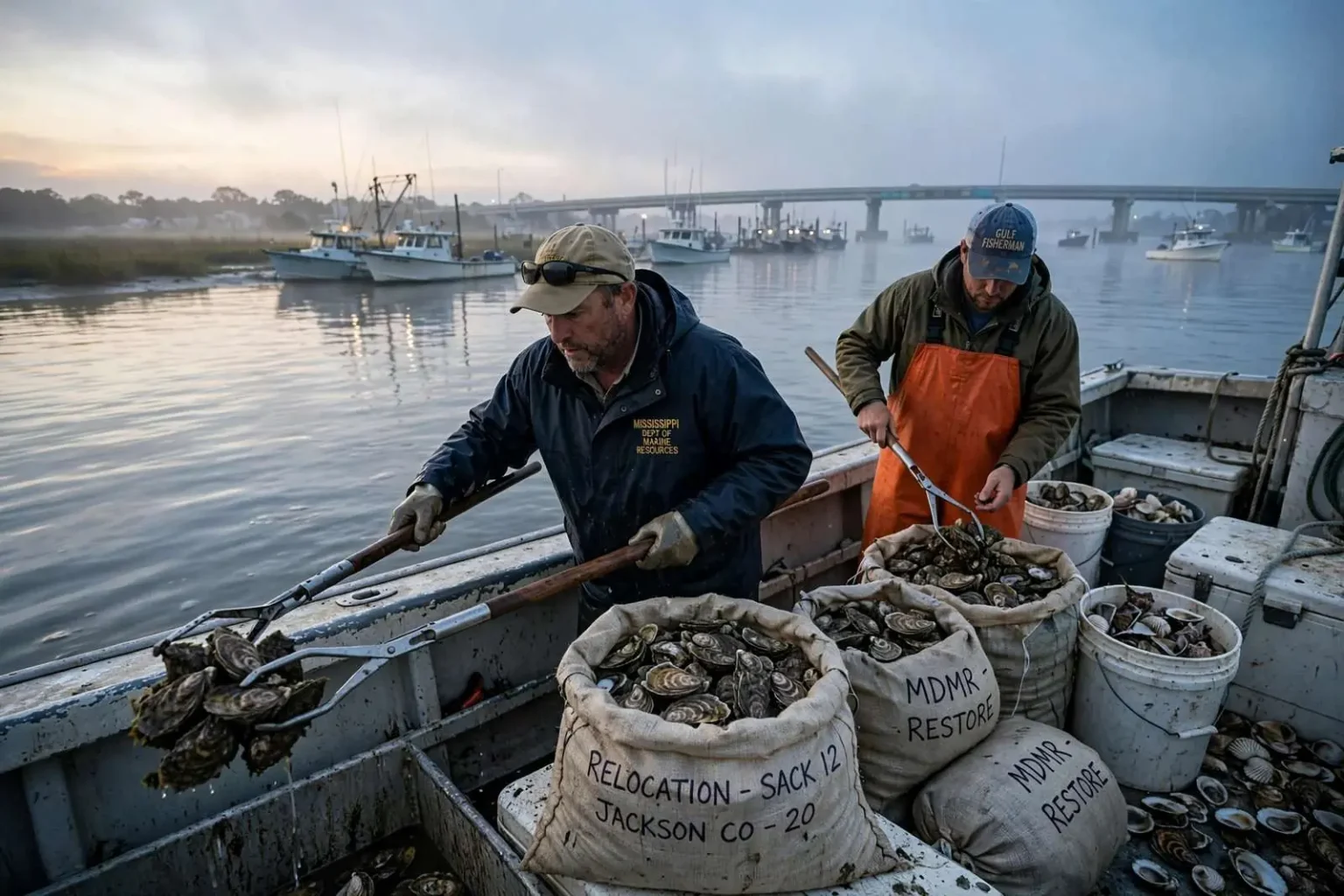
Oystermen in Mississippi are working to rebuild the state’s oyster population by relocating the mollusks to cleaner waters, a cooperative effort between commercial fishermen and the Mississippi Department of Marine Resources. Fishermen teamed up with the state agency to move tens of thousands of oysters, beginning at dawn at the Pascagoula Causeway Reef in Jackson County, where boats gathered before daylight to start the transplant work.
The operation moves oysters from waters where they have struggled into areas with better conditions for survival and growth. Relocation has become one of the state’s most practical tools for restoring a fishery that has been battered in recent years by freshwater intrusions, hurricanes and habitat loss, and it puts the men and women who know the Sound’s waters best at the center of the recovery effort.
Under the rules governing the effort, fishermen were limited to hand tongs for the first three days of the work. After that, tongs and hand-retrieved dredges were allowed until this year’s quota of 18,864 sacks was reached. State specifications require dredges to be retrieved by hand, a restriction meant to limit the impact of harvesting gear on the reef bottom.
How the relocation harvest works
The mechanics of the effort blend commercial fishing tradition with fishery management. Hand tongs — long-handled scissor-like rakes that fishermen work from the side of a boat — lift clusters of oysters off the reef a few at a time. Dredges do the same work with a toothed frame and mesh bag dragged across the bottom, but Mississippi’s rules for this fishery require that the dredge be pulled up by hand rather than by mechanical winch, keeping the harvest labor-intensive and limiting how much bottom each pass disturbs.
The quota system structures the whole operation. There is no daily limit on how many sacks a fisherman can harvest under the program, but a single trip is capped at 20 sacks whether the fisherman is using tongs or a dredge. The 18,864-sack quota for the year sets the ceiling for the entire relocation harvest, and once it is reached, the work stops. Quotas of this kind give the Department of Marine Resources a way to channel fishing effort toward restoration while keeping the take within bounds that managers believe the reef can sustain.
For the fishermen, the program offers paid work in a fishery that has offered little of it in recent seasons. Oyster harvests in Mississippi have collapsed in some years to a fraction of historic levels, leaving boats tied up and families scrambling. Relocation harvests turn restoration into income, and they keep working watermen engaged in the rebuilding of the very resource they depend on.
Why Mississippi’s oysters need the help
Mississippi’s oyster reefs have endured a brutal decade. The Bonnet Carré Spillway’s openings sent floods of fresh river water into the Mississippi Sound, lowering salinity to levels that killed oysters across wide swaths of the fishery. Hurricanes have buried or scattered reef material, and years of light harvests have left the population without the dense adult spawning stock that a reef needs to replenish itself. The result has been consecutive failed or sharply limited seasons, and a shrimp-and-oyster culture along the Gulf Coast that has watched its working fleet shrink.
Oysters are more than a commercial crop. Each oyster filters gallons of water a day, and healthy reefs clean the Sound while providing structure that fish, crabs and other species use as habitat. Reefs also buffer shorelines, taking energy out of waves that would otherwise chew away marsh edges. When oyster populations collapse, the losses ripple through the ecosystem and through the economies — restaurants, seafood houses, bait shops, boatyards — that depend on the fishery.
That is why moving oysters to cleaner water matters. Relocation takes surviving oysters out of areas where salinity, silt or disease threaten them and plants them where they are more likely to grow, spawn and multiply. It also concentrates brood stock on reefs chosen for their conditions, jump-starting natural reproduction in places where managers want the population to rebuild.
The Department of Marine Resources and reef management
The Mississippi Department of Marine Resources manages the state’s oyster fishery from its base in Biloxi, setting seasons, quotas and gear rules, and running restoration programs funded by state appropriations and by the penalties and settlements that followed the Deepwater Horizon disaster. The agency plants cultch — oyster shell and other hard material — to create new reef bottom, monitors salinity and spat set, and works with commercial fishermen on programs like the relocation harvest at the Pascagoula Causeway Reef.
The Pascagoula Causeway Reef and Jackson County’s waters
The Pascagoula Causeway Reef sits in Jackson County waters along the causeway that links Pascagoula with the barrier-island side of the Sound, an area where fresh water from the Pascagoula River mixes with Gulf water. That mix of salinity is exactly what makes reef management there delicate: oysters thrive in brackish water, but too much fresh water — as the region has seen in flood years — can kill them. Starting the relocation at dawn, as the fishermen did, is both a practical choice and a traditional one; oystermen have always worked the early tide, and daylight hours in a Mississippi summer are punishing on open water.
Jackson County’s working waterfronts at Pascagoula and Moss Point have long ties to the seafood industry, and the sight of tong boats gathering before sunrise at the causeway is a familiar one to locals. The relocation effort brings those boats back to work, and it concentrates activity at a reef that state managers have invested in as part of the broader rebuilding plan for the Sound.
What the rules tell us about the fishery
Every rule in the relocation program reflects a judgment about how to harvest oysters without undoing the restoration they are meant to advance. The three days of hand-tongs-only work allowed the most delicate early harvest while the effort got organized. The hand-retrieval requirement for dredges keeps mechanical power out of the operation, limiting both the pace of harvest and the disturbance to reef material that serves as substrate for the next generation of oysters. The 20-sack trip cap spreads opportunity across the fleet rather than letting the biggest boats dominate. And the 18,864-sack quota fixes a hard ceiling tied to what managers believe the resource can bear.
Regulations of this kind have long defined the Mississippi oyster fishery, which is managed sack by sack in a way that few other fisheries are. Sacks — the burlap bags into which tonged and dredged oysters are piled — are the fishery’s common currency, counted at the dock and tallied against quotas. A season’s total, like this year’s 18,864 sacks, tells biologists exactly how much biomass came off the reefs, and it gives the Department of Marine Resources a clean point at which to close the harvest.
What rebuilding means for the Gulf Coast
A restored oyster fishery would ripple across the Mississippi Gulf Coast’s economy. Oyster houses and raw bars from Biloxi to Bay St. Louis depend on local product, and when Mississippi reefs fail, restaurants turn to oysters trucked in from Texas, Louisiana and beyond. A healthy local supply keeps money in the state’s seafood industry and preserves the culinary identity that Gulf oysters carry. The working fleet matters too: every season lost pushes captains and crew toward other trades, and rebuilding the resource is the only sure way to keep them on the water.
The ecological stakes are just as large. The Mississippi Sound’s oyster reefs are living infrastructure — filtering water, feeding fish, shielding shores — and the restoration investments now underway across the coast, from cultch planting to the relocation harvest, treat them that way. Programs that pay fishermen to move oysters to cleaner water combine the two goals: economic relief now, ecological recovery over time.
For the oystermen who gathered at the Pascagoula Causeway Reef before dawn, the work is both livelihood and legacy. The tens of thousands of oysters they moved to cleaner waters represent the next generation of the fishery — and, if the reefs respond as managers hope, the promise of seasons ahead when Mississippi oysters return to the docks, the markets and the tables of the Gulf Coast in numbers the state has not seen in years.
Lessons from other Gulf restoration efforts
Mississippi’s relocation work fits into a wider Gulf Coast playbook. Louisiana has run oyster relocation programs for years, paying fishermen to move oysters ahead of fresh-water floods and oil spills, and the model has proven its worth both as relief for the fleet and as conservation. Texas and Florida operate their own reef-building programs, and the federal RESTORE Act money that flowed to the Gulf after the 2010 oil spill has funded large-scale oyster restoration across all five Gulf states, Mississippi included.
The shared lesson from those efforts is that oyster recovery is measured in years, not seasons. Spat — the tiny oysters that settle on hard surfaces — take 18 months to three years to reach market size in Gulf waters, so an oyster moved to cleaner water this year becomes next year’s spawner and the year after’s harvest. Managers who plan on that timeline invest in reefs the way farmers invest in soil, and the fishermen who take part in the work are, in effect, tending a crop they will not fully see for several seasons.
For the coastal communities watching the quota climb toward 18,864 sacks, the numbers are more than bookkeeping. Each sack of oysters moved to cleaner water is a stake in the fishery’s future — a bet, backed by dawn starts on the causeway and hand-pulled dredges, that the Mississippi Sound’s oyster reefs can come back, and that the people who work them will be there when they do.