Salvation or Snake Eyes? Two Mobilians Argue Over the Convention Center’s Return on Investment
A published conversation between two Mobile observers weighs whether the downtown convention center has paid for itself, why Government Plaza depresses them, and whether high-speed ferries would ever carry anyone.
MOBILE — Has the Mobile Convention Center earned its keep? Two longtime observers of the city took up the question in a published exchange, and the answer they arrived at was less a verdict than a portrait of a city that has never quite been able to decide what it is. The Ledger Nobody Has Seen Neither participant was willing to brand the building a white elephant without the books in hand. One, a veteran of the hospitality and visitor industry, laid out the arithmetic he would want to perform: weigh the bricks-and-mortar cost of the structure against the dollars that flowed into Mobile’s economy because it exists, applying a conservative economic multiplier — he favors 2-to-1 — rather than the extravagant ones consultants tend to reach for. Then, he said, one would have to add the intangibles: civic pride, and the way the center may have catalyzed other downtown redevelopment. Pressed hard enough, he allowed, he would eventually concede that building the convention center downtown was a good idea.
Two Buildings, Two Fates
His counterpart was more skeptical about the investment but unreserved about the architecture. He calls the building beautiful and says walking through it lifts his spirits — a feeling he contrasts sharply with the sensation of entering Government Plaza, where he reports something closer to dread, “a foreboding that something Kafkaesque is just around the corner.” The two buildings, he notes, went up in roughly the same era, in roughly the same part of downtown, at enormous public expense. One inspires. The other deflates. He confesses he has never understood how that happened.
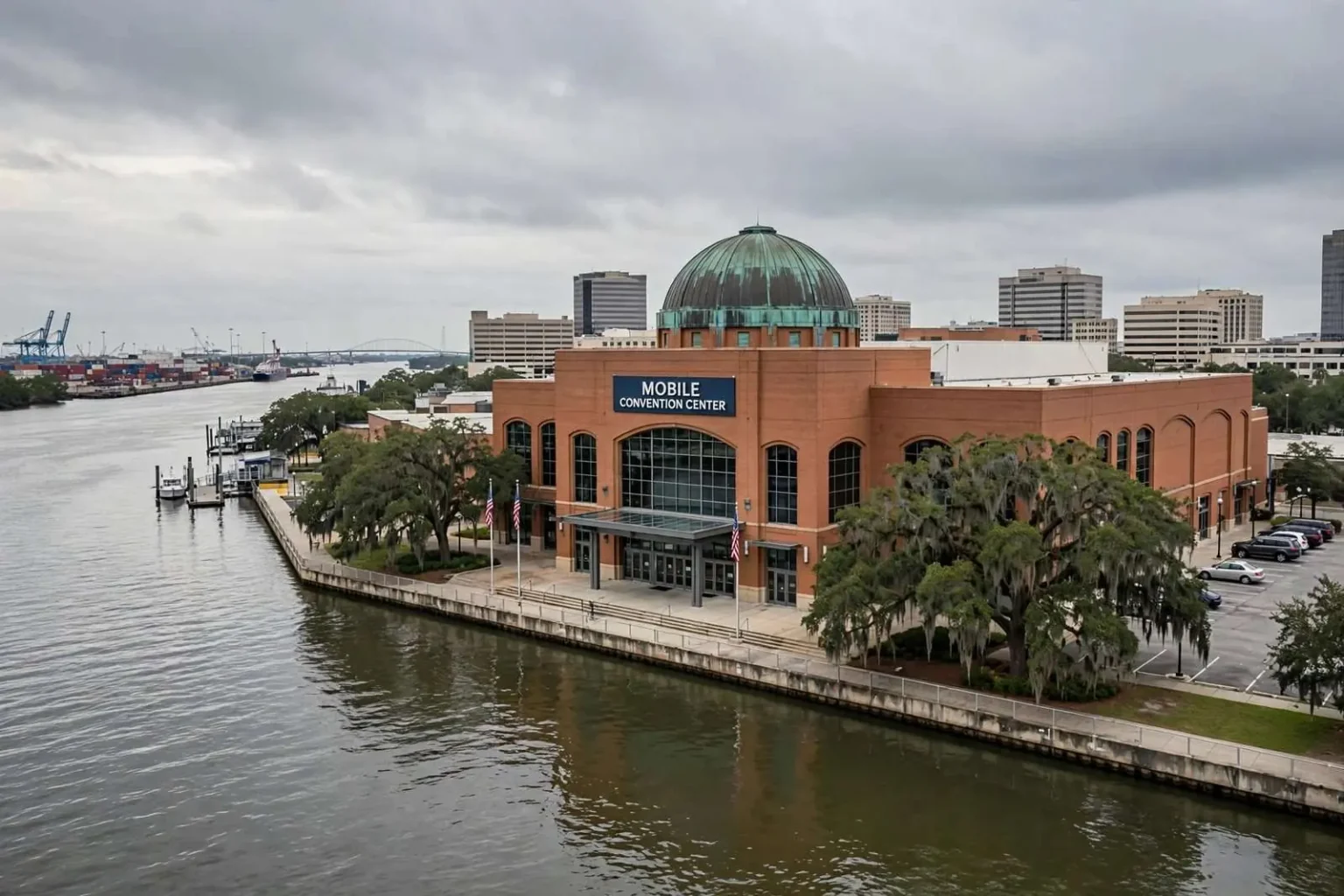
The Mobile Convention Center, opened in 1995 at a cost of approximately $42 million (equivalent to roughly $85 million in 2024 dollars), sits on a 14-acre site along the Mobile River waterfront. Its 100,000 square feet of exhibit space, 24,000 square feet of ballroom space, and 18 meeting rooms were designed to attract regional and national conventions that would fill hotel rooms, restaurants, and shops. Government Plaza, the consolidated city-county administrative complex completed in 1994, occupies a full block across Water Street. Its Brutalist-inflected design — concrete, glass, sharp angles — has been polarizing since its opening. The contrast the observer draws is not just aesthetic; it’s about the relationship between public architecture and civic identity.
The City With Perpetual Promise
The harder question is what the convention center has actually produced. The hospitality veteran recalled that in his professional dealings he heard plenty of praise for the building itself — usually followed by a variation on the same complaint: Why can’t they get their act together and attract visitors? He expects that to change, and he pins his hope on the Mobile Bay Convention and Visitors Bureau’s rebranding as “Gulf Shores & Orange Beach Tourism” — a shift that acknowledged the region’s true draw is the coast, not the convention center. The center, in this view, is a supporting player: a place for the meetings that happen when the beach families come for the weekend, or the corporate retreats that piggyback on a Gulf Shores golf outing.
The skeptic countered that this supporting-player role is precisely the problem. A convention center built to be a primary economic engine cannot survive as a secondary amenity. The fixed costs — maintenance, utilities, staffing, capital reserves — require a baseline of bookings that Mobile’s market has struggled to deliver. The center’s annual operating budget, subsidized by the city through lodging tax allocations, has run deficits in more years than not. The hospitality veteran acknowledged the deficits but argued they were the cost of maintaining capacity for the events that do materialize — the Shriners convention, the Mardi Gras balls, the Alabama League of Municipalities meeting — events that would have no other home in the city.
Downtown Redevelopment and the Convention Center’s Role
The question of catalytic effect — whether the convention center sparked broader downtown redevelopment — divides the observers. The hospitality veteran points to the Renaissance Mobile Riverview Plaza Hotel (opened 1996, adjacent to the center), the subsequent development of the Arthur R. Outlaw Convention Center’s adjacent parking deck and retail pad, and the gradual revival of Dauphin Street as evidence of a ripple effect. The skeptic argues that Dauphin Street’s revival owes more to the LoDa Artwalk, the arrival of craft breweries, and the adaptive reuse of historic warehouses — organic, bottom-up forces that had little to do with the convention center. He notes that the blocks immediately surrounding the center remain a mix of surface parking, generic office towers, and the occasional restaurant that lives and dies on convention traffic.
The debate mirrors a broader scholarly divide on convention center economics. Studies by the Brookings Institution, the Federal Reserve Bank of Chicago, and various university centers have consistently found that convention centers rarely generate the economic impact their boosters claim. The “multiplier effect” — the ripple of visitor spending through the local economy — is often overstated because it counts dollars that would have been spent elsewhere in the region anyway, or because it assumes full employment in the hospitality sector when slack capacity is the norm. The opportunity cost — what else the public investment could have funded — is rarely calculated.
Mobile’s convention center was born in an era when midsize cities across the country were building convention facilities as economic development strategies. The 1980s and 1990s saw a construction boom: Charlotte, Nashville, Indianapolis, San Antonio, Portland, and dozens of smaller markets all built or expanded centers. The logic was simple: if you build it, they will come. The reality was more complicated. The supply of convention space grew faster than the demand for conventions. Associations consolidated, meeting planners became more sophisticated, and second-tier cities found themselves competing for a shrinking pool of national events with escalating bids and concession packages.
The Mardi Gras Factor
Mobile’s convention center has a unique advantage that most midsize cities lack: Mardi Gras. The city’s Carnival celebration, the oldest in the United States (dating to 1703), generates a month-long surge of balls, parades, and events that fill the convention center’s ballrooms and exhibit halls every year. The hospitality veteran estimates that Mardi Gras-related bookings account for 30-40 percent of the center’s annual revenue — a guaranteed baseline that insulates the facility from the feast-or-famine cycle that plagues convention centers in non-festival cities. The skeptic concedes the point but notes that Mardi Gras would happen regardless; the balls just need a venue, and the convention center happens to be the largest one.
This Mardi Gras dependency shapes the center’s calendar in ways that limit its ability to pursue other business. The peak convention season — spring and fall — overlaps with the Carnival buildup and the post-Carnival decompression. Corporate events, which prefer predictable scheduling, often find the center blocked during the weeks they want. The center’s management has tried to mitigate this by marketing the facility for summer and winter events, but the Gulf Coast heat and humidity in summer, and the holiday season in winter, present their own challenges.
The Competing Vision: Cruise Terminal vs. Convention Center
The conversation turns, inevitably, to the cruise terminal. The Alabama Cruise Terminal, opened in 2016 on the site of the former Mobile State Docks grain elevator, represents a different bet on the waterfront. Carnival Cruise Line’s seasonal service from Mobile — initially the Carnival Fantasy, later the Carnival Sensation and Carnival Ecstasy — has brought thousands of passengers through downtown, generating hotel nights, restaurant meals, and parking revenue that the convention center’s backers once promised. The skeptic sees the cruise terminal as the better investment: a smaller footprint, lower operating costs, a clearer demand signal (people want to go on cruises), and a direct connection to the Gulf that the convention center lacks.
The hospitality veteran disagrees. The cruise terminal, he argues, is a tenant — Carnival could leave, as it did from Mobile in 2011 when the Fantasy was redeployed, and as it did from Gulfport and New Orleans at various points. The convention center is an asset the city owns and controls. The two can coexist, and the waterfront master plan adopted by the city in 2018 envisions a connected corridor from the cruise terminal through the convention center to the GulfQuest maritime museum and the Cooper Riverside Park. The challenge is operationalizing that vision — turning a string of disconnected facilities into a coherent destination.
Financial Transparency and the Missing Ledger
The exchange returns, repeatedly, to the ledger nobody has seen. The convention center’s financial statements are public records — the Mobile City Council approves the annual subsidy, and the center’s management presents quarterly reports. But the observers argue that the reports don’t answer the fundamental question: what is the net economic impact? The city’s lodging tax, which funds the subsidy, is itself generated by the hotel stays the center is supposed to produce. This circularity makes it difficult to isolate the center’s marginal contribution. A rigorous analysis would require tracking the origin of every convention attendee, their spending patterns, their length of stay, and the displacement effect on other local businesses — data that neither the center nor the visitors bureau collects systematically.
The hospitality veteran suggests a forensic audit — an independent, third-party analysis of the center’s economic impact using methodology accepted by the academic community. The skeptic doubts it would change minds. People who believe in the convention center will find validation in the numbers; people who doubt it will find confirmation of their skepticism. The building, in this sense, has become a Rorschach test for Mobile’s self-image: a city that builds beautiful things but can’t quite figure out what they’re for.
The Architecture as Argument
The skeptic’s architectural comparison — the convention center as uplifting, Government Plaza as oppressive — is not incidental. The convention center was designed by the local firm Holmes & Holmes (now Holmes & Associates) in a postmodern style that references Mobile’s historic architecture: arched windows, brick detailing, a copper dome that echoes the Cathedral Basilica of the Immaculate Conception a few blocks away. Government Plaza, designed by a joint venture of national firms, embraced the institutional modernism of the early 1990s — curtain walls, geometric massing, a plaza that feels more like a security perimeter than a public square.
The contrast matters because public architecture signals civic values. A convention center that welcomes visitors with light, proportion, and local reference says: this city values hospitality, beauty, and its own history. A government complex that turns its back on the street says: this city values efficiency, security, and the machinery of administration over the experience of citizens. The two buildings, built at the same time by the same political leadership, embody a contradiction that Mobile has never resolved.
Looking Forward
The convention center’s next chapter will be shaped by forces beyond its control. The post-pandemic meetings industry has shifted toward hybrid events, smaller footprints, and flexible spaces — trends that favor the center’s 18 meeting rooms over its 100,000-square-foot exhibit hall. The rise of remote work has reduced corporate meeting budgets but increased demand for off-site retreats. The Gulf Coast’s growing reputation as a leisure destination — driven by the beaches, the culinary scene, and the cultural revival in Mobile and Fairhope — creates a new context for the center as a venue for destination events rather than pure conventions.
The city’s waterfront master plan, if fully realized, would connect the convention center to a continuous riverwalk from the cruise terminal to the Africatown welcome center (currently in development). That connectivity could transform the center from an isolated facility into a node in a larger experience — exactly the kind of “destination within a destination” that meeting planners now seek. Whether Mobile can execute that vision, with its fragmented governance, limited capital, and perpetual promise, remains the question the two observers have been debating for decades. The building stands, beautiful and underutilized, waiting for the city to decide what it is.