A federal investigation into a long-running foreclosure auction scheme in Mobile has produced its 11th guilty plea, more than a decade after the illegal scheme is believed to have gotten underway. On Sept. 2, 2015, Michael P. Barbour admitted to conspiring with other investors to fraudulently acquire title to foreclosed properties at what prosecutors described as “artificially low prices.” The plea adds another name to a case that has unfolded in Mobile’s federal courts for years and has redrawn how many local buyers think about the courthouse auction business.
The scheme first came to light publicly with the 2011 indictment of Harold H. Buchman and Allen K. French. Investigators say a larger network of investors intentionally suppressed bidding at public foreclosure auctions, allowing a single designated bidder to purchase a property without competition and at a fraction of its value. In a normal auction, competing bidders drive the price toward what a property is actually worth; in a rigged one, everyone but the designated bidder holds back, and the difference becomes profit for the group.
According to court documents, the group would then hold a secret, second auction limited to conspiracy members, effectively creating a private secondary market for properties that should have been sold competitively at public auction. Only after that inner auction was over would the winning conspirator file the paperwork to take title, with the outside world never seeing the real level of interest in the property.
Authorities say a cash payoff system, based on a predetermined formula agreed to by participants, was used to distribute the proceeds among conspirators. The investor who gave up the right to bid on a given day, or who stood aside while another member bought low, was compensated from the spread between the public price and the true value established among the group. The formulas and side payments, prosecutors say, were the glue that held the arrangement together across years and dozens of properties.
Investigators say the scheme operated in some form from at least 2001 to 2010, though the length of involvement varied by individual and business. Not every participant took part for the full span, and prosecutors have declined to describe precisely how many properties passed through the arrangement, but the pattern documented in court filings shows coordinated conduct stretching across most of a decade.
The housing crash fueled the scheme
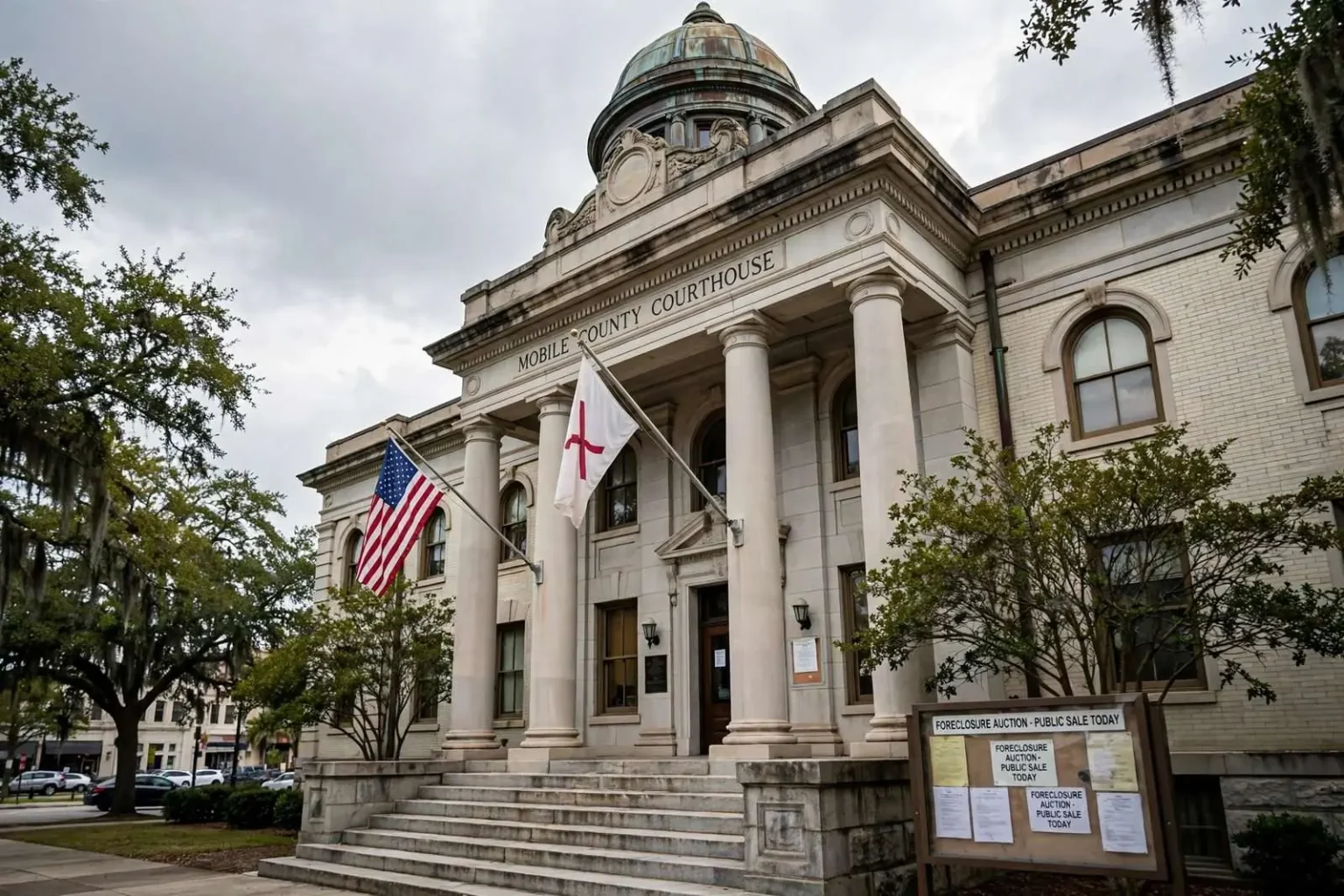
The scale of the fraud grew substantially after the 2007 housing market crash triggered a sharp rise in foreclosures nationwide, Mobile included. More distressed properties meant more auction days, more opportunities to suppress bidding, and more inventory for the group’s private second auctions. Foreclosure sales in Mobile County are public events, typically held at the county courthouse, where lenders’ attorneys read the legal notices and open bidding on homes lost to unpaid mortgages. In the years after the crash, those sales became a regular feature of the local real estate week, drawing small crowds of professional investors who understood the process far better than the families losing the homes.
That information gap is a large part of why bid-rigging schemes of this kind have historically been hard to detect. To an outside observer, a quiet auction looks like a boring one — a single bid, no competition, a routine sale. Only when investigators compare notes across many auctions, many buyers and many years does the pattern of designated bidders and coordinated stand-downs become visible.
After taking office in 2008, President Barack Obama created a Financial Fraud Enforcement Task Force, directing federal agencies to pursue “aggressive, coordinated and proactive” investigations into financial crimes. The task force was designed to concentrate resources scattered across dozens of agencies onto exactly the kind of scheme that had thrived in the chaos of the foreclosure wave.
How the federal case came together
Shortly after the task force was created, the Antitrust Division of the Department of Justice and the FBI’s Mobile field office opened an investigation into the local foreclosure auction industry, working alongside the office of then-U.S. Attorney Kenyen Brown. The combination was deliberate: antitrust prosecutors brought experience in bid-rigging cases that usually surface in road construction or government contracting, while the FBI’s Mobile agents supplied the local knowledge needed to trace who stood where at the auction steps and who paid whom afterward.
Foreclosure auction bid-rigging has been a recurring target for the Antitrust Division across the country, particularly in markets hit hard by the housing crisis. The legal theory is straightforward — public foreclosure auctions are competitive markets, and agreements among buyers to suppress bidding are per se violations of federal antitrust law, the same category of offense as price-fixing among competitors.
“When individuals knowingly defraud homeowners and financial institutions, the FBI is committed to holding them accountable in accordance with the law,” said Special Agent Robert F. Lasky of the FBI’s Mobile division, following the announcement of the most recent guilty plea. “We will continue working with our law enforcement partners to identify and stop those who line their own pockets at the expense of others.”
The case may not be finished
Statements from investigators, along with the pattern of indictments unsealed so far, suggest the case may not be finished. When asked directly, Brown deferred further comment to the DOJ’s Antitrust Division, noting that “if there is anything pending or not pending, we typically can’t comment on it per Department of Justice’s rules.” An unnamed source within the DOJ confirmed only that “the investigation is ongoing,” and described the broader context of the scheme by noting that “the conspirators capitalized on and benefited from the market conditions that resulted from the housing crisis.”
It remains unclear exactly how investigators first identified the rigged bidding process in Mobile, or why it took roughly four years after the 2011 indictments to bring additional charges forward. Federal antitrust investigations of this kind typically rely on cooperating participants, and each guilty plea that follows often becomes leverage for the next. The staggered pace of the Mobile case — a pair of indictments in 2011, then a slow drumbeat of pleas stretching through the middle of the decade — is consistent with that approach.
For the neighborhoods where the foreclosed properties were located, the practical harm is difficult to quantify but easy to describe. Homes sold at artificially low prices can drag down appraisals on surrounding streets, and proceeds that should have gone toward the unpaid mortgage balances — money that would have reduced losses for lenders and, in some cases, for homeowners with equity in their properties — instead leaked into the conspirators’ payoff system.
Who has pleaded guilty
Along with Barbour, Buchman and French, eight other individuals have now pleaded guilty in connection with the conspiracy: Bobby Threlkeld Jr., Steven J. Cox, Lawrence B. Stacy, David R. Bradley, Ali Forouzan, Chad E. Foster, Robert M. Brannon and Jason R. Brannon. Two businesses have also entered guilty pleas — M & B Builders LLC, of which French was a part owner, pleaded guilty in 2011, and J & R Properties LLC, owned by Robert and Jason Brannon, later reached a similar plea agreement with the court.
The mix of individuals and companies reflects how the scheme was structured. Investors operated through their own names and through limited liability companies, which allowed property purchases and the internal payoff accounting to be handled in the ordinary language of local real estate business even as the underlying bidding was being coordinated behind the scenes.
Each defendant has been charged under the Sherman Antitrust Act, which carries a maximum penalty for individuals of 10 years in prison and a $1 million fine. The Sherman Act, the nation’s foundational antitrust statute, has been applied to foreclosure auction bid-rigging since the 1980s, and courts have repeatedly upheld treating agreements among bidders as criminal conspiracies rather than mere regulatory violations.
Because correspondence and financial documents connected to the scheme were sent through the U.S. Postal Service, mail fraud charges were also filed in the case. Those charges carry a maximum penalty of 20 years in prison, along with a fine equal to the greatest of $250,000, twice the conspirators’ gross gain, or the gross loss suffered by victims. If the mail fraud is found to have affected a financial institution, the maximum penalty rises to 30 years in prison and fines can reach into the $1 million range.
Sentences for those who have already pleaded guilty have varied depending on the specifics of each case, including the length of a defendant’s involvement, the number of properties touched and the degree of cooperation with the government. That variability is standard in antitrust pleas, where the first cooperators typically fare better than those who hold out longest.
“[These] guilty pleas demonstrate the Antitrust Division’s resolve to pursue those who conspire to defraud distressed homeowners and financial institutions,” said then-Assistant Attorney General Bill Baer. “The division will continue to hold accountable individuals who subvert the competitive process for their own gains.”
A window on a wider federal crackdown
The Mobile case represents just one piece of a much larger nationwide effort. Obama’s Financial Fraud Enforcement Task Force has coordinated with more than 20 federal agencies and 94 U.S. attorneys’ offices, along with numerous state and local law enforcement partners, to pursue financial crime across the country. Since 2011, the Department of Justice has filed nearly 10,000 financial fraud cases against close to 15,000 defendants nationally, including more than 2,900 defendants charged specifically with mortgage fraud, underscoring how the local Mobile investigation fits into a much broader federal crackdown following the housing crisis.
For Mobile, the lasting effect is a foreclosure auction market that now operates under closer scrutiny. Public foreclosure sales remain open to any registered bidder, and the string of guilty pleas has served as a visible warning that the courthouse steps are not a private club. More than a decade after the scheme began, the investigation that started with a quiet pattern of one-bid auctions has become one of the most significant antitrust enforcement actions in the region’s recent history — and, by the government’s own account, it is not necessarily over.