Mobile Federal Prosecutor May Face Discipline After Appeals Court Rebuke
A federal appeals court vacated a Mobile man's 10-year prison sentence after finding a prosecutor improperly injected race and sex into his trial.
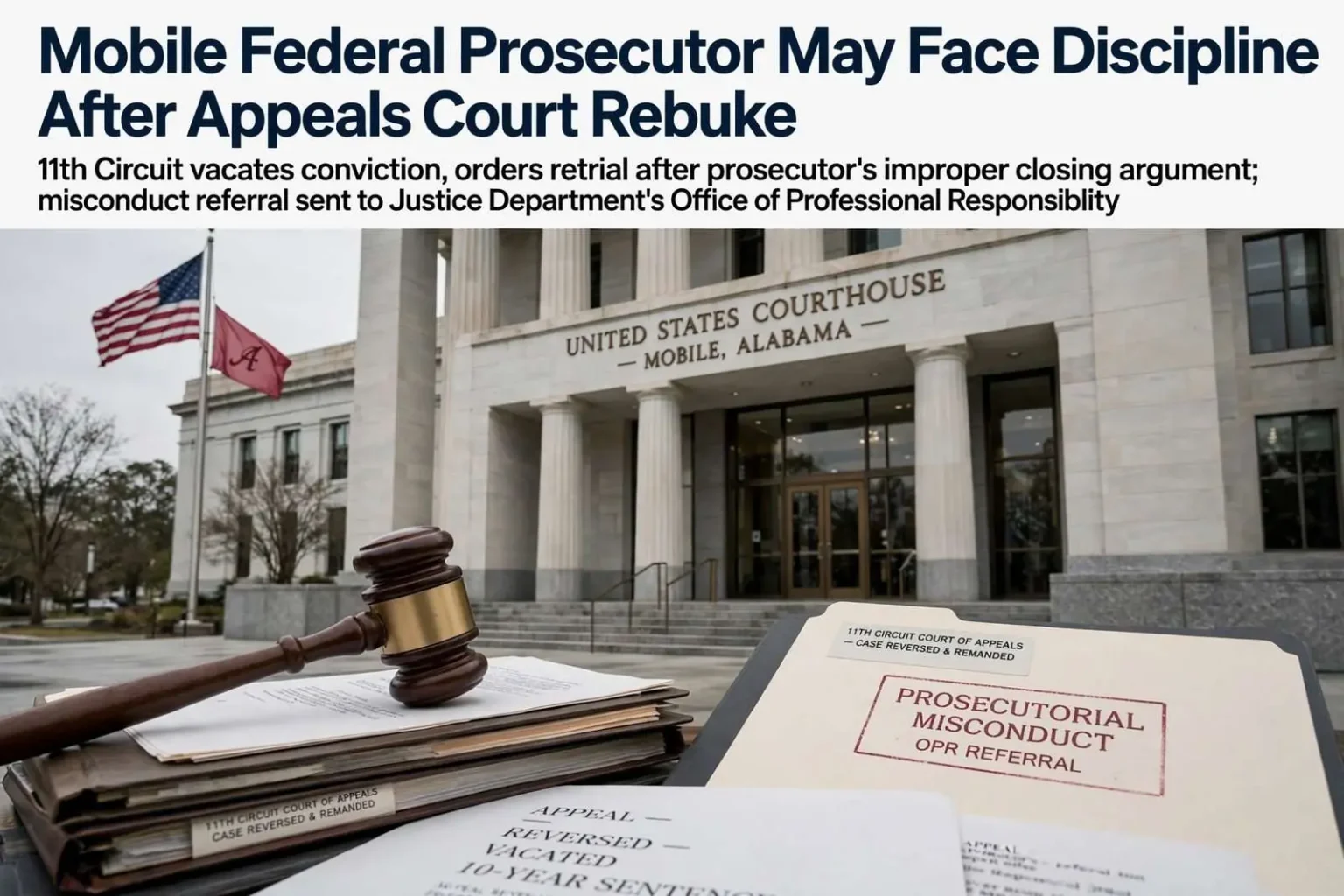
A Mobile-based federal prosecutor could face discipline after an appellate court sharply criticized her conduct during a criminal trial, prompting the reversal of a conviction and the vacating of a 10-year prison sentence.
U.S. Attorney Kenyen Brown said that any case in which a court finds prosecutorial misconduct is automatically referred to the U.S. Department of Justice’s Office of Professional Responsibility for further review. Brown’s office said it plans to retry the underlying case, though no new trial date had been set at the time of the ruling.
The Office of Professional Responsibility, based at Justice Department headquarters in Washington, investigates allegations of misconduct by department attorneys and can recommend consequences ranging from counseling and reprimand to termination, with findings that follow a prosecutor through their career. Referrals like this one are handled confidentially, and outcomes are rarely made public — which is why an appellate opinion as blunt as this one carries unusual weight inside a U.S. attorney’s office.
What the Court Found
The 11th U.S. Circuit Court of Appeals vacated the sentence and reversed the conviction of a Mobile man who had been found guilty on a federal gun charge earlier in the year. The man, a felon previously convicted of drug crimes and receiving stolen property, was prohibited from legally possessing firearms. He had been charged after a March 2013 search of his bedroom turned up a shotgun, a rifle, and evidence connected to methamphetamine production.
According to the appellate ruling, the prosecutor made an improper and false claim during closing arguments, conflating separate pieces of testimony to assert that the defendant had traded methamphetamine for sex with a specific individual, an assertion the record did not support. The court also found that the prosecutor improperly suggested the defendant’s guilt based on his invocation of his Fifth Amendment right to remain silent during testimony, at one point appearing to tell jurors that invoking the right implied the witness was hiding something.
Both errors go to the heart of what appellate courts watch for in criminal trials. Closing arguments are supposed to stay within the four corners of the evidence, and a jury that hears a prosecutor connect dots the testimony never drew may convict on an inference the law does not permit. The Fifth Amendment point is even more settled: the Supreme Court has held for decades that a defendant’s silence cannot be used against him, and prosecutors are barred from asking jurors to draw suspicion from it.
The misstatement at the center of the case was not a matter of emphasis. Prosecutors are granted wide latitude to argue inferences from evidence, but the line is drawn at assertions the record cannot support — and the appellate panel found the prosecutor’s claim about a meth-for-sex trade stitched together fragments of two unrelated pieces of testimony into an accusation no witness had made. Jurors who heard it were left believing something had been proven that had never even been alleged under oath, and no instruction from the trial judge could fully un-ring that bell.
The Fifth Amendment argument compounded the damage. A defendant’s decision not to answer questions is protected from the moment of arrest through his own trial testimony, precisely because the right would be meaningless if exercising it cost him the jury’s goodwill. Courts have reversed countless convictions over comments that came close to that line; a prosecutor who appears to tell jurors outright that silence suggests something to hide has crossed it, and the 11th Circuit’s opinion describes the comment here in those terms.
What happens next unfolds on two parallel tracks. The criminal case returns to the district court for retrial, where the government must again prove every element beyond a reasonable doubt to a new jury. The professional responsibility referral proceeds separately in Washington, where investigators will examine the trial record, the hearing where the prosecutor explained her conduct, and any history of similar findings before recommending whether discipline is warranted. Neither track is quick — federal retrials take months to schedule, and OPR reviews routinely run a year or more.
In his written opinion, the 11th Circuit’s chief judge did not mince words, writing that the trial errors “were as plain as could be.” The court noted that the prosecutor had been asked to appear at a hearing to explain her conduct, and that her explanation was “unconvincing.”
A Rare Public Rebuke
The case has drawn attention within Mobile’s legal community as a rare instance of an appellate court publicly rebuking a sitting federal prosecutor’s trial conduct and ordering a case restarted as a result.
Local defense attorneys say the opinion will echo in courtrooms long after this case resolves. Closing arguments in the district’s federal courthouse are watched with new attention now that the panel has drawn such a bright line, and defense lawyers will cite the opinion whenever a prosecutor’s argument drifts past the evidence. For trial judges, the case offers a reminder that a strong objection record at trial is what makes reversals like this one possible years later.
Federal appeals courts reverse convictions on multiple grounds every year — suppressed evidence, jury instruction errors, sentencing mistakes — but published opinions that name a prosecutor’s argument as false and her explanation unconvincing are comparatively rare. Defense attorneys across the Southern District of Alabama’s jurisdiction read such opinions closely, both for their legal holdings and for what they signal about how the court evaluates trial conduct going forward.
The sequence that produced the opinion also stands out. Before an appellate court even reaches the merits of a conviction, the defendant’s attorney must preserve and present the error — here, objecting at trial and then arguing the point in written briefs and oral argument before the three-judge panel. The court then asked the prosecutor to appear at a hearing to account for her conduct, an uncommon step that signals the panel viewed the problem as more than a stylistic excess. Her explanation’s failure to satisfy the court turned what might have been a technical reversal into a published rebuke with professional consequences attached.
The 11th Circuit, seated in Atlanta, hears appeals from the federal district courts of Alabama, Georgia and Florida, and its opinions bind trial judges across those states. When a panel writes that an error was “as plain as could be,” that language raises the bar for prosecutors in the district: the same argument, made the same way, now carries a known consequence — a retrial that costs the office a second trial and the defendant years of added process.
The Case Itself
The underlying charge — a felon in possession of a firearm — is one of the most common prosecutions in federal court, part of the long-running strategy of moving gun cases with prior records into the federal system, where sentencing guidelines run stiffer than many state courts would impose. A 10-year sentence reflected the seriousness with which prosecutors treated the case: a defendant with drug and stolen-property priors, found with two guns and methamphetamine production evidence in his own bedroom.
The search that produced the guns followed standard federal practice: agents and task force officers executing a warrant document what they find room by room, photograph the scene and inventory the weapons, building the record a jury later weighs. Methamphetamine production evidence alongside firearms raises the stakes further, because federal law enhances sentences when guns are connected to drug activity. None of that was disputed on appeal; the question the panel answered was narrower and more fundamental — whether the trial that produced the conviction was fair.
But the strength of the underlying case is exactly why appellate courts insist on clean trials. A conviction built on improper argument cannot stand, the courts hold, because no one can know whether the jury convicted on the evidence or on the prosecutor’s version of events. The retrial the U.S. attorney’s office has promised will present the guns, the search and the methamphetamine evidence again — this time, presumably, with a different lawyer standing up for closing argument.
The defendant’s public defender did not immediately comment on the ruling. With the conviction reversed, prosecutors in the Mobile federal court will now have to build their case again from the retrial stage, while the Justice Department’s internal review process determines what, if any, professional consequences the prosecutor may face for her handling of the original trial.
For the Southern District’s office, the ruling lands amid broader attention to prosecutorial ethics nationwide. Justice Department guidelines require prosecutors to pursue justice rather than convictions alone, and federal judges have grown more willing in recent years to call out trial misconduct by name. Brown’s automatic-referral policy, his office noted, applies to every case where a court finds misconduct — a framework designed, officials say, to ensure that errors are reviewed internally regardless of the outcome on appeal.