

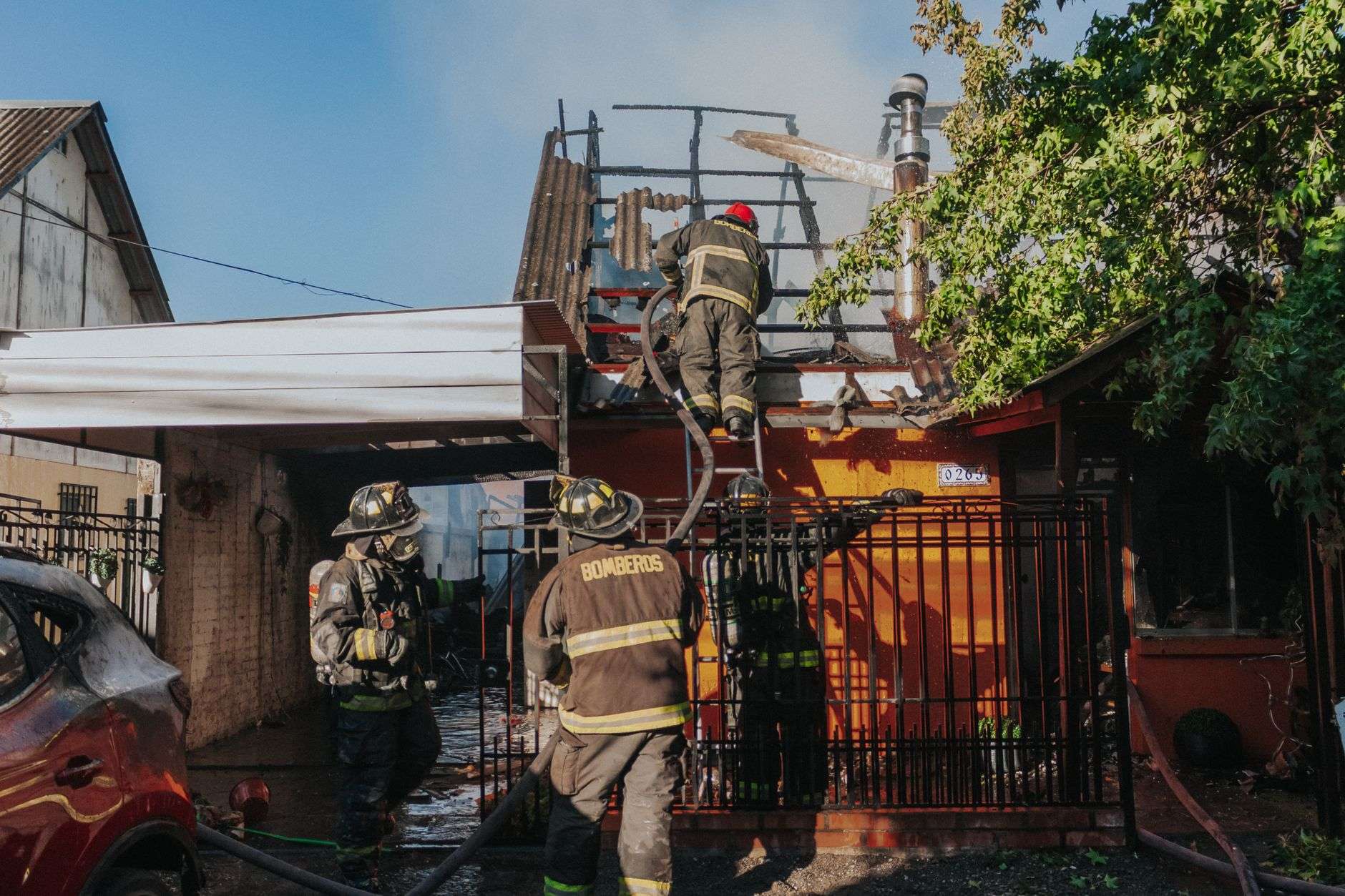
A quick-thinking off-duty police officer helped pull a wheelchair-bound resident to safety Monday morning as fire tore through a two-story home in the 1000 block of Imperial Court in Mobile, according to Mobile Fire-Rescue Department officials. Mobile 911 dispatch received reports of a residential fire in the area just after 11 a.m. When MFRD crews arrived, they found flames and smoke pouring from the front door and through the roof at the back of the house.
Two people were inside the home when the fire broke out. One occupant managed to get out on their own without injury. The other, a disabled resident who uses a wheelchair, needed help escaping the burning structure. That help arrived from an unexpected source.
An off-duty Saraland police officer, who is also a former Mobile Fire-Rescue Department firefighter, happened to be driving through the area when he spotted smoke rising over a hill near the home, according to MFRD. He stopped and got the wheelchair-bound occupant out of the house safely before fire crews arrived on scene. Fire officials credited the officer’s fire service background and quick action with preventing a much worse outcome.
The rescue underscores how quickly a residential fire can turn deadly. Homes furnished with modern synthetics burn faster than older structures did, and the window for safe escape inside a burning house is often measured in minutes. For a resident who cannot walk, that window can close before the first fire engine clears the station, which is what made the officer’s timing so consequential. Imperial Court sits in a residential area of Mobile, and the fire serves as a reminder for area residents of the importance of home fire safety, particularly for households with elderly or disabled family members who may need extra time or assistance to evacuate during an emergency.
No injuries were reported in connection with the fire, MFRD said. The residence sustained significant damage from the fire itself, as well as from smoke and the water used to extinguish the flames. Damage assessments were still being conducted as of Monday, according to fire officials. The cause of the fire has not yet been determined. MFRD said the investigation remains open as crews work to pinpoint how the blaze started.
A Department Rooted in the Gulf Coast
Mobile Fire-Rescue Department is one of the oldest fire organizations in Alabama, with organized fire protection in the port city reaching back to the nineteenth century. Today the department provides fire suppression, emergency medical response, hazardous materials response, fire prevention, and fire investigation services across Mobile, one of the largest cities in the state. Its crews operate from stations spread throughout the city so that engines, ladder trucks, and rescue units can reach both the densely built streets of the older neighborhoods and the newer subdivisions on the city’s western and southern edges.
Rescues performed by civilians or by off-duty responders remain the exception rather than the rule, and national fire service research has consistently shown that most civilian fire deaths occur in homes. Older adults and people with mobility, sensory, or cognitive disabilities face an elevated risk in a house fire, because a resident who uses a wheelchair may need assistance to negotiate stairs, doorways, and debris even in a calm evacuation, let alone one filled with heat and smoke. Those realities are why fire departments across the region put sustained effort into escape planning for residents with disabilities.
Saraland, where the officer serves, sits just north of Mobile along the U.S. 43 and Interstate 65 corridors and is among the fastest-growing cities in Mobile County. The Saraland Police Department patrols a community that has expanded rapidly in recent decades, and its officers regularly travel into and around the larger city for work, family, and daily errands. That geographic overlap means off-duty first responders from the suburban agencies pass through Mobile neighborhoods constantly, and in this case one of them was positioned to act the moment smoke appeared over a hill.
What Investigators Look For
With the rescue complete and the fire knocked down, attention shifts to how the blaze began. MFRD said the cause has not yet been determined and that the investigation remains open. Fire investigation is a methodical discipline: investigators generally begin at the area of least damage and work toward the area of heaviest destruction, reading burn patterns on walls, floors, and ceilings to identify where the fire originated and how it moved through the structure. Utility records, witness accounts, and the condition of appliances and electrical systems all feed into that analysis.
Investigators will also weigh the common causes of residential fires, including cooking equipment, heating devices, electrical wiring, and smoking materials. Cooking fires are the leading cause of home fires nationally, while fires started by smoking materials have historically been among the deadliest because they often ignite in upholstered furniture or bedding while occupants sleep. The two-story layout of the Imperial Court home matters as well, since fires that reach upper floors through wall voids or a stairwell can cut off the primary escape route before people inside are fully aware of the danger.
The damage assessment cited by fire officials will account for more than what the flames consumed. Smoke penetrates wall cavities, ductwork, and furnishings well beyond the room where a fire burned, leaving corrosive residue that can ruin electronics and fabrics. Water and the moisture it introduces damage floors and drywall of their own, and contractors evaluating the home will look at whether charring compromised framing or load-bearing walls. For the occupants, the practical aftermath typically involves working with an insurer, securing the property, and arranging somewhere to stay while repairs are scoped.
Fire departments across Mobile and Baldwin counties work through this same sequence many times a year. Extended cold snaps in recent winters produced waves of residential fires when space heaters and overloaded extension cords were pressed into service, but a blaze on a mild Monday points investigators toward a different set of likely origins. Officials have not said whether anyone was cooking, whether the home’s smoke alarms sounded, or where in the house the fire was first noticed.
Lessons for Households With Disabled or Elderly Members
Fire officials routinely encourage residents to maintain working smoke detectors, and the Imperial Court fire is a reminder of why that advice carries extra weight for households that include elderly or disabled family members. Safety advocates recommend a smoke alarm inside every sleeping room, outside each separate sleeping area, and on every level of the home, with alarms tested monthly and batteries replaced at least once a year. Alarms that are more than ten years old should be replaced outright, because sensor reliability degrades with age.
For a household with a member who uses a wheelchair or has limited mobility, escape planning requires more than the standard advice. Fire educators suggest assigning a specific able-bodied person in the household to assist the member who needs help, practicing that plan physically rather than only discussing it, and identifying the exits that actually work for a wheelchair, which may not be the door an able-bodied resident would choose. Keeping ramps, hallways, and doorways clear of clutter can shave critical seconds off an evacuation.
Technology can close part of the gap as well. Strobe-light and bed-shaker alarms exist for residents who are deaf or hard of hearing, and interconnected smoke alarms sound throughout the house at once, buying time for someone on a different floor. Some families arrange a downstairs bedroom for the member with mobility limitations, shortening the distance an assisted evacuation must cover. Fire educators also urge residents to keep bedroom doors closed at night, since a closed door slows the spread of fire and smoke long enough for an alarm to wake the household.
Bystanders without training should not enter a burning structure, even when someone appears to be trapped, fire officials stress. The safest contribution an untrained witness can make is to call 911 immediately, give dispatchers an accurate address, and report what can be seen from outside, including whether anyone is still inside and where. In this case the combination of a trained off-duty responder, smoke visible from a distance, and a prompt 911 call produced the best available outcome: two residents out of the house, no injuries, and crews arriving to a rescue already complete.
How the Region’s Fire Agencies Respond Together
Incidents like the one on Imperial Court also illustrate how the emergency response network functions across Mobile County. A 911 call placed from a Mobile address reaches the emergency communications center, which assigns the call to the fire agency responsible for that territory and can dispatch police and medical units at the same time. Mutual aid agreements allow neighboring departments to cover stations and backfill territory when a city’s crews are committed to a working fire, a system that becomes especially important during major blazes, severe weather, and hurricane season.
The dual background of the rescuer, a police officer who previously served as an MFRD firefighter, reflects a broader pattern on the Gulf Coast, where public safety careers frequently cross between fire and police services. Emergency medical certification is standard for many fire and police positions in the region, and cross-training between the disciplines is common. Officials have long noted that this kind of cross-disciplinary experience matters most in the unpredictable first minutes of an incident, before a command structure is established and additional resources arrive.
What Comes Next
For now, the focus remains on the residents displaced by the fire and on the open investigation. MFRD has not released the names of the occupants or of the off-duty officer, and officials have not indicated when a cause determination is expected. Fire investigations of this kind can conclude within days when the evidence is unambiguous, or stretch for weeks when specialists must be consulted about electrical systems or appliances.
Residents who want to review their own readiness can take straightforward steps. Fire departments in Mobile and Baldwin counties offer guidance on smoke alarm placement, escape planning, and, in many cases, assistance obtaining alarms for residents who cannot afford them. Households that include an older adult or a member with a disability are also encouraged to share any special evacuation needs with their local emergency management agency, information that helps first responders account for those residents during a disaster.
Monday’s fire ended with a rescue rather than a tragedy, and officials made a point of crediting the officer whose training made the difference. For the neighborhood along Imperial Court, the damage to a single home stands as a concrete reminder that a house fire offers no negotiation and no warning, only whatever preparation was done in advance, and whoever happens to be nearby when the smoke begins to rise.