Okaloosa County woman escapes Holt home before it burns to the ground
An Okaloosa County woman escaped her Holt home unharmed Tuesday night before the structure burned to the ground.
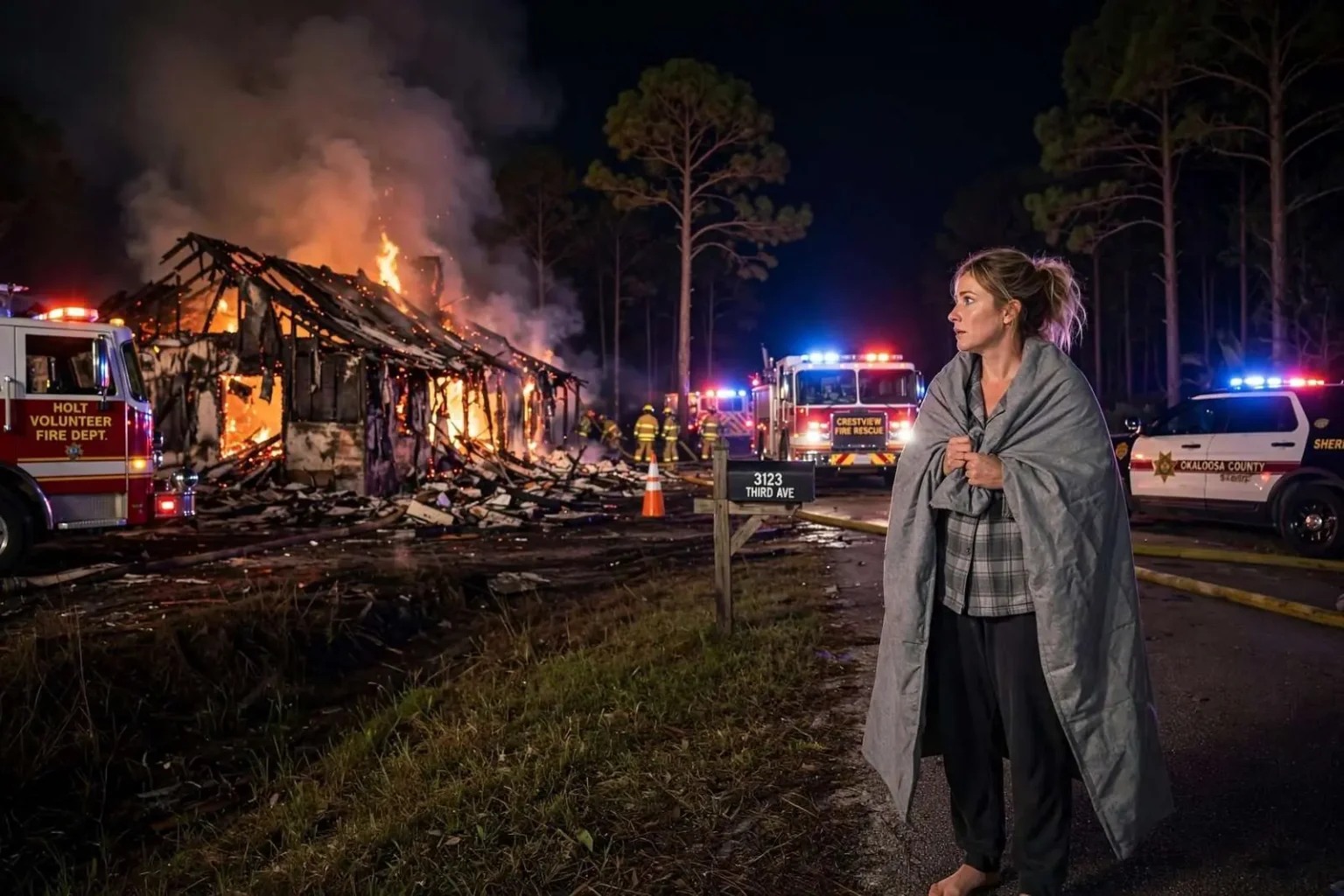
HOLT, Fla. — A woman escaped her home without injury late Tuesday night before it burned to the ground in Holt, according to the Okaloosa County Sheriff’s Office. The resident’s nighttime escape is the headline in a story that could easily have ended in tragedy, and it underscores how quickly a house fire can consume a home in a rural community where volunteer response is often the first line of defense. Deputies confirmed the woman got out safely, and no injuries were reported in connection with the blaze.
The fire was reported on Third Avenue in Holt, a small community in the western reaches of Okaloosa County. By the time the firefighting effort was over, the home was declared a total loss. Several nearby fire departments responded to help extinguish the blaze, a common arrangement in rural Northwest Florida where mutual-aid agreements allow departments to combine personnel and equipment when a single station cannot bring enough resources to bear on its own.
A late-night escape
House fires that break out late at night are among the most dangerous that firefighters respond to, and the circumstances in Holt illustrate why. Residents who are asleep lose precious minutes that daytime occupants have, and smoke — not flame — is the leading killer in residential fires, capable of incapacitating a sleeping person long before the fire itself reaches the room. That this woman recognized the danger, got out, and did so without injury is the outcome fire safety educators across the country hope for and rarely take for granted.
The Okaloosa County Sheriff’s Office confirmed the escape, and officials noted the home was declared a total loss. A total-loss designation means the structure and its contents are beyond repair, and for a rural homeowner it often means losing not just housing but irreplaceable personal items, documents, and in many cases pets’ and family keepsakes that no insurance check can restore. The immediate priority after any such fire is shelter and basic needs, and neighbors, churches, and community organizations in small Florida towns like Holt typically mobilize quickly when a family loses everything.
Third Avenue sits in the kind of quiet residential stretch that defines Holt — modest homes, tree lines, and the sort of spacing between properties that rural residents choose for privacy. But distance works both ways. When a fire starts in a rural area, it can burn unchecked longer than it would in a dense neighborhood where a passerby spots smoke within minutes. That reality is precisely why mutual aid from several nearby fire departments was needed, and why the response timeline matters so much in these communities.
Fighting fire in rural Okaloosa County
Holt sits along the western edge of Okaloosa County, between Crestview and the Blackwater River corridor, in a part of the Florida Panhandle where fire protection depends heavily on volunteer-staffed departments. These departments operate on tight budgets, rely on fundraising and volunteer hours, and answer calls ranging from structure fires to brush fires to vehicle accidents across wide response territories. When a working structure fire breaks out, the standard practice is to call in neighboring departments, which is what happened on Third Avenue as crews from surrounding communities converged to help extinguish the blaze.
Mutual aid works because Northwest Florida’s fire service is built on cooperation. A department that might field only a handful of firefighters on a weeknight can be reinforced by crews from Crestview, Milligan, Baker, or across the county line in Santa Rosa, bringing additional tankers, pumpers, and manpower. Rural homes outside pressurized hydrant systems also require water shuttle operations — tanker trucks ferrying loads of water to the scene — which multiplies the personnel needed. A house fire in Holt is therefore a regional effort almost by definition.
The cause of the fire and any additional details about the investigation had not been made public in the immediate aftermath. Fire origin-and-cause investigations in Florida typically involve the responding fire departments working alongside sheriff’s deputies or the State Fire Marshal’s office, particularly when a home is destroyed. Investigators look at everything from electrical systems and heating equipment to accidental outdoor burning, and their findings determine whether insurers treat the loss as accidental. In the meantime, the Sheriff’s Office’s confirmation that the resident escaped safely remains the most important fact of the night.
What residents should know about fire risk
Northwest Florida’s fire risk runs along two tracks. The first is the brush fire season that grips the Panhandle in dry spring months, when lightning and escaped debris burns ignite wildfires in the pine flats. The second is the year-round reality of structure fires — heating equipment in winter, electrical faults and cooking accidents in every season. Rural homes with older wiring, propane systems, wood heat, or outbuildings full of fuel and equipment carry risks that suburban homes with municipal water and full-time departments simply do not face.
Fire safety educators repeat a short list of protections that make a measurable difference, and every one of them applies in a place like Holt. Working smoke alarms on every level of the home and outside sleeping areas remain the single most effective life-saving tool, because they buy the minutes an escape requires. Families are urged to practice a home escape plan with two ways out of every room and a meeting spot outside, so that no one re-enters a burning structure to search for a missing family member. Close doors behind you as you leave — a closed door slows fire and smoke spread measurably.
Recovery after a total-loss fire follows a familiar path. Homeowners are advised to contact their insurance carrier promptly, and those without insurance can turn to organizations such as the American Red Cross, which responds to house fires throughout the Florida Panhandle and provides immediate assistance with lodging, clothing, and food. In communities the size of Holt, local churches and volunteer fire department auxiliaries often coordinate donations, and neighbors’ help with everything from temporary housing to pet care arrives faster than any agency can organize it.
The outcome that matters
For the Okaloosa County crews who spent the late-night hours on Third Avenue, the arithmetic of the night comes down to one line in the report: no injuries. Structures can be rebuilt and belongings can be replaced, but the people inside a burning home cannot be brought back, which is why an escape without injury is counted as the success it is. The firefighters who responded from several nearby departments did the work the region’s mutual-aid system exists to do, and the woman who got out did exactly what fire safety educators urge everyone to do — she left, and she stayed out.
The investigation into what started the fire is expected to continue as officials work to determine the origin and cause. For the residents of Holt and the surrounding communities, the scene on Third Avenue stands as a local reminder of two things that rural Panhandle families know well: fires move faster than most people imagine, and the difference between a close call and a catastrophe is usually measured in the seconds it takes to get out.
When a home is a total loss
The term “total loss” carries weight beyond the fire scene. For the homeowner, the days after a destructive fire are a blur of paperwork and practical decisions: where to sleep tonight, how to replace identification documents and medications, how to secure the property against weather and trespassers, and how to begin an insurance claim. Okaloosa County residents who experience a house fire are generally advised to ask the responding department for a copy of the incident report, which insurers require, and to keep receipts for every expense the displacement creates.
Community support moves quickly in small towns, and Holt is small enough that word of a family’s loss travels the same day. Area churches frequently open their clothing closets and food pantries on short notice, and social media groups serving the Crestview-to-Holt corridor have become an efficient way to connect displaced families with furniture, bedding, and school supplies for children. Fire departments themselves often pass along contacts for longer-term assistance, and the volunteer firefighters who fought the blaze frequently remain connected to the families they served.
Rebuilding in rural Okaloosa County also means navigating practical infrastructure questions that urban homeowners rarely face. A rural lot may need utility service restored from the pole or the well, septic and water systems may need inspection, and permits for rebuilding flow through the county’s building department. None of it is insurmountable, but all of it takes time — months, usually, from total loss to move-in — which is why temporary housing arrangements are among the first hurdles a fire-displaced family faces.
Smoke alarms and the minutes that matter
The escaped resident’s outcome is the story fire departments across the Panhandle tell when they talk about preparedness, because late-night fires leave so little margin. Modern fire safety guidance asks families to think of the first moments of a fire as a countdown rather than an emergency to be investigated: hear the alarm, feel the bedroom door with the back of a hand, get out through the planned route, and go to the designated meeting place. Anything that slows that sequence — looking for shoes, gathering valuables, checking on a smoke smell — costs time that the fire is not wasting.
Smoke alarms deserve special mention in rural communities, where homes are older on average and where large houses, workshops, and detached garages spread alarm coverage thin. Safety officials recommend alarms inside every bedroom, outside each separate sleeping area, and on every level, tested monthly, with batteries replaced at least yearly and the units themselves replaced per the manufacturer’s date. For households with members who sleep through standard alarms, units that combine a strobe light with a loud tone are available, and some models can be interconnected so that an alarm in the kitchen wakes a sleeper at the far end of the house.
Escaped residents should also resist the instinct to re-enter for pets or possessions. Firefighters uniformly advise against it — animals often find their own exits or can be located by responding crews, and the residents who die going back inside for pets or valuables are a recurring, preventable tragedy. The meeting-place discipline exists for this reason: when everyone is accounted for at the mailbox or the end of the driveway, no one goes back.
The mutual-aid system in action
The response on Third Avenue — several nearby fire departments answering the same call — is worth understanding, because it is how fire protection actually works in rural Okaloosa County and across the Florida Panhandle. Volunteer departments hold mutual-aid and automatic-aid agreements that trigger additional stations on reported structure fires, ensuring that enough water, hoses, and trained hands arrive before the fire outgrows the first-in crew. A working house fire at night can summon crews from multiple counties, and the coordination among dispatch centers, tanker shuttles, and incident command is practiced at drills precisely so it functions on nights like this one.
Those departments depend on community support to keep doing it. Volunteer fire departments across Northwest Florida raise money through membership drives, fish fries, and barbecues, and many rural homes display the reflective address markers the departments sell — a small purchase that genuinely improves response times, because a crew that cannot find a rural driveway at night has already lost minutes. Residents of communities like Holt can also help directly by joining the volunteer roster; departments consistently recruit, and most provide the training required.
For now, the Third Avenue fire goes into the record as a destructive but survivable event: a home lost, a cause under investigation, and a resident who walked away uninjured. In the ledger of late-night rural house fires, that is the best entry a community can ask for — and a standing reminder to check the smoke alarms tonight.