Orange Beach Asks Judge to Throw Out Attorney’s Defamation and Conspiracy Suit
Orange Beach has asked a Baldwin County judge to dismiss a lawsuit by attorney Harry Still alleging libel, slander, harassment and conspiracy. None of the allegations on either side has been proven.
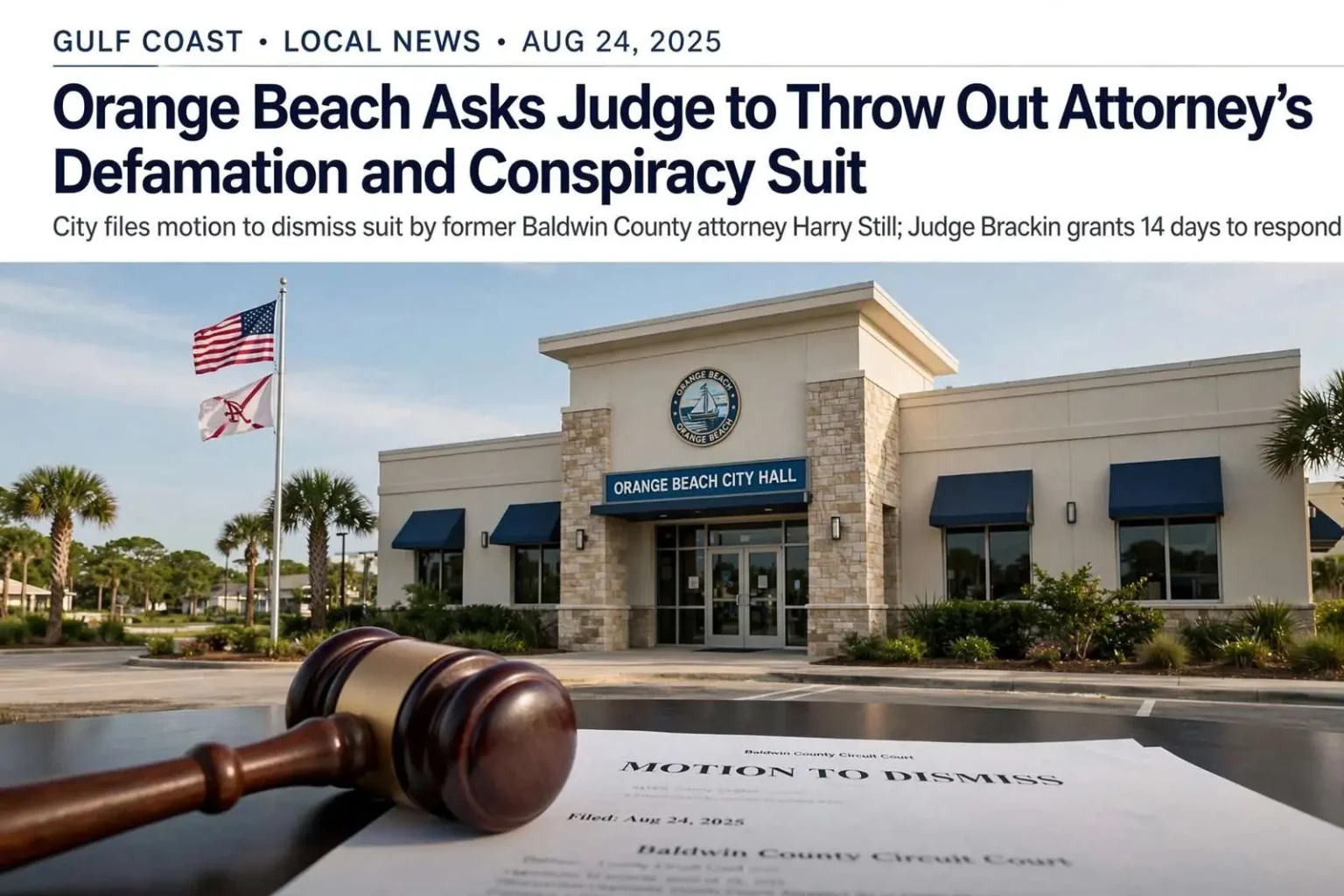
ORANGE BEACH — The city of Orange Beach has asked a Baldwin County judge to throw out a lawsuit filed against it by attorney Harry Still, and the motion is now pending in circuit court.
Still, described in court filings as a former Baldwin County attorney, sued the city and several local officials alleging libel, slander, harassment and conspiracy. Baldwin County Circuit Judge Byron Brackin, as of Aug. 24, gave Still 14 days to respond to the city’s motion to dismiss those claims.
None of the allegations in the case — Still’s claims against the city and officials, or the city’s characterizations of his complaint — has been proven. What exists at this stage is a complaint, a motion attacking it, and a judge who has not yet ruled.
Who Is Named
The defendants include Orange Beach Mayor Tony Kennon, City Attorney Jamie Logan, City Administrator Ford Handley and former police chief Steven Brown, who retired in 2025. The complaint also lists additional unnamed defendants.
Naming unidentified defendants is a common pleading device used to preserve claims against people whose identities or roles a plaintiff says are not yet known, with the expectation that they may be substituted by name later if discovery identifies them.
What the Complaint Alleges
According to the complaint, city officials conspired to defame Still through statements made by Handley that appeared in a news article concerning Still’s September 2025 arrest on a charge of assaulting a Bay Minette city councilman. Still was later found not guilty in that case, in May, by Baldwin County Circuit Judge Clark Stankoski.
“In making this willful, false, malicious, defamatory and slanderous Press Release, the Defendants intended to injure the Plaintiff’s reputation and character,” Still wrote in the complaint. “Further, the Defendants’ conduct was intended to bring the Plaintiff into scandal, public ridicule, disgrace, odium, contempt, and professional repute to future clients and employers.”
The complaint also raises several other Baldwin County matters. Among them are a reference to Thomas Daniel Williams, who died in 2022 and is the subject of a wrongful death lawsuit, and a reference to a 2012 murder case in Orange Beach. Still claims that he and a client in that case were harassed by Orange Beach Police Department officers twice in 2025. Those claims are allegations in a pleading and have not been tested in court.
What a Motion to Dismiss Decides
The city’s filing is a motion to dismiss, and understanding what that motion asks a judge to do is central to reading the dispute.
A motion to dismiss for failure to state a claim does not ask the judge to decide who is telling the truth. For purposes of the motion, the court generally assumes the factual allegations in the complaint are true and asks a narrower question: even if everything the plaintiff says happened did happen, does the law provide a remedy?
That is why a defendant filing such a motion can argue a case should end without ever contesting the underlying events. It is also why a denial of the motion is not a finding that the plaintiff is right. If the motion is denied, the case simply proceeds to discovery, where the facts are actually developed through documents, written questions and depositions, and where the defendants can later seek summary judgment or take the matter to trial.
Alabama’s civil rules require a complaint to give fair notice of the claim and the grounds for it. A recurring line of argument in dismissal motions is that a complaint recites the legal elements of a claim without alleging facts that would satisfy them — and that is the shape of much of what the city has filed here.
The City’s Argument on the Defamation Counts
In its motion, filed by attorney Mark Redditt, the city argues that Still has not stated claims for which a court can grant relief.
“Each of these counts are doomed to fail,” the motion reads.
Redditt wrote that Still failed to fully meet certain legal thresholds within his complaint on all of the counts he filed against the city and the individual officials. Among the arguments, according to the motion, is that Still alleged certain defendants committed slander or libel when they were not involved in the statements at issue, and that the allegations do not qualify as defamation because Still did not explain how Handley’s statement was defamatory.
“In both Counts One and Two, Plaintiff merely makes a bare bones restatement of the elements of a defamation action in support of his claim,” the motion reads. “He does not establish or even allege, how Handley’s statement, which by his own admission was based on reports from the Alabama Law Enforcement Agency, was negligent. Nor does he allege Handley’s reliance on information provided by ALEA was negligent or in some way a breach of duty owed to Plaintiff.”
Defamation claims in Alabama generally require a false statement of fact about the plaintiff, communicated to someone else, made with the required degree of fault, causing harm. Libel refers to written or published statements; slander refers to spoken ones. The fault element is the point the city’s motion presses: a defendant who repeats information from an official law enforcement source is in a different position, legally, than one who invents an accusation, and the motion argues the complaint never alleges what was careless about relying on ALEA’s reports.
The Conspiracy Count
On the conspiracy allegation, the city argues that Still did not state a basis for the claim.
“In fact, it is unclear from this Count, which of the other counts are the basis for this claim,” the motion reads. “With nothing more than a bare recitation of the elements of a civil conspiracy, and without even identifying the underlying tort necessary to support the claim, the Defendants and Court are left to speculate as to the basis of Plaintiff’s claim.”
Civil conspiracy in Alabama is not a freestanding wrong. It is a theory for holding multiple people responsible for an underlying tort that someone actually committed — meaning a conspiracy claim rises or falls with the claim it is attached to. If the defamation counts fail, a conspiracy count built on them generally fails with them. That relationship is what the city’s motion is invoking when it says the underlying tort has not been identified.
The Harassment Count
Redditt also argued that Still’s harassment claim is not one that can be remedied through a civil lawsuit.
“As there is no claim for harassment in Alabama, there can be no set of facts where Plaintiff is entitled to relief under this Count, and it is due to be dismissed as a matter of law,” the motion reads.
The argument reflects a distinction between criminal statutes and civil causes of action. Alabama’s criminal code defines harassment as an offense that the state can prosecute, but a criminal statute does not automatically create a private right to sue for money damages. Conduct described as harassment is more often pursued civilly under other recognized theories — such as invasion of privacy or intentional infliction of emotional distress — each of which carries its own elements and its own demanding standards. Whether that argument prevails here is for the judge to decide.
Where the Case Stands
As of Thursday, Still had not filed a response to the dismissal motion. He has requested a trial by jury, and Judge Brackin has not scheduled a hearing to take arguments in the case.
If the motion is granted in full, the case ends at the trial level, subject to appeal. If it is granted in part, some counts proceed and others drop out. If it is denied, the case moves into discovery, and the allegations on both sides — still unproven — would be tested against evidence for the first time.