
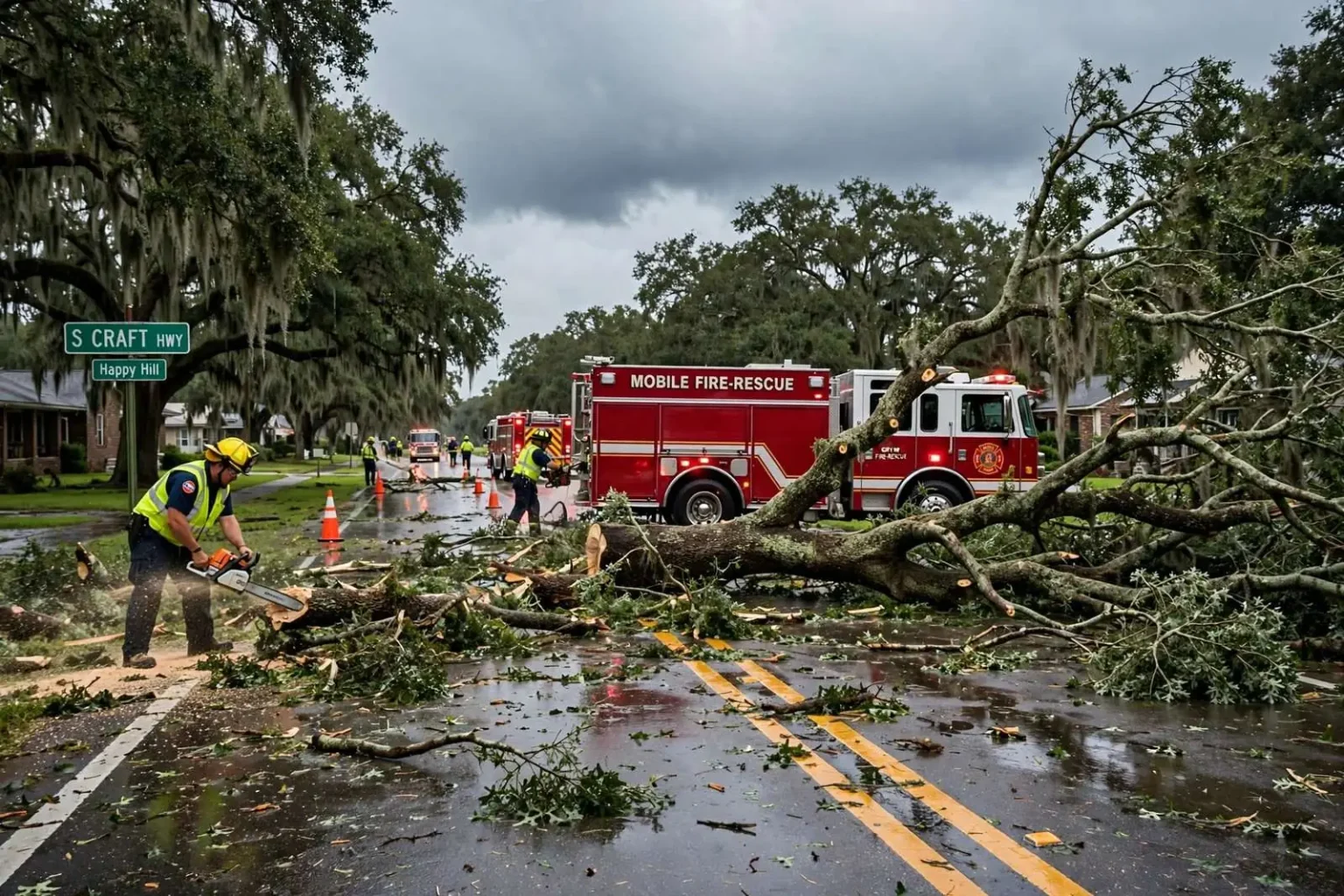
A strong storm that moved through the Mobile area Monday afternoon knocked down trees across South Craft Highway in the city’s Happy Hill community, blocking one lane of the roadway. The kind of quick-hitting cell that defines a Gulf Coast summer afternoon did its work in minutes — trees that have stood for decades came down across the highway, leaving drivers to find a familiar route reduced to a single open lane and a mess of limbs and trunks on the pavement.
The Mobile Fire-Rescue Department and other emergency crews responded to the scene after the storm passed through, working to clear the downed trees from the highway. Crews were able to remove the trees from the roadway, allowing the blocked lane to reopen to traffic. The response was routine in its speed and unusual only in its necessity — until a storm makes it necessary, a highway crew’s day is measured in potholes and shoulders, not hardwoods across the travel lane.
A summer afternoon storm
Storms of this kind are the signature weather of a Mobile summer. Afternoon heat and humidity build through the day, the sea breeze off Mobile Bay and the Gulf nudges the atmosphere over the edge, and storm cells pop up with little warning — violent for twenty or thirty minutes, then gone, leaving behind soaked pavement, downed limbs and a rainbow of debris to clean up. The timing matters for drivers: these cells arrive during the afternoon commute window, when roads are at their busiest and a blocked lane compounds quickly into backed-up traffic.
For the Happy Hill community, the storm’s timing and target were ordinary by Gulf Coast standards and disruptive all the same. South Craft Highway carries neighborhood traffic through the area, and losing half of it — even temporarily — forces detours onto smaller residential streets that were never built for diverted volume. Residents checking on neighbors and drivers inching past the work zone were the visible face of a minor storm event that could have been worse.
About the area
South Craft Highway runs through the Happy Hill community in Mobile County, an area that, like much of coastal Alabama, sees sudden, strong thunderstorms during the late-summer months, when heat and humidity can fuel fast-developing storm cells capable of producing damaging winds. The pattern is predictable even when the storm cells are not: meteorologists can warn of the possibility of strong storms on a given afternoon, but the cell that drops a particular tree across a particular road usually announces itself only minutes ahead.
The landscape makes it worse. Mobile’s tree canopy is among the densest of any city its size in America, and that canopy — a source of shade, beauty and identity — becomes a hazard inventory when the wind blows hard. Mature oaks and pines line the highways and neighborhood streets of communities like Happy Hill, and every serious cell brings the same triage question: which limbs held, and which came down.
The cleanup
Clearing a highway of fallen trees is more than cutting and dragging. Crews must first make sure the area is safe — checking for downed power lines tangled in the limbs, gas leaks, and unstable trunks that could shift — before the chainsaws start. Only then does the removal work begin, cutting the trees into pieces that can be moved, clearing the travel lanes and pushing the debris to the shoulder for later pickup. The Mobile Fire-Rescue Department and the other crews who worked South Craft Highway on Monday did it in the standard way, and by the time they finished, the blocked lane was open and traffic was moving again.
For residents, the aftermath usually includes the smaller cleanup the crews leave behind: limbs in yards, debris at the curb, and the local garbage pickup schedule stretched by weeks of storm waste. On a Gulf Coast summer, that rhythm — storm, response, cleanup, repeat — is as much a part of the season as the heat itself.
Storm safety reminders
Officials routinely remind residents to stay clear of downed trees and power lines after severe weather, since branches can remain unstable and lines can stay energized even when they appear inactive. The reminder is written in hard experience: trees that appear settled after a storm can shift and fall, particularly if root systems are undercut or limbs are hanging in a canopy overhead, and power lines that look dead can be live. The safe distance from any downed line is considerable, and residents are urged to treat every line on the ground as energized and to report it rather than approach it.
Drivers who come across a blocked roadway are urged to turn around rather than attempt to drive around debris, and to report road hazards to local emergency services. The instinct to squeeze past a fallen tree or through standing water is exactly the wrong one — debris can conceal broken pavement or downed lines, and driving around a blocked lane into the opposing traffic lane trades a delay for a head-on risk. Turning around costs minutes; the alternatives can cost much more.
Why the late-summer pattern matters
Coastal Alabama’s late-summer storm pattern is worth understanding, because it shapes how residents should prepare. The same heat that makes August in Mobile famous loads the atmosphere with moisture, and storm cells that develop in that environment can produce damaging wind gusts even without a named system anywhere near the Gulf. Those gusts are what drop trees onto roads like South Craft Highway — not a hurricane, just a strong afternoon cell that found a weak root system.
The practical advice for the pattern is straightforward. Keep trees near driveways, roofs and roadways maintained and inspected; secure loose yard items before any stormy afternoon; have a way to receive weather warnings during the day; and never assume a road that was open at lunch will still be open at rush hour in storm season. The Monday storm on South Craft Highway fit the pattern exactly, and the next one is never more than a few days away in late-summer Mobile.
Who to call
When trees block roads or lines come down, the response usually involves more than one agency, and knowing who to call speeds the fix. Emergency responders handle the immediate hazards — injuries, fires, roads blocked with hazards on them — while utility crews handle energized lines and the local public works or state highway crews handle the debris removal once the scene is safe. Residents reporting a hazard should describe the location as precisely as they can and stay clear of the area while help is on the way.
The system worked on Monday the way it is designed to: a storm dropped trees across a highway, someone reported it, crews arrived, made the scene safe, cut the trees and reopened the lane. It is an unglamorous cycle, repeated dozens of times across Mobile County every storm season, and it depends on residents doing their part — reporting hazards, keeping distance from downed lines, and giving the crews room to work.
Living under the canopy
Communities like Happy Hill live with a trade-off that coastal Alabama knows well. The same mature trees that shade the streets, cool the neighborhood and give the community its character are the first thing to come down when a strong cell moves through. Residents mostly accept the bargain — the canopy is part of what makes Mobile Mobile — but accepting it also means taking the tree risk seriously: watching for leaning trunks after heavy rain, having suspicious trees looked at before the next storm, and never parking under a limb that looks tired.
Homeowners’ responsibilities matter as much as municipal ones. A tree on private property that falls into the roadway starts as someone’s yard, and preventive trimming is far cheaper than emergency removal. After storms, residents clearing their own debris should keep the safety rules in mind: watch for overhead limbs that could drop, stay clear of anything near a power line, and leave the dangerous cutting to professionals with the equipment and insurance for it.
When the next storm comes
The Monday storm on South Craft Highway will not be the last of the season. Late summer along the northern Gulf Coast runs on a cycle of heat, humidity and afternoon cells, and the height of the Atlantic hurricane season sits on the calendar just ahead. Each event like this one is a reminder in miniature — the infrastructure of response works, trees are the region’s most common storm hazard, and the minutes after a storm are when good decisions matter most.
For the drivers who found South Craft Highway down to one lane Monday afternoon, the disruption was temporary and the response professional. Emergency crews cleared the trees, the lane reopened, and the neighborhood went back to its routines. The storm cell that caused it is already a memory; the next one is somewhere over the Gulf, gathering heat and humidity, waiting for a summer afternoon to make its move.