

Originally reported July 6, 2010. This archival update preserves the story’s time frame. Job, investment and production figures below are identified as plans or projections from that period, not current measurements.
In the summer of 2010, ThyssenKrupp’s massive Calvert steel project was moving from construction into operations, transforming a stretch of north Mobile County into one of the largest industrial sites in the American South. The site is in Mobile County, north of Mobile, and was conceived as a paired carbon-steel and stainless-steel complex serving North American customers, the centerpiece of the German industrial group’s push into the U.S. market.
The original report described a July start for a 3,500-acre facility and a $4.65 billion investment. Contemporary reporting preserved by the Alabama Media Portal likewise described a $4.65 billion Calvert complex at the beginning of 2010, when the company expected much of the carbon-steel side and part of the stainless operation to come online later that year. At the time, the investment ranked among the largest single industrial projects ever undertaken in Alabama, rivaling the automotive assembly plants that had reshaped the state’s economy in the 1990s and 2000s.
The scale of the site alone set the project apart. A 3,500-acre footprint along the Tombigbee River shipping corridor gave the complex direct access to waterborne freight, allowing raw materials to arrive by barge and oceangoing vessel and finished coil to move out to customers across North America. That logistics advantage was central to the plant’s business model, which depended on importing semi-finished slabs and processing them into higher-value products close to the customers who would use them.
A Projected Workforce, Not an Immediate Head Count
The often-cited 2,700-job figure was a full-operation target. In January 2010, the company had about 725 workers and said it planned to hire roughly 1,000 more that year on the way to the larger total. Earlier project information from the Association for Iron & Steel Technology also identified the 3,500-acre footprint and the planned 2,700 payroll jobs.
That distinction matters in an archival account. The original story accurately captured the scale of the ambition, but it was reporting a ramp-up rather than a completed local workforce. Hiring at a steel mill of that size unfolds over years, as production lines start one at a time and each new operation requires its own operators, maintenance crews and support staff. Payroll projections of 2,700 represented where the company expected to arrive once both the carbon and stainless sides were fully running.
For north Mobile County and the wider Gulf Coast labor market, the hiring wave was significant even in its early stages. Steel mill jobs carry wages well above the regional manufacturing average, and the project also generated hundreds of indirect positions in trucking, contracting, supplies and services throughout the surrounding communities of Calvert, Mount Vernon, Axis and Citronelle. Economic development officials in Mobile County had spent years recruiting the project, competing against sites in other states for the investment.
What Actually Started in 2010
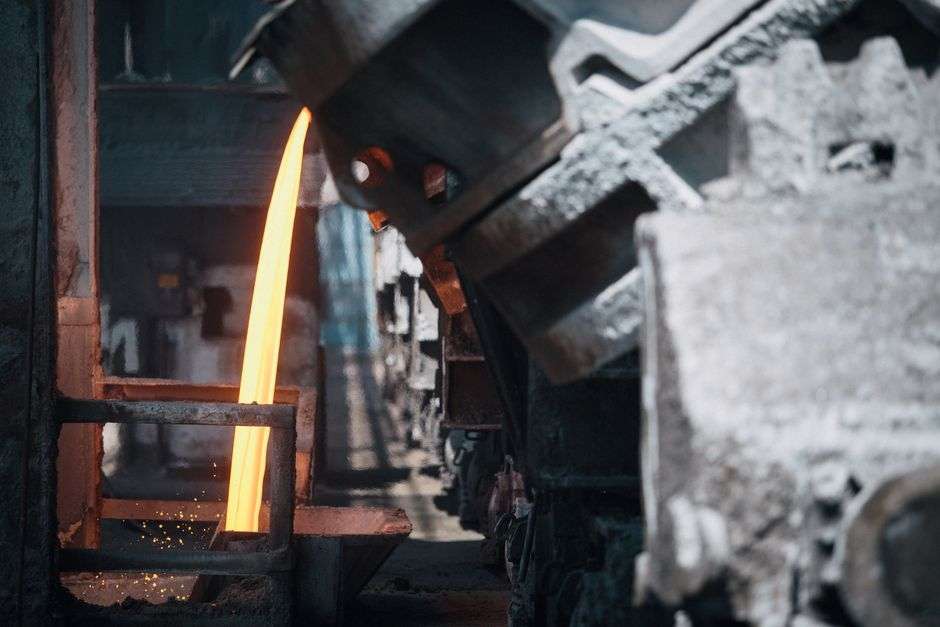
ThyssenKrupp’s subsequent 2010-11 interim report records a clearer sequence: the hot-strip mill produced its first coil on July 31, followed by cold rolling in September and a pickling line in November. The company formally opened the Calvert processing plant on Dec. 10, 2010.
Each of those milestones represented a stage in turning imported slabs into finished steel. The pickling line cleans the surface of hot-rolled steel in acid baths, preparing it for cold rolling, which reduces the steel to thinner gauges with tighter tolerances and a better surface finish for demanding applications. Together, the lines allowed the Calvert plant to process carbon steel for customers who needed exactly the kind of high-quality flat-rolled product that American service centers and manufacturers depend on.
The early reporting also emphasized the complex’s intended market. The project was designed to process carbon and stainless steel for North American industrial customers, including automotive, construction, pipe-and-tube and service centers. The automotive segment in particular shaped the plant’s specifications, since carmakers and their suppliers demand consistently finished steel delivered on precise schedules, a requirement that favors producers located near the customers they serve.
Serving those markets from the Gulf Coast was the strategic logic of the entire investment. By importing slabs produced overseas and finishing them in Alabama, the company aimed to combine its global production base with proximity to North American manufacturers, shortening supply chains and shielding customers from import duties and transatlantic shipping delays. The strategy reflected the economics of the steel trade as it stood at the turn of the decade, when domestic finishing capacity for certain grades lagged behind demand.
The Region and the Ripple Effects
Calvert itself is a small unincorporated community in north Mobile County, and the arrival of a multi-billion-dollar complex on its doorstep changed the character of the area almost overnight. Workers commuting to the site filled housing in outlying towns, local governments planned for road improvements and expanded services, and school districts braced for the arrival of families relocating for mill jobs. The pattern echoed what Baldwin County had experienced with industrial and aerospace growth across the bay, though concentrated in a rural corner of Mobile County.
The project’s construction phase had already been an economic engine in its own right, employing thousands of tradespeople during the build-out of the mill’s foundations, buildings and equipment installations. Companies from across the region won contracts during that phase, and the operational ramp-up in 2010 marked the transition from a construction economy to a permanent industrial payroll that planners expected to endure for decades.
Reading the Numbers as They Were Written
Archival reporting requires care with every figure. The $4.65 billion investment total, the 3,500-acre site and the 2,700-job projection were the numbers in circulation during 2010, drawn from company statements and industry sources at the time, and they are reproduced here as historical claims rather than current facts. The distinction between a plan and a payroll is a recurring theme in coverage of major industrial projects, and the Calvert story illustrates why: the plant that opened in December 2010 was real, but so was the distance between 725 employees in January and the workforce the project ultimately aimed to reach.
The sequencing recorded in the company’s interim report gives researchers a reliable skeleton for how the ramp-up actually proceeded. First coil from the hot-strip mill on July 31, cold rolling by September, a pickling line by November, and a formal opening ceremony on Dec. 10 — each step brought the complex closer to the fully integrated processing operation its planners had described, and each required hiring and training that unfolded alongside the production milestones.
For Alabama, the project’s 2010 start marked a signature moment in the state’s broader industrial recruitment story. The state had spent two decades building a manufacturing economy around automotive plants, and the Calvert complex extended that strategy into heavy industry, anchoring the Gulf Coast corridor between Mobile’s port and the interior with a facility designed to serve the entire North American market.
What Came After
The story of the Calvert complex did not end with its opening, and readers examining the site’s history should know that the ownership picture changed in the years that followed. ThyssenKrupp ultimately restructured its American operations, and the Calvert assets changed hands: the stainless operation was sold to the Spanish group Acerinox, while the carbon-steel mill was acquired by ArcelorMittal and Nippon Steel, which continue to operate it as a major Gulf Coast steel processing plant under the AM/NS Calvert name. The site remains one of the most significant industrial facilities in Alabama, a legacy of the investment whose beginnings this archival account records.
For residents of north Mobile County, the events of 2010 remain a hinge point in local memory — the year construction cranes gave way to production lines, and a projection became a payroll. The figures in this story capture that moment as it was understood at the time: a $4.65 billion bet on the Gulf Coast, a 3,500-acre site filling with equipment, and a workforce plan still climbing toward its target.
The completion of the opening-year sequence also settled questions that had hovered over the project through the construction period. Industrial projects of that magnitude draw skepticism about whether schedules will hold, and the string of 2010 milestones — first coil in July, cold rolling in September, pickling in November, formal opening in December — demonstrated that the complex was moving from promise to production on roughly the timeline the company had sketched at the start of the year. In industrial recruitment, where incentive packages are justified by projections, delivering the early milestones matters as much as any ribbon-cutting speech.
The training burden behind those milestones was substantial as well. Steel processing lines require experienced operators, and a Gulf Coast workforce without a resident steel industry meant the company built its training programs from scratch, pairing new hires with experienced personnel transferred from the company’s German and Brazilian operations. That knowledge transfer was itself part of the investment, and it left behind, in the years that followed, a cadre of locally trained steelworkers whose skills stayed in the region even as corporate ownership changed hands.