AM/NS Calvert Announces $500 Million Steel Furnace Expansion, 300 New Jobs
AM/NS Calvert has announced a $500 million Electric Arc Furnace expansion at its north Mobile County steel plant, a project expected to create 300 permanent jobs and support hundreds of construction positions over the next two years.
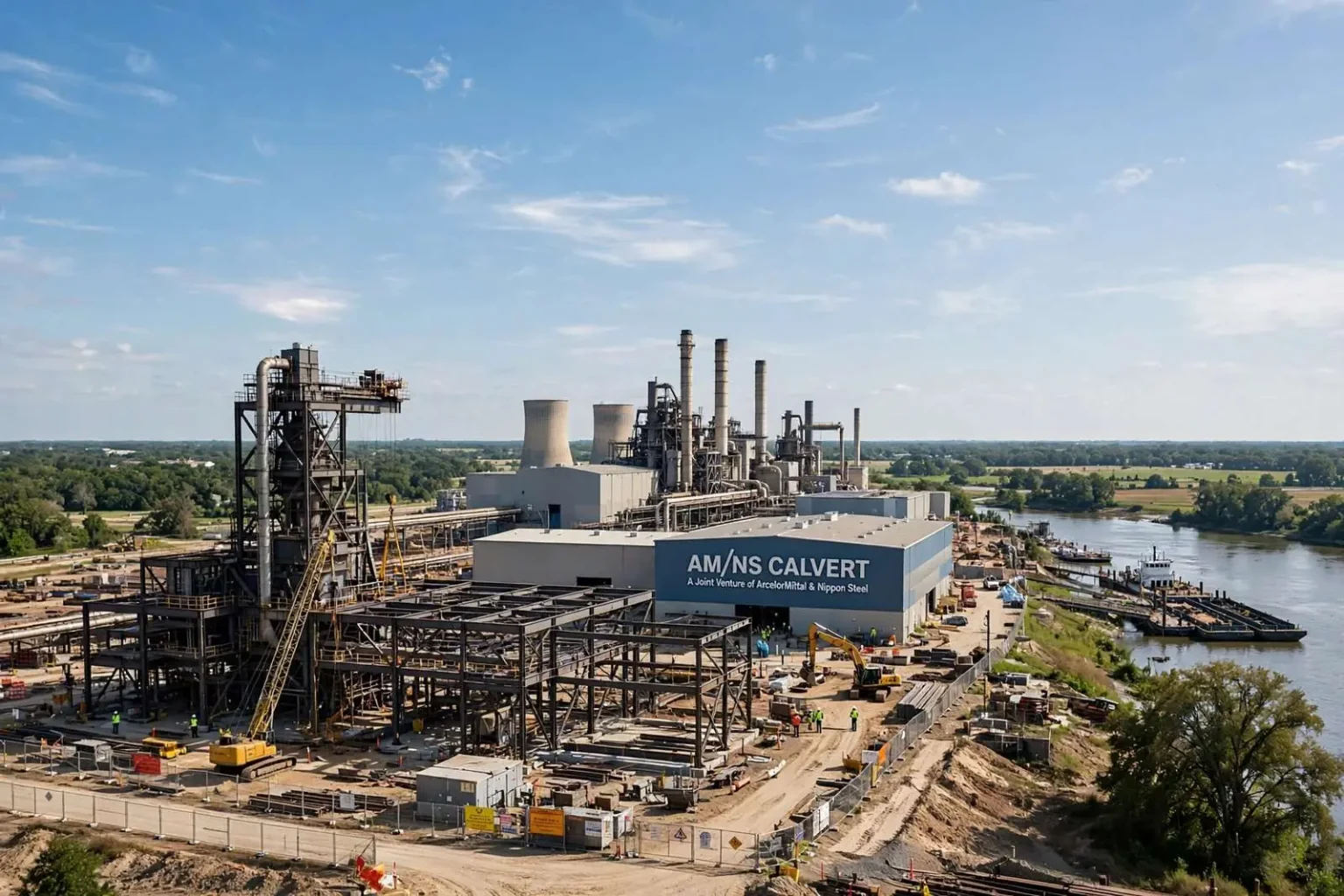
A major steel manufacturer with operations in north Mobile County has announced a $500 million expansion that is expected to bring 300 permanent jobs to the area. AM/NS Calvert, the joint venture between ArcelorMittal and Nippon Steel Corporation that operates a sprawling processing plant along the Tombigbee River in Calvert, revealed plans to construct a new Electric Arc Furnace steel-making facility on its existing property. The announcement marks a strategic turn for the site: after a decade of finishing steel made elsewhere, the plant will begin making its own raw steel in the same north Mobile County fields where Alabama’s industrial recruiters once staked the state’s biggest bet.
The expansion
The project, which will also support as many as 500 construction jobs over roughly 24 months, marks one of the largest single investments in Mobile County in recent years. According to information released through the Mobile Area Chamber of Commerce, the new furnace will allow the plant to produce its own steel slabs rather than relying entirely on slabs shipped in from outside sources, a shift that industry officials say will make the facility more competitive and self-sufficient. For a plant whose entire business model has rested on imported semi-finished steel, the change is less an upgrade than a re-founding.
Once operational, the Electric Arc Furnace is expected to be capable of producing 1.5 million metric tons of steel slabs annually, feeding the plant’s existing hot strip mill and supporting a wide range of steel grades used by AM/NS Calvert’s customers. Company officials describe the facility as one of the most technologically advanced steel finishing operations in the world, and say the new furnace will strengthen the plant’s position in the automotive and energy sectors, two of its primary end markets — industries where delivery speed, grade precision, and certification standards decide contracts.
Electric arc furnaces differ fundamentally from the blast furnaces that powered the traditional steel belt. Rather than smelting iron ore with coke, an EAF melts recycled scrap steel with enormous electric arcs, allowing production to be flexed up and down with demand and sited wherever power, logistics, and labor converge. That flexibility is precisely what the Calvert expansion is designed to buy: a captive slab supply that arrives on a conveyor schedule instead of an ocean freight schedule.
Company officials have been blunt about the competitive logic. The integrated mills of the Gulf and Midwest coasts have spent years losing share in sheet steel to so-called mini-mills — scrap-based, EAF-fed operators with lower costs and shorter order cycles — and a processor dependent on purchased slabs sits at a structural disadvantage against them. Bringing melting capacity in-house shortens the chain from order to delivery and gives the Calvert plant a weapon it has never had before.
A site built on big bets
The Calvert facility has a long history of large-scale investment. It was originally built by German steelmaker Thyssenkrupp in 2010 as part of a $4 billion project, one of the largest industrial developments in Alabama history at the time — a project landed during the era that also brought Mercedes-Benz, Honda, and Hyundai to the state and made automotive-scale manufacturing Alabama’s signature economic development play. The complex rose on more than 3,000 acres beside the Tombigbee River, chosen for its rail, barge, and highway access.
Thyssenkrupp’s original plan included its own melting capacity, but the economics never supported building it, and the plant operated for years as a processor of slabs rolled elsewhere. ArcelorMittal and Nippon Steel Corporation acquired the plant in 2014 and have since poured more than $200 million into additional upgrades and strategic projects at the site, steadily widening its finishing capabilities while the slab question remained unresolved — until the new furnace announcement effectively answered it.
What the company said
The announcement came after a period of deliberate study rather than impulse. Steel projects of this scale carry long payback periods, expose the owner to scrap and power price cycles, and commit a joint venture’s capital for years, which helps explain why the partners spent months on the evaluation before signing off. When Oliveira described the decision as positive for both company and community, he was acknowledging the two ledgers a plant like Calvert must satisfy at once: the margin statement of an international steelmaker and the payroll of a rural county that has few alternatives at that scale.
AM/NS Calvert CEO Jorge Oliveira said the company had spent months evaluating the opportunity before committing to the new furnace. “We are very pleased to announce the addition of an Electric Arc Furnace at AM/NS Calvert,” Oliveira said. “For many months, we have discussed this opportunity and identified the need for our facility to offer our customers shorter lead times and order flexibility to compete with the mini-mills in our targeted markets. This investment is not only positive for our company but also for the community.”
Oliveira’s reference to lead times and order flexibility put the commercial case in plain terms. Automotive stampers and energy-sector fabricators do not simply buy steel; they buy certainty — the promise that a specified grade will arrive within a contracted window so that downstream production lines keep moving. A plant that controls its own melting can promise that certainty with its own equipment rather than negotiating it through a slab supplier’s backlog.
Local and state reaction
Local and state leaders welcomed the announcement as a significant win for the region’s economy. Mobile County Commissioner Merceria Ludgood praised the company’s continued commitment to the area. “We are excited about the announcement of AM/NS Calvert,” Ludgood said. “This means good jobs and a significant investment in our county. We look forward to a long and prosperous relationship with one of our best corporate citizens.”
Alabama Secretary of Commerce Greg Canfield said the expansion reflects the state’s broader efforts to attract and retain industrial employers. “One of Gov. Kay Ivey’s top priorities is helping companies grow and create jobs in the state, so we fully support the decision by AM/NS Calvert to significantly expand its steel making operations in Mobile County,” Canfield said. “This investment will enhance AM/NS Calvert’s competitive position and expand its capabilities while also delivering a massive economic impact on Alabama.”
The reaction reflected how central the plant has become to the state’s industrial identity. Alabama’s economic development establishment spent two decades chasing headline projects — automotive plants, aircraft assembly lines, shipbuilding contracts — and the Calvert expansion offered the same combination of capital scale and long-horizon employment, this time at a facility already operating rather than one still to be built.
What it means for north Mobile County
The AM/NS Calvert plant has long been considered a cornerstone employer for north Mobile County, drawing workers from surrounding communities and supporting a network of local suppliers and contractors. Communities such as Calvert, Mount Vernon, and Citronelle have historically oriented much of their working population toward the plant, and the wages that flow out of its gates ripple through the rural economies north of Mobile in ways that larger metro-area employers do not replicate.
The addition of 300 permanent positions, along with hundreds of temporary construction jobs during the build-out, is expected to provide a meaningful boost to the local economy over the next two years as the project moves forward. Construction-phase employment tends to concentrate its benefits quickly — heavy civil work, electrical contracting, and equipment installation — while the permanent jobs arrive with the ramp-up of the furnace itself.
For Mobile County’s economic recruiters, the announcement also serves as evidence in an ongoing argument: that the region’s port, rail, and river infrastructure can support not just manufacturing but the full vertical chain behind it. A plant that melts its own steel beside the Tombigbee, rolls it on site, and ships finished product through the Port of Mobile closes a loop that begins to look, to outside investors, like a complete industrial ecosystem on the Gulf Coast.
The end markets named in the announcement — automotive and energy — map directly onto Alabama’s existing industrial strengths. The state’s automotive assembly plants and their supplier networks consume enormous volumes of advanced high-strength sheet steel, while the energy sector’s fabrication yards and pipeline suppliers along the Gulf Coast buy heavy plate and coil for structures that must survive offshore conditions. Holding both customers requires a grade range that the hot strip mill can already deliver; the furnace simply guarantees the feedstock beneath it.
Workforce expectations will grow alongside the equipment. Electric arc furnace operations demand a different mix of skills than finishing operations do — melt shop technicians, crane operators, electrical and instrumentation specialists — and plants of this kind typically train and hire from the surrounding region’s industrial workforce, including graduates of Alabama’s two-year college and skills-training programs that were themselves rebuilt around employers like Calvert after the state restructured its community college leadership years ago.