Dauphin Island Tourism Fell During July 2010 Oil Spill
A 2010 WKRG report documented major holiday-weekend tourism losses on Dauphin Island during the Gulf oil spill.
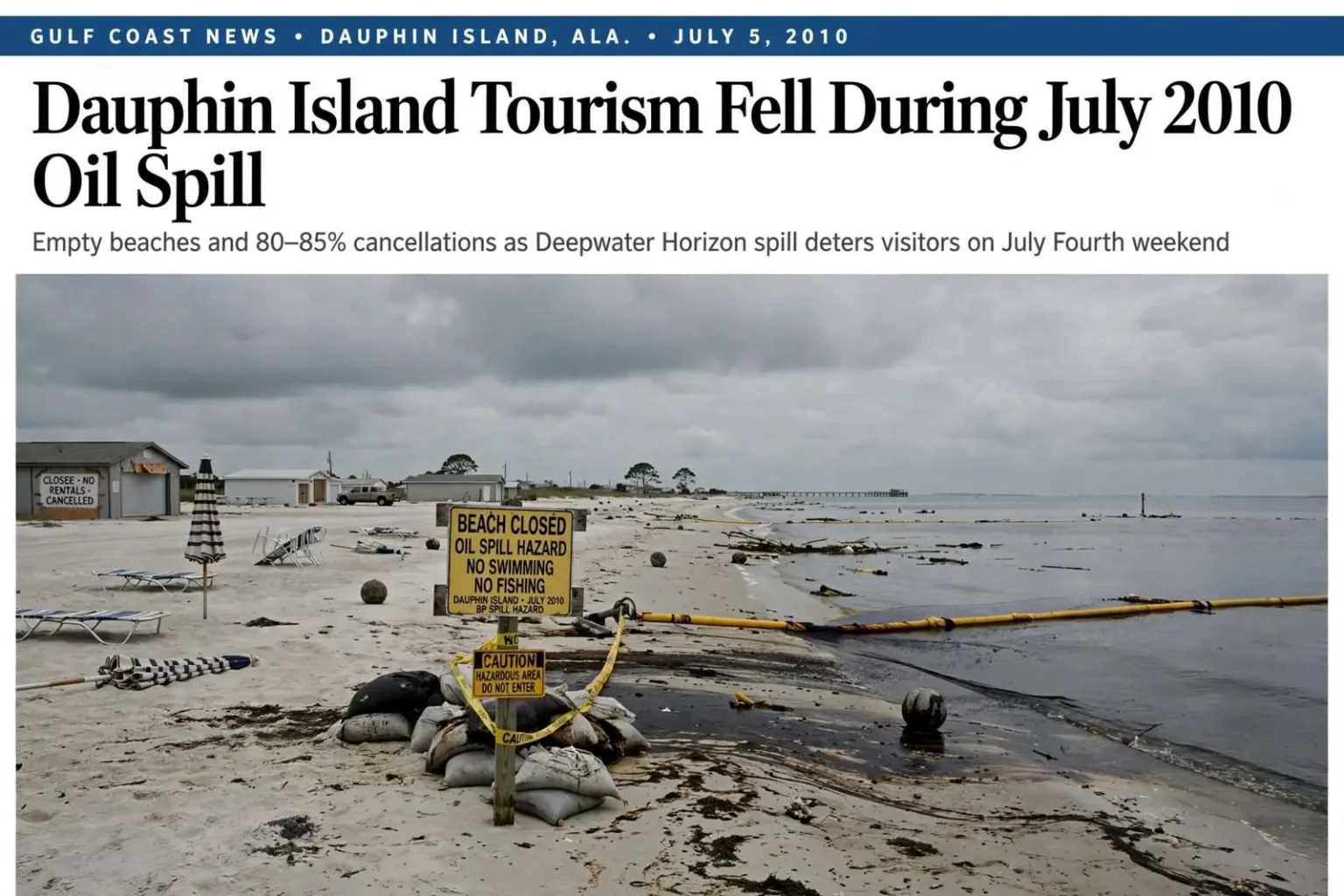
DAUPHIN ISLAND, Ala. — Dauphin Island’s July Fourth holiday weekend was far quieter than expected in 2010, as the Deepwater Horizon oil spill kept visitors away from the Alabama coast, according to a local news report from the time.
The report said beaches and businesses on the barrier island were nearly empty during what is normally one of the busiest vacation weekends of the year. Mayor Jeff Collier said cancellations were running at roughly 80 to 85 percent, and the town planned to file a claim with BP for lost revenue.
Local business owners told the station they feared the prolonged decline could threaten their ability to remain open, a worry that hung over a community whose economy depends almost entirely on the water around it.
This is a historical summary of local reporting from July 2010. It is not a current tourism or business conditions report.
The summer the oil came to the Gulf
The Deepwater Horizon drilling rig exploded on April 20, 2010, killing 11 workers and beginning the largest marine oil spill in U.S. history. For the next three months, oil flowed from the damaged wellhead more than a mile beneath the surface of the Gulf of Mexico, and the disaster became the defining event on the Gulf Coast from Louisiana to the Florida Panhandle.
Dauphin Island, a barrier island guarding the entrance to Mobile Bay, sat squarely in the spill’s potential path. Tar balls and oily material began washing onto Alabama’s beaches as the spring wore on, and while the island’s three-mile public beach and its residential shores were not uniformly coated, the presence of oil — and the near-constant news coverage of where it might land next — was enough to collapse the summer season.
The timing compounded the damage. July Fourth is the hinge of the Gulf Coast tourist year, the weekend on which rental owners and small businesses count on filling every room and table. In 2010, the report found, the crowds simply did not come, leaving beaches and businesses nearly empty at the height of the season.
A town built on tourism and the water
Dauphin Island is a small town of roughly 1,300 permanent residents, connected to the mainland by a single bridge across the Mississippi Sound. Its economy rests on vacation rentals, seafood, fishing charters and the steady traffic of visitors drawn to the island’s beaches, the historic Fort Gaines and the Audubon Bird Sanctuary that makes the island a nationally known stop for migrating birds.
With no industry beyond the water, the island has little insulation from anything that keeps tourists away — a hurricane, a red tide event, or, in 2010, an oil spill more than a hundred miles from its shores that nevertheless emptied its rental houses for the summer.
Mayor Jeff Collier, who led the town through the spill years, told the station that cancellations for the holiday weekend were running at roughly 80 to 85 percent. For a town whose rental income is concentrated in the summer months, the figure described a season that was effectively erased, not merely slowed.
The fears voiced by business owners that summer were straightforward: weeks of empty units and quiet shops do not just reduce a year’s profits, they can drain the reserves that keep a small seasonal business solvent at all. Owners said they worried a prolonged decline could push them to close permanently.
Filing a claim against BP
The town’s plan to file a claim with BP put it among the scores of governments, businesses and individuals across the Gulf Coast who sought compensation for losses tied to the spill. Under the process that took shape after the disaster, claimants documented revenue comparisons between 2010 and prior years to show what the spill had cost them, with payments administered first by BP directly and later by an independent claims facility established under the Oil Pollution Act.
For a municipality, the claim covered the revenue the town itself lost — the taxes, fees and other income that a tourism-dependent community earns from the visitors who were not there. For businesses, the claims covered documented profits that vanished with the season. The claims process stretched on for years, became the subject of court battles over how losses were calculated, and ultimately distributed billions of dollars across the Gulf region under the settlements that followed.
Dauphin Island had additional stakes in the spill’s aftermath beyond lost rental revenue. The island had suffered erosion and storm damage in the years before 2010, and the barrier island’s dependence on beach-quality sand and a healthy sound made it unusually sensitive to any environmental harm the spill caused along its shores. Town leaders spent the spill summer balancing two fights at once — recovering the lost tourist season and protecting the island itself — while residents organized volunteers to watch for oil and report it.
In the summer of 2010 itself, none of that outcome was yet visible to the people of Dauphin Island. What was visible was an empty beach on the weekend that anchors the island’s year, and a town government moving to recover what the season had lost.
How the crisis eventually resolved
The well that fed the spill was capped in mid-July 2010, about three months after the explosion, and declared permanently sealed that September. The response effort — boom lines, skimming vessels, controlled burns and thousands of cleanup workers — shifted the question from whether oil would come ashore to how much had, and where.
On Dauphin Island, cleanup crews worked the beaches through the second half of the summer, and the island gradually returned to something like its normal rhythms. But the 2010 season had already been lost, and the psychological effect — the image of oil threatening the Alabama coast — lingered in the vacation market longer than the oil itself.
The spill’s longer aftermath reshaped the coast in ways that reached beyond one summer. Restoration funding from the legal settlements later flowed into Gulf Coast projects, including habitat restoration, coastal protection and tourism promotion across Alabama’s beach communities, an attempt to convert a catastrophe’s penalties into lasting recovery.
The July 2010 report from Dauphin Island captures the moment before any of that was knowable: a mayor counting cancellations at 80 to 85 percent, business owners wondering whether they would survive the year, a town preparing its claim, and a July Fourth weekend when the island’s beaches sat nearly empty at the height of the season.
Life on an island with one road out
Part of what made the summer of 2010 so stark on Dauphin Island is the island’s simplicity. There is one way on and one way off — the Gordon Persons Bridge carrying AL-193 across the sound — and one commercial strip serving the rental houses, campgrounds and fishing camps that fill up each summer. When visitors stopped coming, the effect was immediate and total, with no alternate economy to absorb the blow.
The island’s attractions are its lifeline in a good year. The public beach and fishing pier, the estuarium at the Sea Lab on the island’s east end, Fort Gaines at the tip of the island guarding Mobile Bay, and the bird sanctuary that draws serious birders during migration together make up nearly everything a visitor comes for. Every one of those draws depends on the Gulf being a place people want to be.
In 2010 the question visitors asked was not whether the beach was open but whether it was clean, and no promotional campaign could answer it in advance. Vacationers who had booked island houses for the summer stayed home or redirected to destinations outside the Gulf, and the town’s rental economy — much of it owned by families who count on summer income to carry the year — took the loss directly.
What the reporting captured
The local report from July 2010 recorded the scene at ground level: beaches and businesses nearly empty over the holiday weekend, owners describing cancellations by the week, and a town government preparing paperwork to recover what it could from the company responsible for the spill.
That kind of documentation proved important later. The claims process that followed the spill depended on exactly these contemporary records — cancellations, empty weekends, revenue shortfalls reported in real time — to establish what the spill had cost communities that were often far from the water the oil actually touched.
Dauphin Island’s experience also became part of the wider story of Alabama’s Gulf summer of 2010. Baldwin County’s beach towns reported similar collapses, the state launched promotional campaigns to reassure travelers, and testing programs worked to verify which waters were safe even as perception lagged behind the science.
Today the episode is history on the island — the beaches busy again, the fort and estuarium operating, the summer rental cycle restored — but the summer of 2010 remains the reference point for what a coastal catastrophe does to a community that lives, almost entirely, on visitors and the water.