

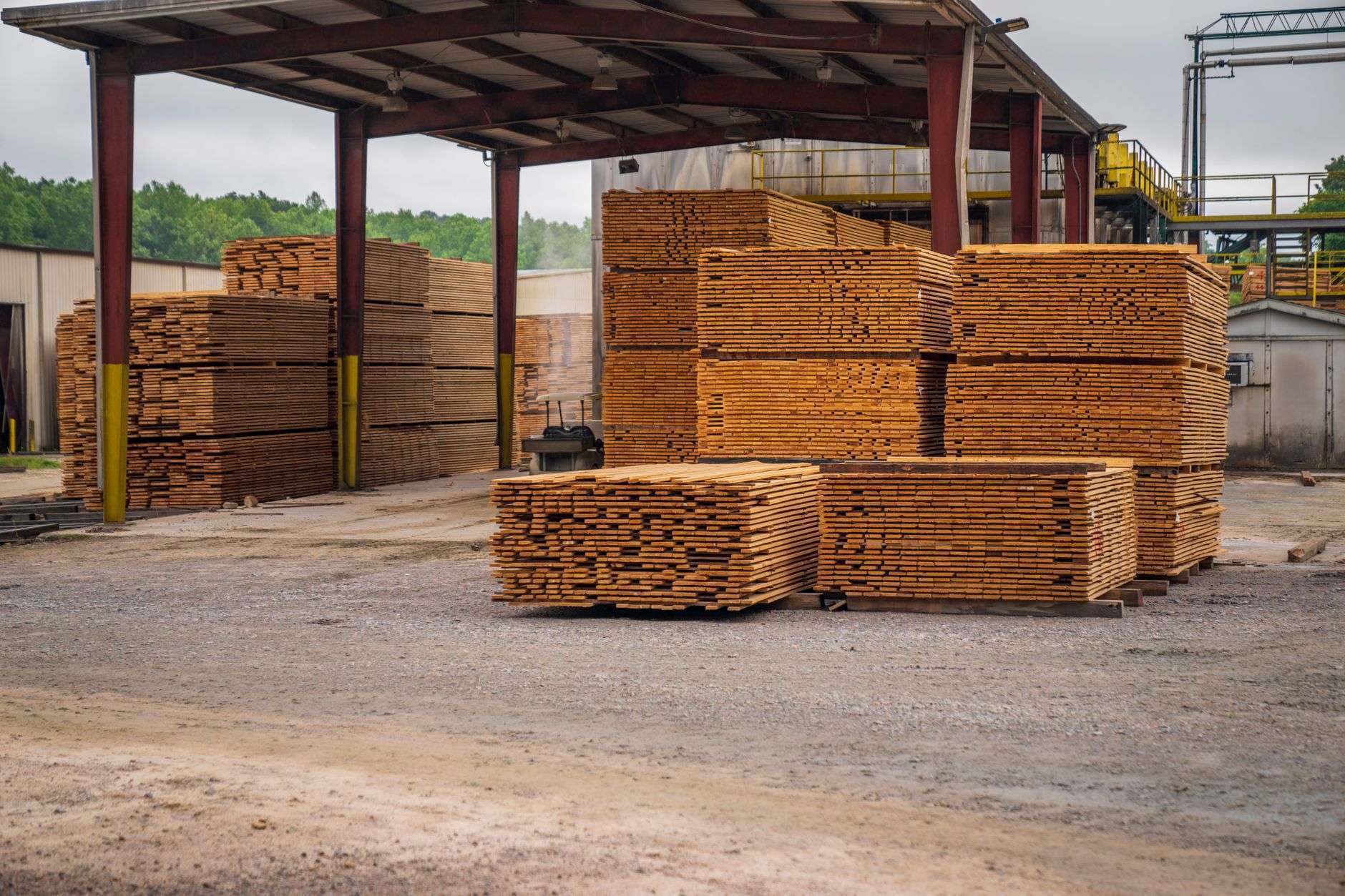
GROVE HILL, Ala. — Westervelt Lumber is planning a $62 million expansion of its Thomasville sawmill that would add decking materials to the products it makes in Clarke County, and the Clarke County Commission on Tuesday approved tax abatements for new equipment tied to the project.
The Thomasville mill currently employs 181 people. The expansion is expected to add 36 or more jobs.
The vote drew warm words from both sides of the table, as commissioners and a company representative traded compliments about a relationship that dates back to the mill’s arrival in the county.
‘Good Partners and Good Neighbors’
Commissioner Rhondel Rhone said the county values the company’s presence.
“We are so proud to have Westervelt in this county,” Rhone said. “You are good partners and good neighbors.”
Commission Chairman Jackie Ray Rush recalled the work that went into landing the mill and getting it open.
“They are a fine bunch of people to work with,” he said.
Westervelt general counsel Ray Robbins returned the compliments.
“We have a great relationship. This is a huge investment,” Robbins said.
How the Thomasville Mill Came to Be
The Thomasville sawmill is a relatively young operation. Gov. Kay Ivey announced in November 2018 that The Westervelt Company, a Tuscaloosa-based company, would build a new lumber production facility in Thomasville, with plans for 125 jobs and the capacity to produce roughly 250 million board feet of Southern yellow pine lumber a year.
At the time, company President and CEO Brian Luoma said south Alabama had always been the company’s preferred location and that the local community offered the workforce and resources to support its long-term strategy. Then-Alabama Commerce Secretary Greg Canfield called the project an important job-creating investment for a rural area.
The first load of lumber left the Thomasville mill on March 5, 2021, roughly two years after the project got underway. Great Southern Wood Preserving bought that first shipment. Luoma marked the occasion by calling it “the first day of the future for Westervelt.”
The mill’s staffing has grown since then. It opened with an initial workforce of 125 employees, and it now employs 181. If the expansion delivers the 36-plus jobs expected, the mill’s workforce would climb past 215.
A Company With Deep Alabama Roots
Westervelt is one of Alabama’s longest-running forest products companies. In 2024, it marked 140 years in business and 50 years of lumber manufacturing. Its flagship sawmill in Moundville, which opened in 1997, is one of the larger Southern yellow pine lumber producers in the region, and the Thomasville mill was built to complement it.
The company describes the Thomasville plant as the next generation of lumber manufacturing, with state-of-the-art equipment and a focus on safety and sustainable operations. Its product lines include small timbers, dimension lumber, boards, and patterns and molding, sold into both domestic and international markets. Adding decking materials would broaden that lineup at the Clarke County mill.
The company’s ties to Clarke County extend beyond the mill gate. Earlier this month, United Way of Southwest Alabama recognized Westervelt Lumber with its outstanding campaign award after the company’s 2025 workplace campaign raised more than $83,000 — its highest total to date. Westervelt also sponsored a December food distribution in Thomasville that provided nearly 6,000 pounds of food to 330 households.
Why Southern Yellow Pine and Decking Fit Together
Southern yellow pine, the species group the Thomasville mill was built to process, grows throughout the Southeast and is one of the most widely used softwoods in American construction. It is valued for its strength and for how readily it accepts preservative treatment, which is why so much of it ends up as pressure-treated lumber for outdoor uses such as decks, fences and porches.
Lumber output is typically measured in board feet. One board foot equals a piece of wood 12 inches long, 12 inches wide and 1 inch thick, so the mill’s designed capacity of about 250 million board feet a year represents an enormous volume of wood moving through a single plant.
The specific decking products the expansion will produce and a timeline for installing the new equipment were not spelled out as part of the commission’s action, which dealt with tax abatements on that equipment.
What a Tax Abatement Does
The abatements the commission approved apply to new equipment for the expansion. In Alabama, such incentives are granted under the Tax Incentive Reform Act of 1992, found in Chapter 9B of Title 40 of the Code of Alabama and often called “Chapter 9B” abatements.
Under that law, counties, cities and public industrial development authorities can abate certain taxes for qualifying industrial projects, including new companies and existing companies expanding their operations. The taxes that can be abated include:
- Non-educational property taxes, for up to 20 years
- State and local sales and use taxes on qualifying property that becomes part of the project, with a small state portion left unabated
- Mortgage and recording taxes in certain cases involving property conveyed to public authorities
Property taxes that go to schools are not part of the abatement, so education funding continues to benefit from new investment. Sales tax exemptions apply only to qualifying equipment and materials incorporated into the project, not to items such as spare parts or consumables, and a property tax abatement ends if the property stops being used in active industrial operations for six consecutive months.
For an existing company, an expansion generally must represent a significant new investment to qualify — at least 30% of the original facility’s cost or $2 million, whichever is less. A $62 million project easily clears that bar.
Railroad Crossing Closure and Other Business
The Westervelt vote was one of several items on the commission’s agenda. In other business, the commission:
- Heard a closure notice for Walker Springs. County engineer Lance Jordan reported that the railroad crossing at Walker Springs on County Route 19 will be closed for maintenance from Sept. 28 to Oct. 1. The crossing lies on a major route into the southeastern part of the county. Jordan and Emergency Management Agency Director Roy Waite said the school system has been notified so bus routes can be adjusted, and emergency responders and others have also been notified.
- Approved a sales tax refund. Commissioners agreed to a $32,000 sales tax refund petition from the developers of a solar farm in the Alma and Gainestown area, after some sales taxes that were supposed to be exempt were collected.
- Awarded road and bridge materials bids. The commission approved the lone bids from Petroleum Traders for fuel, Ozark Striping for traffic striping, Vulcan Materials for stone and rip-rap, and Tractor & Equipment for motor grader blades. It also approved APAC’s asphalt bid.
- Recognized a retirement. The commission approved a retirement resolution for Jill Walker, an administrative clerk with the sheriff’s department, and declared the position open to be filled.
- Announced a holiday closure. The Clarke County Courthouse will be closed Monday, Oct. 12, for Columbus Day.
What the Crossing Closure Means for Drivers
Residents who use County Route 19 through Walker Springs should plan alternate routes during the four-day closure from Sept. 28 through Oct. 1. Because the road is a main way into the southeastern portion of the county, the closure could add time to trips for drivers who live or work in that area.
County officials said they notified the school system in advance so bus routes could be changed, and emergency responders were alerted so they can plan around the closed crossing.
Timber and the Clarke County Economy
The Westervelt expansion adds to the long-standing role of forest products in Clarke County’s economy. Westervelt is one of several forest products companies with deep ties to the county — Louisiana Pacific was also honored this month by United Way of Southwest Alabama for its long-standing investment in Clarke County — and the timber industry has anchored southwest Alabama’s economy for generations.
A $62 million investment in new product lines at an existing mill signals continued confidence in that base. For Thomasville, it means the possibility of dozens of new jobs at a plant that has already grown well beyond its original staffing since shipping its first load of lumber in 2021.