Beau’s Law Takes Effect Oct. 1 With Statewide Rules for Tethering, Shelter and Care of Outdoor Dogs
Beau's Law establishes statewide standards for outdoor dogs beginning Oct. 1, banning direct tethering to trees and poles, requiring shelter with a solid floor, and creating escalating criminal penalties for violations.
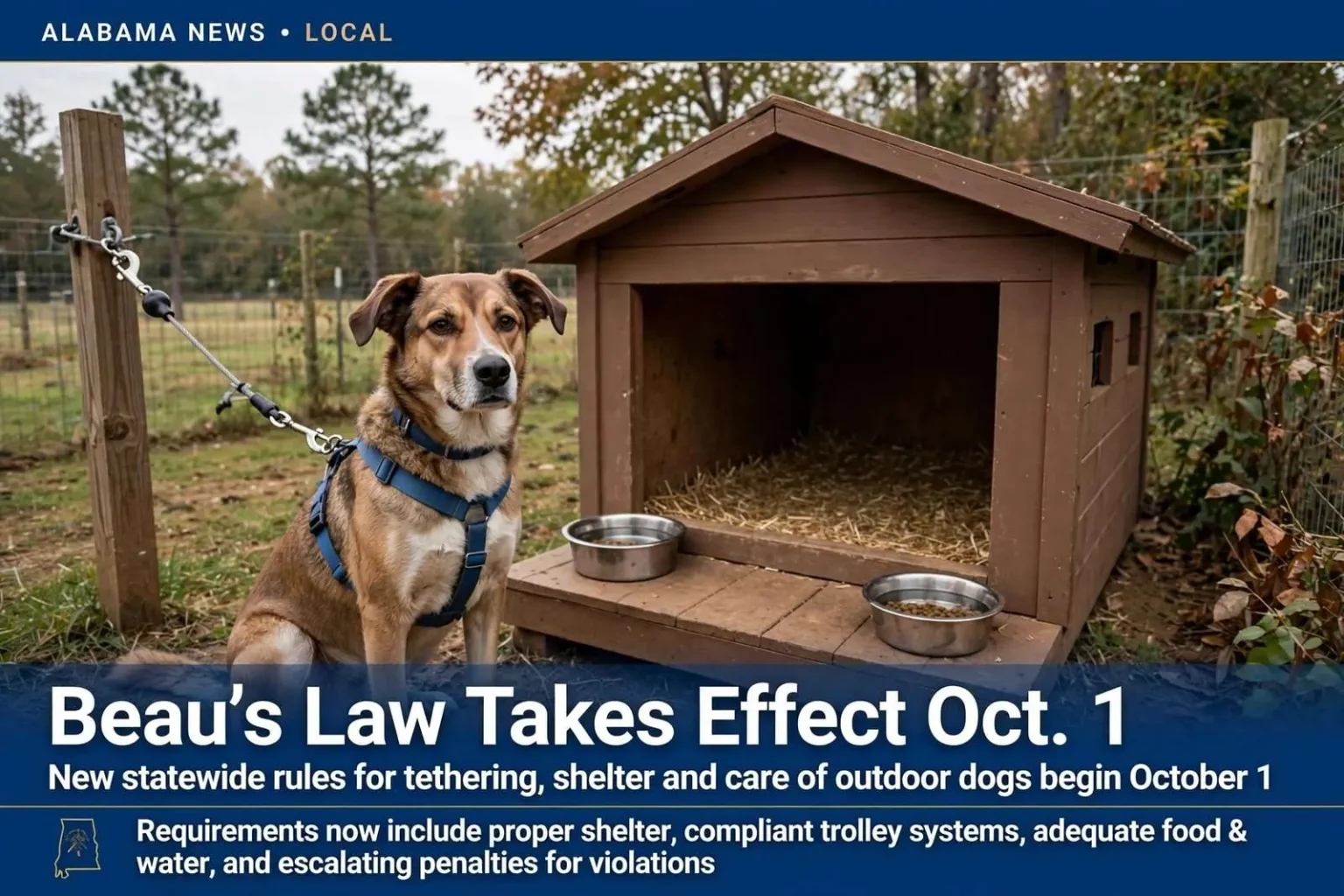
Alabama dog owners who keep animals outdoors face a new set of legal requirements beginning Oct. 1, when Beau’s Law takes effect and establishes statewide standards for the care, shelter, tethering and confinement of outdoor dogs.
The law sets requirements for adequate food and water, proper shelter, and safe methods of tethering or confining dogs. It also creates escalating criminal penalties for violations, and it does not replace Alabama’s existing animal cruelty laws, which remain in effect and enforceable.
What the Law Requires
Food and water. Dogs must have adequate food and potable water provided in sufficient amounts to prevent starvation or dehydration.
Shelter. Dogs kept outdoors must have access to proper shelter that protects them from the elements, including extreme heat and cold. The shelter must have a roof, walls and a solid floor, with adequate ventilation and enough space for the dog to stand, turn around, lie down and extend its limbs. Bedding must be provided when necessary to protect the dog from cold conditions.
Tethering. Dogs may not be tethered directly to stationary objects such as trees, poles, stakes or structures unless tethered through a compliant trolley system. A trolley system must have swivels on both ends, be appropriate for the dog’s size, and allow the dog continuous access to adequate food, water and shelter.
Prohibited equipment. Logging chains, choke collars and pinch collars may not be used to tether a dog.
Tether attachment. Tethers must be attached to a properly fitted collar or harness and positioned to prevent entanglement, strangulation or injury.
Confinement. Dogs confined in an enclosure must have a secure, fully fenced area with adequate space to move freely, and must not be able to leave the property.
Why Each Requirement Exists
The specificity of the law reflects the particular ways outdoor confinement causes harm, and the requirements are less arbitrary than a list of rules might suggest.
The solid floor requirement addresses the most common shelter failure. A structure with a dirt floor becomes mud in rain and offers no insulation from ground cold. A dog lying on wet ground in winter loses body heat continuously regardless of whether it has a roof overhead.
The space to stand, turn around, lie down and extend its limbs standard is the same functional test used in animal welfare regulation generally. It defines the minimum volume in which an animal can perform basic postural movements.
The prohibition on direct tethering to stationary objects addresses the entanglement problem. A dog tied to a fixed point will wrap its tether around that object, progressively shortening its range until it cannot reach food, water or shelter — and in the worst cases, until the tether tightens around its neck. A trolley system, which runs a line between two points with the tether sliding along it, prevents that wrapping. The requirement for swivels on both ends addresses the same problem from the other direction: a swivel allows the line to rotate freely instead of twisting shorter over time.
The ban on logging chains is a weight standard. A logging chain heavy enough to restrain a vehicle load imposes constant strain on a dog’s neck and spine. Choke and pinch collars are training tools designed to apply pressure in response to tension; used as tethering hardware, they apply that pressure continuously and without a handler present.
The Penalty Structure
The law establishes escalating criminal penalties:
- First offense: Class C misdemeanor, punishable by up to three months in jail and a fine of up to $500.
- Second offense: Class B misdemeanor, punishable by up to six months in jail and a fine of up to $3,000.
- Third or subsequent offense: Class A misdemeanor, punishable by up to one year in jail and a fine of up to $6,000.
The graduated structure matters practically. A first-offense Class C misdemeanor is a level at which an officer encountering a violation can realistically expect compliance rather than a contested prosecution — and compliance, rather than punishment, is generally the objective in this area of law. The escalation to a Class A misdemeanor for repeat offenders gives the statute teeth against owners who do not correct conditions after being cited.
Enforcement Authority
Law enforcement officers and authorized agents of political subdivisions may inspect for violations.
In cases involving a dog in life-threatening danger, officers may order immediate care or remove the dog at the owner’s expense.
That emergency provision is the most consequential operational element of the law. Without explicit statutory authority, an officer encountering an animal in immediate danger faces genuine uncertainty about what action is lawful. A provision authorizing immediate care or removal — with costs assigned to the owner — resolves that question and shifts the financial burden of emergency veterinary treatment away from the responding agency or shelter.
What Is Exempt
The law includes exemptions for a range of circumstances and activities, including:
- Veterinary practices
- Animal shelters
- Boarding kennels
- Groomers
- Dog shows
- Lawful hunting or retrieving training
- Service dogs
- Dog walking
- Temporary tethering or confinement for a reasonable period
The hunting and retrieving training exemption is significant in Alabama, where hunting with dogs is a long-established practice and where legislation touching on dog confinement has historically drawn scrutiny from hunting interests. The exemption for temporary tethering for a reasonable period covers ordinary situations — a dog secured briefly outside a store, or while an owner works in the yard — that the law is not intended to reach.
What It Does Not Do
Beau’s Law does not replace Alabama’s existing animal cruelty statutes, which remain in effect and may continue to be enforced.
That distinction matters. Alabama’s cruelty laws address intentional or reckless infliction of harm and, at the felony level, torture and severe abuse. Beau’s Law addresses conditions — whether shelter meets a standard, whether a tether is properly configured — without requiring proof of intent to harm.
That is a meaningfully different enforcement tool. Many cases of outdoor dogs suffering do not involve an owner who intends cruelty; they involve an owner who does not recognize that a chain around a tree or a shelter with a dirt floor is causing harm. A conditions-based standard gives officers something to enforce before a case rises to cruelty, and gives owners a clear specification of what compliance looks like.
What Owners Should Check Before Oct. 1
For most dog owners, compliance will require inspection rather than expense. The items most likely to need attention:
- Direct tethers. A dog tied to a tree, post or stake needs a compliant trolley system instead.
- Tether hardware. Logging chains, choke collars and pinch collars must be replaced with a properly fitted collar or harness on an appropriate tether.
- Shelter floor. A doghouse without a solid floor does not meet the standard.
- Shelter size. The dog must be able to stand, turn around, lie down and fully extend its limbs inside.
- Reach. Whatever the configuration, the dog must have continuous access to food, water and shelter — not access that disappears once the tether wraps.
- Fencing. An enclosure must be secure and fully fenced, with the dog unable to leave the property.
- Bedding. Required when necessary to protect against cold.
Where Local Rules Fit
Beau’s Law sets a statewide floor. Municipalities and counties across Alabama have their own animal ordinances, and several jurisdictions in the Mobile and Baldwin County area have revised theirs in recent years.
Local ordinances may be more restrictive than the state standard. Owners should check the rules in their own city or county in addition to the statewide requirements taking effect Oct. 1.