SPLC Sues ALDOT Over Covenants It Says Left Shiloh Landowners With Uninsurable, Unsellable Property
The Southern Poverty Law Center filed suit in Montgomery County Circuit Court alleging that restrictive covenants imposed by ALDOT after a Highway 84 widening project left Shiloh residents unable to insure, repair or sell flood-damaged property.
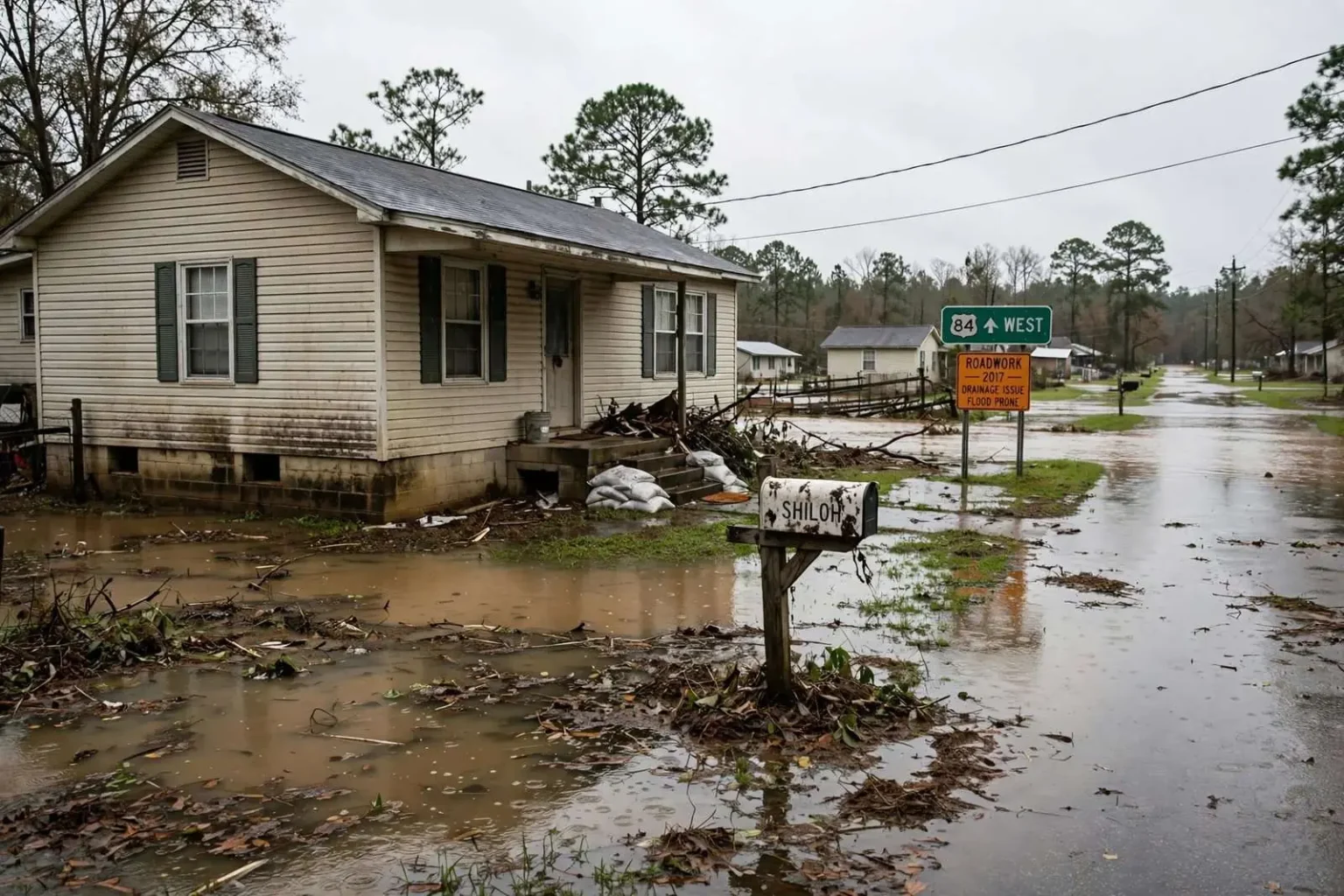
MONTGOMERY, Ala. — The Southern Poverty Law Center filed suit Tuesday in Montgomery County Circuit Court challenging restrictive covenants imposed by the Alabama Department of Transportation that landowners in the community of Shiloh say have turned their properties into uninsurable flood zones.
The complaint alleges the covenants operate beyond ALDOT’s authority and violate the Fifth Amendment, preventing landowners from using or selling their property. It names ALDOT Director John Cooper, ALDOT Chief Legal Counsel William Patty and Gov. Kay Ivey.
ALDOT representatives said Wednesday the department is aware of the filing and is reviewing it. Efforts to reach Ivey for comment were not immediately successful.
How Shiloh Got Here
The dispute traces to a 2017 project in which ALDOT received partial federal funding to widen U.S. Route 84 from two lanes to four.
According to the complaint, extensive construction resulted in severe soil erosion and stormwater flooding caused by drainage system failures.
Despite repeated warnings from residents, the first major flooding event occurred in 2019 — described in the complaint as preventable — followed by 13 floods the next year, according to the SPLC. The most recent reported flood occurred this past summer.
After the initial flood, residents filed claims with the Alabama Board of Adjustment, the state body that hears claims against the state and its agencies in circumstances where sovereign immunity would otherwise bar a lawsuit. By late 2020, many of those claims were settled, releasing ALDOT from liability.
The Covenants at the Center of the Case
The complaint alleges that Shiloh landowners were deceived into agreeing to unlawful restrictive covenants that protected the department and the state from future litigation.
“For nearly a decade, ALDOT has made life for Shiloh residents unbearable,” wrote Crystal McElrath, senior supervising attorney for the SPLC. “The illegal settlement agreements and restrictive covenants were used as a Trojan horse, essentially giving ALDOT the ability to flood land without penalty. Unfortunately, flooding was only the tip of the iceberg, as mold, expensive property damage, unusable driveways and the inability to insure homes have created even more costly hardships that have yet to be remedied.”
A restrictive covenant is a legal restriction recorded against a parcel of land, binding not only the owner who agreed to it but subsequent owners as well. That permanence is what distinguishes a covenant from an ordinary settlement release. A release resolves claims between the parties who signed it. A covenant attaches to the land itself.
The practical consequence alleged here follows from that distinction. A property carrying a recorded covenant that anticipates flooding is difficult to insure, difficult to finance and difficult to sell. Buyers and lenders review title records; a covenant of that character appears there.
The Generational Wealth Argument
The SPLC has framed the case in terms of property ownership as a mechanism of wealth transfer.
“Land ownership is an important means of creating generational wealth for families, and especially Black families, in this nation,” McElrath wrote in a news release. “These restrictive covenants have robbed Black property owners in Shiloh of that opportunity.”
That framing connects to a body of scholarship and litigation concerning land loss among Black families in the rural South. For families whose principal asset is land held across generations, a legal encumbrance that renders that land unsellable and uninsurable eliminates the asset’s value without transferring title.
The Federal Investigation and What Followed
In 2022, the Federal Highway Administration began investigating complaints that the Highway 84 expansion project disproportionately harmed Shiloh residents because of their race.
Investigations of that kind proceed under Title VI of the Civil Rights Act of 1964, which prohibits discrimination on the basis of race, color or national origin in programs receiving federal financial assistance. Because the highway project received partial federal funding, it fell within that authority.
In late 2024, the federal government closed the investigation and reached an agreement with the state to address the flooding problem.
Shiloh residents said previously that the plan did not do enough to compensate them. They described the loss of homeowners insurance, an inability to repair their homes, ongoing septic tank overflows and backups, and pests including snakes and mosquitoes.
That gap — between a resolution satisfactory to federal regulators and a resolution satisfactory to the people living with the flooding — is what the new lawsuit is attempting to close.
The Fifth Amendment Claim
The constitutional theory in the complaint rests on the Takings Clause of the Fifth Amendment, which provides that private property shall not be taken for public use without just compensation.
Takings law recognizes more than outright seizure. A regulatory taking occurs when government action deprives an owner of economically viable use of property without formally condemning it. Courts have also long recognized that recurrent government-caused flooding of private land can constitute a taking — the U.S. Supreme Court addressed the point in the context of temporary flooding induced by government action.
The allegation here combines both elements: physical invasion by floodwater attributed to a state project’s drainage failures, and a legal encumbrance said to prevent the owners from using or selling what remains.
The claim that the covenants exceed ALDOT’s authority is a separate and potentially more direct route. A state agency possesses only the powers granted to it by statute. If ALDOT lacked authority to impose covenants of this kind, they could be void regardless of whether landowners signed them.
The Board of Adjustment Problem
The 2020 settlements present the most significant obstacle the case will face.
Alabama’s Board of Adjustment exists because the state and its agencies enjoy broad sovereign immunity under the Alabama Constitution, which sharply limits suits against the state. The board provides a limited administrative avenue for claims that could not otherwise be brought.
Claims settled through that process ordinarily include releases barring further litigation on the same subject — which is what makes the SPLC’s allegation of deception central rather than incidental. A release procured through misrepresentation may be set aside; a valid release is a complete defense. Whether residents understood what they were signing, what they were told, and whether the covenants exceeded the agency’s statutory authority are the questions on which the case is likely to turn.
What the Lawsuit Seeks
The complaint seeks immediate repairs to the drainage system and an end to the covenants.
Those two requests address different problems. Fixing the drainage stops the flooding going forward. Removing the covenants restores the owners’ ability to insure, finance and sell property that has been effectively frozen — and neither remedy alone resolves the situation the residents describe.
What Comes Next
The case was filed in Montgomery County Circuit Court, the venue where suits against state officials and agencies are commonly brought in Alabama.
ALDOT said it is reviewing the filing. The department has not responded substantively to the allegations, and the defendants have not yet filed answers.
South Alabama News will follow the case as it proceeds.